
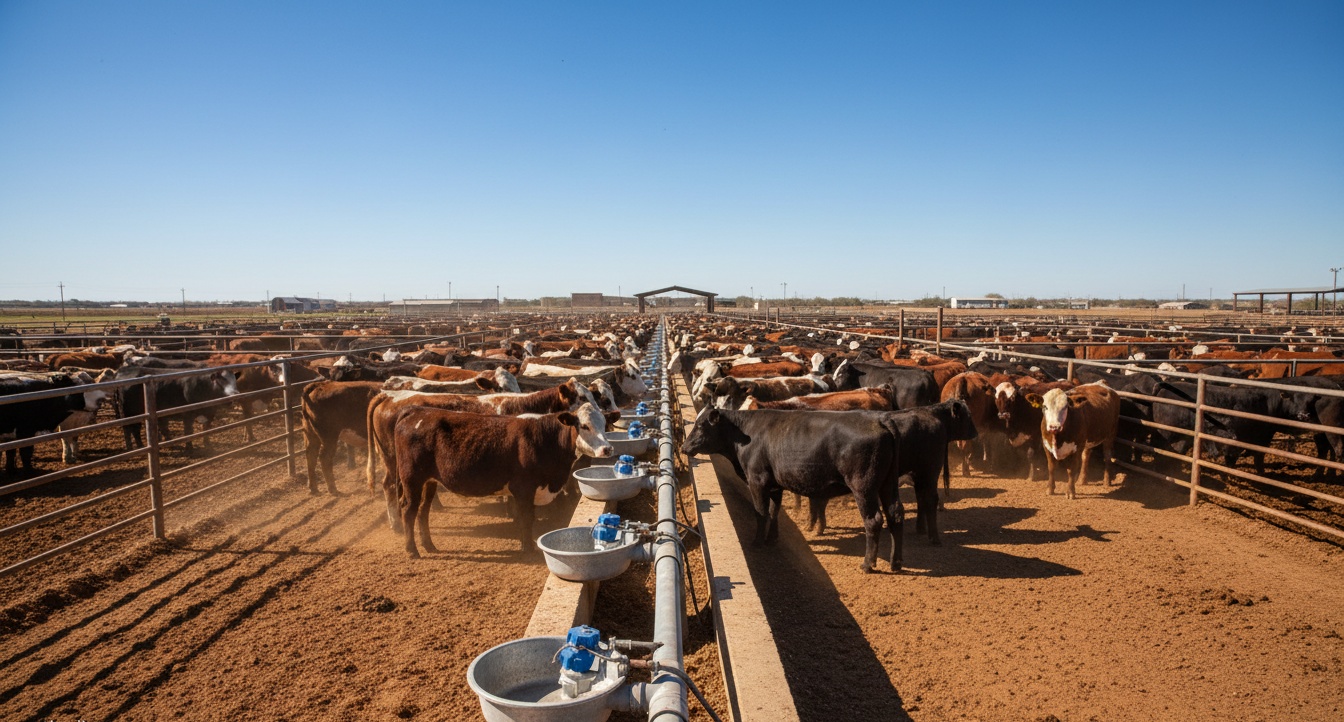
Ordering cattle waterers for a Texas 500-head feedlot isn’t a casual purchase. When you’re watering that many animals across a facility, a bad decision doesn’t just waste money — it disrupts herd hydration, creates compliance headaches, and can force emergency replacements during peak season. Over the years we’ve fielded calls from feedlot operators across the Texas Panhandle — and according to Texas A&M AgriLife Extension, proper hydration infrastructure is among the top three factors affecting feedlot efficiency in the state, the Edwards Plateau, and the Gulf Coast who learned those lessons the hard way.
This guide gives you the 5 checks every Texas feedlot owner or procurement manager should run before signing a purchase order with any livestock watering system supplier. We’ve written this from the perspective of what we look for ourselves when evaluating equipment for our own operations, and what we advise clients to demand from their suppliers. No fluff. No vendor spin. Just the questions that matter.
Check #1: Waterer Capacity Match for500-Head Herd Size
The most common mistake we see is ordering waterers that are technically correct on paper but practically insufficient for a 500-head feedlot operation. Cattle waterers are rated by how many animals they can serve per unit, but those ratings assume average conditions. Texas feedlots rarely see average conditions.
In July, when temperatures routinely hit95–105 °F across much of Texas, cattle water consumption can double or triple compared to mild-weather baselines. A waterer rated for 30 head might serve 30 head in March, but during a Texas summer heat wave, those same 30 head will crowd, wait, and — more importantly — dehydrate. Dehydration in feedlot cattle suppresses weight gain, increases susceptibility to respiratory disease, and directly cuts your bottom line.
Here’s what to verify with your supplier:
- Peak demand capacity: Ask the supplier to confirm the waterer’s gallon-per-hour flow rate and how that translates to your herd size during Texas summer peak conditions. A high-capacity, fast-fill system — like the continuous-flow models in our watering equipment catalog — prevents the “bottleneck around the waterer” problem that stresses cattle and creates social hierarchy conflicts.
- Simultaneous access points: For a 500-head feedlot, you typically need multiple waterers spaced throughout the pen area. The rule of thumb is one waterer per 15–20 head of cattle in a pen, but in Texas heat, that ratio should tighten. Confirm the layout the supplier recommends for your specific pen configuration.
- Trough reserve: A larger trough reserve — generally20 gallons or more for commercial feedlot waterers — acts as a buffer during high-demand periods or temporary pump issues. Smaller troughs may look adequate in catalogs but don’t account for Texas-scale herd pressure.
Because a mis-sized waterer creates a cascading chain of problems — from herd stress to reduced average daily gain (ADG) — we recommend always sizing up your capacity requirement by at least 20% when evaluating options for a 500-head operation. The marginal cost difference is almost always smaller than the production loss from under-sized equipment.
Check #2: Frost-Proof and WeatherDurability for Texas Conditions
Texas weather is deceptively hard on cattle waterers. People hear “Texas” and assume heat, but the Texas Panhandle, the Rolling Plains, and even parts of Central Texas experiencehard freezes from November through March. Night temperatures below 28 °F are routine in many feedlot regions, and a waterer that freezes up during a December cold snap is not just inconvenient — it’s a herd health emergency.
Not all “freeze-resistant” waterers are created equal. Here’s what to look for and what to demand from any livestock watering system supplier you’re considering:
- Continuous-flow or heated-bowl designs: The most reliable freeze protection comes from waterers with a continuous fresh-water flow mechanism or built-in heating elements. Continuous-flow waterers keep water moving, which dramatically reduces freeze risk. Heated models require a reliable electricity supply but offer the best cold-weather performance.
- Insulated tank construction: Double-wall insulated tanks retain heat longer and reduce heating costs. Look for models with high-density polyethylene (HDPE) or stainless steel shells — these materials resist both freeze damage and the corrosion that Texas’s variable water chemistry can cause.
- Valve protection rating: The filling valve is the most freeze-vulnerable component. Ask the supplier for the minimum operating temperature rating of the valve mechanism, not just the waterer’s overall rating. A valve rated to 20 °F is not the same as one rated to 10 °F when your local winter lows hit −5 °F during Blue Norther events.
- UV stability for summer: Texas summers are not just hot but intensely sunny. Composite or polymer waterer housings should be UV-stabilized to prevent material degradation over seasons of exposure. Non-UV-stabilized plastics become brittle and crack within 2–3 years in Texas sunlight.
Because Texas feedlots experience both extreme heat and genuine freezing conditions within the same year,don’t evaluate freeze protection as a winter-only concern. A waterer that survives a Panhandle January but cracks in an August sun is still a bad investment. Ask your supplier for third-party durability test data or material spec sheets that confirm year-round performance.
Check #3: Material and Build Quality — What “Heavy-Duty” Actually Means
When a livestock watering system supplier describes their cattle waterers as “heavy-duty,” that term covers a wide range of actual build quality. We’ve seen waterers marketed as commercial-grade that used thin-gauge metal, standard plastic fittings, and domestic valves clearly designed for residential garden use. At500-head scale, sub-commercial components fail fast.
Here’s the component-by-component quality checklist we use internally, and what you should require documentation on before placing any order:
- Trough and shell material: The gold standard for commercial cattle waterers is 304 stainless steel for the trough and drinking surface. Stainless steel resists the corrosion that results from mineral-heavy Texas well water and the slight acidity of some surface water sources. HDPE is a good alternative for the outer shell — it’s rugged, chemical-resistant, and quieter for the cattle. Reject any model with painted or powder-coated carbon steel troughs — USDA APHIS guidelines on livestock facility standards emphasize corrosion-resistant materials for long-term animal health compliance; the coating chips quickly and the underlying metal corrodes.
- Floats and valves: Demandcommercial-grade brass or stainless steel float valves. Residential-style plastic floats swell, crack, and fail within one Texas summer. A float valve failure causes either a constantly overflowing waterer (wasting water and creating mud) or a dry trough (creating an emergency hydration gap).
- Anchor and mount system: Cattle bump, push, and lean against waterers constantly. A waterer without a robust anchor system will shift, tilt, or topple. Look for concrete-anchor or heavy-gauge post-mount systems rated for pen environments with mature cattle (1,200–1,400 lb animals). Confirm the supplier provides anchor hardware or detailed anchoring specs.
- Warranty coverage: A confident supplier stands behind their product. We look for cattle waterers backed by aminimum 3-year warranty on the valve and float assembly, and at least a5-year warranty on the tank or shell. Suppliers unwilling to provide written warranty terms are signaling that they don’t expect their product to last.
Because material quality is invisible from a catalog photo, always ask for a material spec sheet or bill of materials before ordering. Any supplier who can’t or won’t provide this documentation should be removed from your shortlist immediately. The initial purchase price of a budget waterer is rarely where the real cost appears — it’s in the service calls, replacement parts, and lost production that sub-quality components generate.
Check #4: Maintenance Accessibility — The Hidden Cost Factor
Maintenance accessibility is the most frequently overlooked check in the cattle waterer purchasing process, and it’s the one that costs feedlot operators the most over the life of the equipment. A waterer that’s difficult to service creates three problems: it gets maintained less often, each service call takes longer, and small problems escalate into major repairs.
For a 500-head feedlot operation, service time directly equals labor cost and pen disruption time. Every minute a service technician spends wrestling with a poorly designed waterer cover or inaccessible valve is money subtracted from your operating margin. Here’s what to evaluate before you order:
- Service access design: The best cattle waterer designs feature a single-point top-access cover that allows a technician to service the float valve, drain the trough, and inspect the tank interior without removing the entire unit from its mount. Ask the supplier specifically how the valve assembly is accessed and how long a standard valve service call takes.
- Replacement parts availability: Confirm that the supplier stocksreplacement float valves, heating elements, and seals as standard inventory items — not special-order components with 2-week lead times. In a 500-head feedlot, you cannot afford a 2-week wait for a part that leaves cattle without reliable water access. Ask the supplier for a current parts list and typical lead times.
- Drainage and winterization: Does the waterer have abuilt-in drain plug for winterization and periodic cleaning? Models without drain plugs require disassembly or siphoning to service — a messy, time-consuming process that discourages regular cleaning. Poor waterer hygiene is linked to higher bacterial loads and reduced water consumption among cattle, which circles back to lower ADG.
- Technical support accessibility: Who do you call when something breaks at 6:00 AM on a Sunday before a processing day? The supplier’s technical support availability is a real operational concern. Look for suppliers who offer phone or chat support during extended hours, and ideally a local dealer network in Texas or the broader Southern Plains region.
Because maintenance accessibility determines your total cost of ownership more than the initial purchase price does, we recommend building a simple service-log template before your waterers arrive. Record the time and cost of each service event. After12 months, you’ll have a clear picture of which brands and models are actually cheaper to own — and that data should inform every future purchasing decision.
Check #5: Supplier Reliability and Track Record in Texas Feedlot Environments
The final check is the one most buyers skip — verifying that the livestock watering system supplier you’re considering actually has a documented history serving commercial feedlot operations in Texas or comparable climates. A supplier with a polished website and good catalog photos may have zero actual feedlot experience, and that gap shows up fast when you need support.
Here’s how to vet a supplier rigorously:
- Texas or regional feedlot references: Ask for a minimum of three commercial feedlot references within Texas or the Southern Plains. Call them. Ask about installation experience, post-sale support responsiveness, and whether they’d buy from that supplier again. A reputable supplier will provide references without hesitation.
- Installation and commissioning support: Does the supplier provide a detailed installation guide? Do they offer on-site commissioning for large orders? For a 500-head feedlot installation involving multiple waterers, we consider commissioning support essential — improper installation is one of the leading causes of early waterer failure, and it’s entirely preventable with proper guidance.
- Lead time and inventory stability: Ask the supplier about their current production lead time and whether they maintain finished-goods inventory. In a 500-head feedlot, you may need a replacement waterer within days during an emergency. Suppliers who build to order with 8–12 week lead times are not viable partners for commercial operations where downtime is expensive.
- Company longevity and financial stability: Look for suppliers with at least 10 years of continuous operation in the livestock equipment space. The cattle equipment market has seen suppliers enter and exit frequently. Purchasing from a supplier with thin operating history carries the risk of discovering2 years later that the company has closed and parts support has evaporated.
Because the supplier you choose becomes a long-term operational partner, we recommend conducting at least one direct conversation — a phone call or video call — with the supplier’s technical or sales lead before placing a large order. How they communicate, whether they answer technical questions directly, and whether they seem to understand feedlot operations are all strong indicators of the support relationship you’ll actually get. A supplier who talks down to you during the sales process will be worse to deal with when something breaks at 2:00 AM.
Frequently Asked Questions
Q: How many cattle waterers do I need for a 500-head feedlot in Texas?
A general rule is one waterer per 15–20 head in a pen, but during Texas summer peak demand (temperatures above 95 °F), that ratio should tighten to one per 10–15 head. For a 500-head operation with typical pen configurations, most operators install 25–40 waterers across the facility. Your specific layout, water flow rate, and pen management practices will determine the exact count — your supplier should help you run a proper layout calculation before you order.
Q: Are stainless steel waterers worth the extra cost overHDPE models?
For most Texas feedlot operations, stainless steel troughs deliver better long-term value despite the higher upfront cost. Stainless steel resists the mineral corrosion common in Texas well water, cleans more easily, and maintains a sanitary drinking surface better than polymer materials over time. HDPE shells are excellent for the outer housing, but we recommend against polymer troughs in commercial feedlot applications.
Q: What flow rate do I need from a cattle waterer for a 500-head Texas feedlot?
For a commercial Texas feedlot at 500-head scale, look for waterers with a minimum flow rate of 8–12 gallons per minute to the trough to keep up with peak herd demand. During summer heat events, a 500-head pen can consume 3,000–5,000 gallons per day. If your water source can’t supply that volume at adequate pressure to all waterers simultaneously, you’ll need to consider supplemental storage or a divided pen rotation strategy.
Q: How do I prevent cattle waterers from freezing in Texas winter?
The most reliable freeze protection for Texas feedlots combinescontinuous-flow mechanisms with supplemental heating in the valve area. Passive insulation alone is insufficient during severe cold events. Install waterers on the south side of structures when possible for maximum solar gain, and ensure all electrical heating elements are on dedicated, properly wired circuits with freeze-stat controls that activate automatically below35 °F.
Q: How often should cattle waterers be cleaned in a feedlot?
Commercial feedlot waterers should be visually inspected weekly and physically cleaned at minimum monthly. In high-mineral-water areas of Texas, quarterly descaling with a food-safe acid rinse may be needed to remove mineral buildup on trough surfaces and valve components. Keep cleaning logs — consistent cleaning is one of the simplest ways to maintain water consumption rates and protect herd health.
The Bottom Line: Start With the Supplier, Not the Specs
Here’s the one insight we come back to every time we advise a Texas feedlot operator on cattle waterer purchasing: the quality of your supplier matters as much as the quality of the waterer. A good supplier helps you size the system correctly, supports you through installation, answers technical questions at 2:00 AM when a valve fails, and stocks the parts you need to stay operational. A bad supplier delivers a box to your dock and disappears.
When you evaluate a livestock watering system supplier for your 500-head operation, run all five checks we’ve outlined here — capacity match, freeze durability, material quality, maintenance accessibility, and supplier reliability. Skip any one of them, and you’ll pay for it. Run all five, and you’ll have a waterer system that performs season after season without becoming a management headache.
Explore our complete range of cattle waterers and livestock watering equipment at sound-ai.com/products/, or reach out directly to our sales and technical team for a feedlot-specific layout consultation. We regularly work with Texas and Southern Plains feedlot operators to design systems that perform in Texas conditions — not just on paper, but in the pens.
Post time: Jun-09-2026