
Farm Rodent Control and Feed Protection Guide
TL;DR
- Reduce feed loss by combining storage hygiene, exclusion, monitoring, and properly placed mouse traps.
- Rodent control works best when traps are part of a routine feed-management system, not a one-time reaction.
- B2B buyers should choose a farm mouse trap supplier that offers durable traps, clear specifications, packaging support, and repeat-order stability.
For livestock farms, feed mills, poultry houses, dairy barns, and farm supply distributors, rodent control is a cost-control issue as much as a hygiene issue. A small rodent problem near a feed room can become a recurring expense when spilled grain, open bags, and unorganized storage give rodents a reliable food source.
This guide explains how farms can reduce feed loss with practical facility management and how buyers can evaluate a farm mouse trap supplier. SOUNDAI offers traps and cages through https://www.sound-ai.com/traps-and-cages/ for farm supply importers, wholesalers, distributors, and livestock equipment businesses.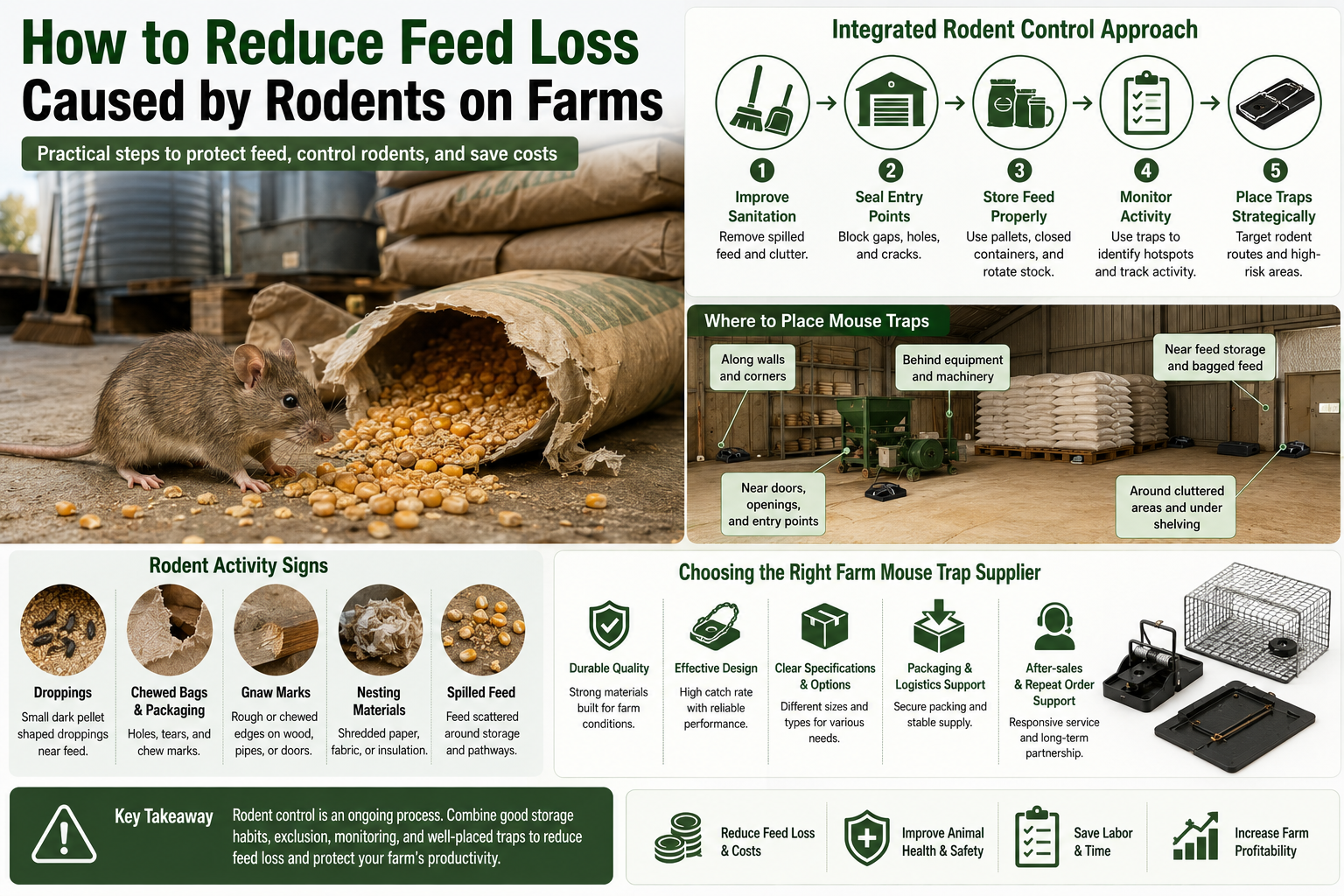
Why Rodents Cause More Than Direct Feed Consumption
Rodents reduce usable feed by eating, contaminating, scattering, and damaging stored materials. The visible amount eaten may be smaller than the amount lost through droppings, urine, nesting materials, torn bags, and rejected feed. This is why rodent control should be measured by feed protection, not only by the number of rodents captured.
On farms, rodents usually follow food, shelter, warmth, and water. Feed rooms, grain bins, poultry houses, calf barns, and storage corners can provide all four. Once rodents find a reliable route, they may return repeatedly unless the farm changes the environment. Traps are useful, but they work better when they are supported by storage discipline and sanitation.
Feed loss also creates hidden labor cost. Workers spend extra time cleaning spills, moving damaged bags, checking contamination, and reorganizing stock. When rodent activity is ignored, the farm pays twice: once for lost feed and again for the time needed to manage the problem.
Start with Feed Storage Discipline
Feed storage discipline is the foundation of rodent loss reduction because rodents cannot build a stable population without predictable food access. Farms should store feed off the ground, keep bags closed, rotate inventory, clean spilled grain quickly, and avoid leaving damaged packaging in corners.
Bulk feed and bagged feed require different control points. Bulk storage needs clean transfer areas, closed lids, and regular checks around augers, bins, and unloading points. Bagged feed needs pallets, dry rooms, clear aisles, and a first-in, first-out routine. If older bags stay hidden behind new stock, small chewing damage may not be noticed until contamination spreads.
Importers and distributors can use this point in product education. A mouse trap is not a replacement for good storage, but it supports a storage program by catching rodents near the places where feed loss begins. Customers who understand this relationship are more likely to use traps correctly and reorder reliable products.
Seal Entry Points Before Rodents Reach Feed Areas
Exclusion reduces feed loss by stopping rodents before they reach storage rooms, feed mixers, and animal housing areas. Farms should check gaps under doors, broken wall panels, drainage openings, ventilation points, pipe penetrations, and damaged corners where rodents can enter.
Rodents prefer protected movement paths. They travel along walls, behind stored items, under equipment, and through cluttered spaces. If a feed room has open gaps and stacked unused materials, traps may catch some rodents but new rodents can continue entering. The long-term solution is to reduce access and reduce cover at the same time.
Farm teams should assign a regular inspection schedule. A monthly walk-through can identify new holes, chewed edges, loose door seals, and spilled feed around delivery points. Small repairs are often cheaper than repeated feed loss. For distributors, this also creates a practical selling angle: traps are part of a complete farm rodent control routine.
Use Traps as Monitoring Tools, Not Only Capture Tools
Mouse traps help farms monitor rodent pressure because trap activity shows where rodents are traveling and whether control efforts are working. A trap that catches rodents near a feed room entrance tells the farm where the route is. A trap that stays empty for weeks may show that the area is under better control or that placement needs adjustment.
Monitoring is especially valuable in large facilities. A dairy farm may have several feed-related zones: silage storage, concentrate storage, calf feeding areas, and machinery rooms. A poultry farm may have feed bins, egg rooms, manure areas, and service corridors. Placing traps without a map can waste time. Placing traps according to activity signs improves efficiency.
Workers should record where traps are placed, when they are checked, and what activity is found. Simple records help managers identify recurring hot spots. They also help buyers decide how many traps are needed for a new facility or seasonal increase in rodent pressure.
Place Mouse Traps Where Rodents Actually Move
Mouse traps are most effective when placed along walls, near entry points, behind storage areas, and close to signs of rodent activity, while still keeping animal and worker safety in mind. Random placement in the middle of open floors usually produces weaker results because rodents prefer edges and cover.
Common placement points include feed room corners, pallet lines, bin foundations, wall edges, doorways, utility openings, and protected routes between shelter and feed. Farms should look for droppings, gnaw marks, greasy rub marks, shredded material, and spilled grain. These signs show where traps are likely to work.
Trap spacing depends on the facility layout and the severity of activity. A small storage room may need fewer units, while a large feed warehouse may require a structured grid. The key is consistency. Traps must be checked and reset. A forgotten trap is not a control system.
Choose the Right Trap Type for Farm Conditions
The right farm mouse trap should match the environment, target rodent size, cleaning routine, safety requirement, and expected reuse frequency. A trap used in a clean feed room may need different features from a trap used near outdoor storage, machinery sheds, or barn edges.
Durability matters because farm conditions can be rough. Traps may be exposed to dust, moisture, feed particles, handling by workers, and repeated cleaning. Buyers should check material strength, spring or trigger reliability, cage structure, door closure, corrosion resistance, and whether the trap can be cleaned without complicated disassembly.
SOUNDAI’s traps and cages category describes animal trap cages as reusable and made from durable materials such as galvanized steel or heavy-duty plastic. For B2B procurement, these details matter because wholesalers and retailers need products that can withstand customer use and reduce complaints.
Reusable traps can also support lower long-term cost when farms maintain them properly. A cheap trap that bends, rusts, or fails after short use may become more expensive than a better-built option.
Avoid Depending Only on Poison Near Feed
Farms should be cautious with poison near feed areas because safety, contamination risk, regulations, and non-target exposure can create serious problems. Rodenticides may have a role in professional pest management, but feed storage areas require careful handling and local compliance.
Authoritative resources such as the U.S. Environmental Protection Agency rodenticide guidance explain that rodenticide control and regulation are important for reducing risks linked to rodent control products. Farms should follow local rules, label directions, and professional guidance when chemical methods are used. For many feed areas, mechanical traps are attractive because they help monitor activity without adding chemical contamination concerns.
A balanced rodent management program may include sanitation, exclusion, traps, monitoring, and professional advice when infestation pressure is high. For suppliers, this is a more credible message than promising that one trap alone can solve every rodent problem.
How Feed Loss Reduction Supports Animal Health
Reducing rodent-related feed loss also supports animal health because cleaner feed storage lowers the chance of contamination reaching livestock or poultry. Feed is one of the largest operating costs on many farms, but it is also a direct input into animal performance. Protecting feed quality protects both budget and production consistency.
Rodent contamination can lead workers to discard feed or, worse, miss contamination before feeding. Good storage and trap programs reduce the chance that damaged bags or contaminated feed will enter daily feeding routines. This is especially important for young animals, poultry, dairy herds, and intensive production systems where feed consistency matters.
For broader livestock management context, the FAO animal health care worker manual provides training-oriented animal health references. While it is not a farm trap buying guide, it reinforces the wider principle that animal care depends on practical prevention, hygiene, and routine observation.
What B2B Buyers Should Ask a Farm Mouse Trap Supplier
A reliable farm mouse trap supplier should provide clear product specifications, durable materials, packaging options, sample support, carton data, lead time, and repeat-order stability. Buyers should evaluate whether the product can serve farm conditions and whether the supplier can support wholesale distribution.
Start with material and construction. Ask whether the trap uses galvanized steel, heavy-duty plastic, or another farm-suitable material. Check size, trigger design, door mechanism, cleaning method, and whether the trap is reusable. If the product will be sold through retail channels, ask for packaging photos, label space, and barcode support.
Next, confirm the sales channel. A farm supply distributor may need bulk cartons and neutral packaging. An e-commerce seller may need individual boxes and product photos. A private-label buyer may need OEM logo support. A wholesale importer may care most about carton loading, mixed orders, and stable availability.
SOUNDAI offers related livestock and farm supply categories through Traps and Cages, with additional internal pages for Feeding, Watering, Cow Magnet, and Animal Syringe.
Procurement Checklist for Farm Mouse Traps
Before placing a bulk order, buyers should define trap type, target rodent, farm use scenario, material, packaging, quantity, and after-sales expectations. A clear checklist helps the supplier quote accurately and helps the buyer compare options fairly.
- Confirm whether the trap is intended for mice, rats, or general small animal control.
- Check dimensions, material, wire thickness, door design, and trigger sensitivity.
- Ask whether the trap is reusable and how it should be cleaned.
- Confirm packaging style, carton quantity, gross weight, and loading details.
- Request sample support before bulk orders when entering a new market.
- Ask about OEM logo, label, barcode, or retail box options.
- Check lead time, MOQ, payment terms, and mixed-category order possibilities.
- Prepare target customer information so the supplier can recommend suitable models.
Common Mistakes That Keep Feed Loss High
Common mistakes include placing traps randomly, ignoring spilled feed, storing bags directly on the floor, leaving doors unsealed, and failing to check traps on schedule. These mistakes allow rodents to keep feeding even when traps are present.
Another mistake is treating rodent control as a crisis response. Farms often react after workers see damage, but by then the rodent route may already be established. A better approach is preventive: inspect feed storage, clean spills, maintain traps, and review activity records before losses become obvious.
Buyers should also avoid choosing traps only by the lowest unit price. A weak trap that fails quickly may create customer complaints and reduce reorder confidence. For distributors, a durable trap with stable packaging and clear specifications can be easier to sell and safer for long-term brand reputation.
Build a Rodent Control Routine Around Feed Movement
Rodent control becomes more effective when farms connect trap checks with normal feed movement routines. Workers already visit feed rooms, bins, pallets, and mixing areas every day, so these moments can be used to inspect bait-free traps, look for new droppings, and remove spilled feed before rodents treat it as a food source. A simple daily check is often more realistic than a separate pest-control task that everyone forgets during busy seasons.
Feed movement also reveals risk patterns. If losses appear after bulk deliveries, the unloading point may need better cleaning. If bags are damaged near one wall, that wall may be part of a rodent route. If traps are active near calf feed or poultry feed, the farm may need tighter container control in those areas. These observations help managers spend money where it actually reduces losses.
For distributors, this routine-based message makes farm mouse traps easier to position in catalogs and sales conversations. The product is not only a capture device. It is a monitoring tool that supports feed inventory protection, hygiene routines, and farm cost control. That message is more persuasive for professional buyers than simply listing trap size and unit price.
Match Trap Packaging to the Sales Channel
Packaging affects how farm mouse traps are sold, stored, shipped, and reordered. A wholesale buyer may prefer compact bulk cartons with clear model codes, while a farm supply retailer may need individual boxes with product photos and usage notes. An e-commerce seller may need stronger individual packaging to reduce damage during parcel delivery.
B2B buyers should discuss packaging before confirming the order. Important details include inner quantity, master carton quantity, carton dimensions, gross weight, label language, barcode position, and whether instruction sheets are required. If the trap will be sold under a private label, artwork approval should be completed before production begins.
Packaging also affects warehouse efficiency. Clear carton marks help workers pick the correct model quickly, especially when a distributor stocks several trap sizes or related cage products. Good packaging reduces errors, protects the product, and makes repeat orders easier to manage.
Conclusion
Reducing feed loss caused by rodents requires a complete system: clean storage, sealed entry points, proper trap placement, activity monitoring, and reliable farm mouse traps. Traps work best when they are used as part of a routine feed-protection program rather than an emergency purchase after damage appears.
For farms, the goal is to protect feed value, reduce contamination risk, and lower hidden labor cost. For importers, wholesalers, and farm supply retailers, the opportunity is to offer durable traps and cages that fit real farm conditions. Product quality, packaging, and repeat-order stability matter because rodent control is an ongoing farm need.
To source farm mouse traps, animal trap cages, or related farm supply products, visit https://www.sound-ai.com/traps-and-cages/ or the SOUNDAI website at https://www.sound-ai.com/.
FAQ
How do rodents cause feed loss on farms?
Rodents cause feed loss by eating grain, contaminating feed with droppings or urine, tearing bags, scattering feed, and forcing farms to discard damaged stock.
Where should mouse traps be placed in farm feed areas?
Place traps along walls, near entry points, behind pallets, around feed storage corners, and close to signs of activity such as droppings, gnaw marks, and spilled grain.
Are reusable traps suitable for farms?
Reusable traps can be suitable when they are durable, easy to clean, and matched to farm conditions. Buyers should check material, construction, and cleaning requirements.
What should I ask a farm mouse trap supplier?
Ask about material, dimensions, trap type, packaging, carton data, MOQ, samples, OEM options, lead time, and repeat-order availability.
Where can I source farm mouse traps from SOUNDAI?
Buyers can visit https://www.sound-ai.com/traps-and-cages/ to review trap and cage products and send an inquiry for specifications, packaging, MOQ, and quotation support.
Request Farm Mouse Trap Information
Need farm mouse traps, animal trap cages, or reusable rodent control products for wholesale, retail, or farm supply distribution? Visit SOUNDAI Traps and Cages and prepare your target market, trap type, quantity, packaging requirement, and destination country.
Suggested inquiry format: “We are looking for a farm mouse trap supplier. Please send available trap models, materials, dimensions, packaging options, MOQ, sample policy, lead time, carton details, and OEM label support.”
Post time: May-09-2026