
TL;DR — Key Takeaways
- Operating pressure: 0.2-0.4 MPa (29-58 psi). Below 0.15 MPa causes slow refill; above 0.5 MPa damages valves.
- Flow rate drives pipe sizing — oversize by one diameter to minimize pressure loss and allow future expansion.
- Burial depth by climate zone: Zone 4: 24 inches, Zone 6: 36 inches, Zone 7: 48 inches below final grade.
- Bowl rim height: 30-45 cm above ground — adjust for operation type (calves lower, mature cattle higher).
- Freeze prevention: heat tape on supply lines + insulated covers + proper bury depth. Heated bowls consume 60-150 W each.
Why Water Pressure Mismatch Is the #1 Cause of Automatic Drinking Bowl Failures on Farms
In 2017, I visited a 400-head dairy farm in northern Jiangsu where the manager complained that his cattle were “not drinking enough.” Water consumption had dropped 30% over three months, and somatic cell count was climbing. The vet suggested a waterborne disease was circulating.
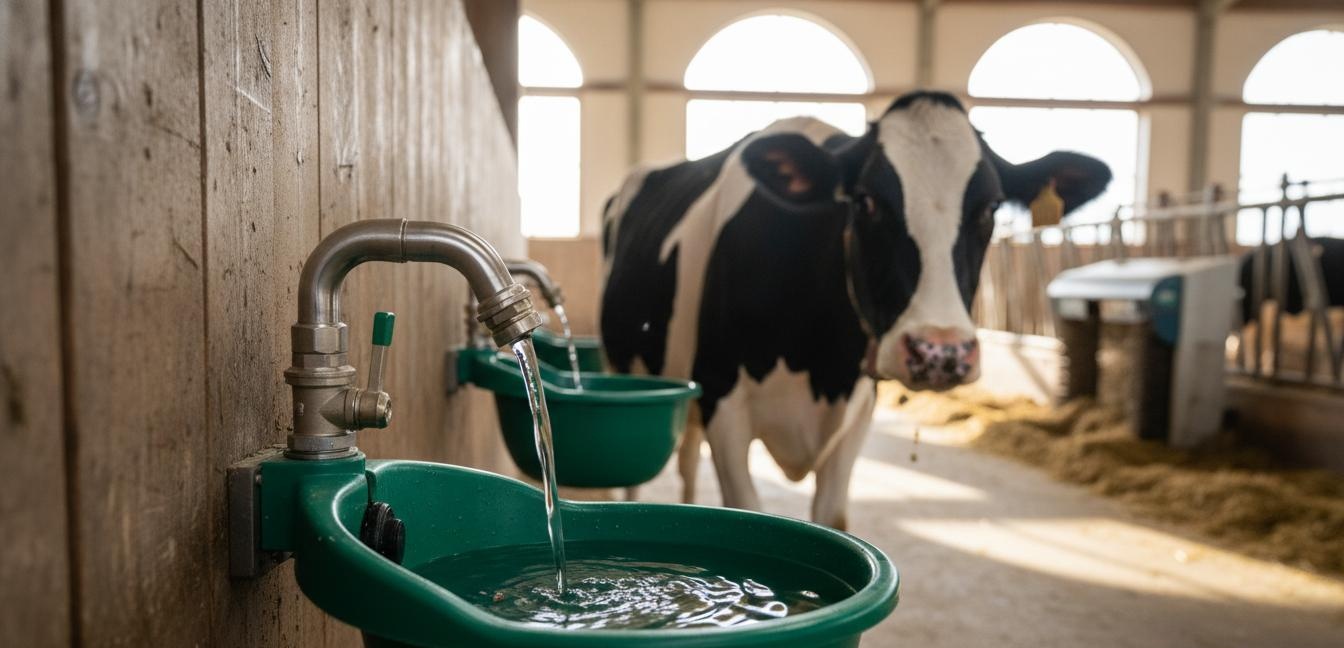
It wasn’t disease. The water pressure in the new barn had been set at approximately 0.08 MPa (12 psi) — well below the minimum required for proper bowl function. When a cow pressed the tongue trigger, water trickled out slowly (the bowl would take 45-60 seconds to refill after a large drink). The cattle learned that the bowls were unsatisfying and reduced their water intake accordingly.
Low pressure isn’t the only failure mode. I once saw a farm that connected drinking bowls to a high-pressure line (0.7 MPa, 102 psi) used for their irrigation system. The float valves failed within 6 months — the rubber seals were being extruded by the excessive pressure. Leaks developed at every connection point.
Water Pressure Requirements: Measuring Your Farm’s System Pressure Before Installation
Before installing any drinking bowls, you need to measure the actual pressure at the proposed installation points. This requires a pressure gauge (dial type or digital, range 0-100 psi, accuracy plus or minus 2 psi or better) and a bit of patience.
Here’s the measurement protocol:
- Connect the pressure gauge to a hose bib or tap nearest to the proposed installation point. Use a hose if necessary.
- Open the tap fully and record the static pressure (no flow). This is your baseline system pressure.
- Then, open a second tap or hose bib at the same pressure zone and record the pressure again while water is flowing. This is your dynamic pressure under load.
- Use the lower (dynamic) pressure value for installation planning — this represents what the bowls will actually experience during peak use.
If your static pressure is within 0.2-0.4 MPa but your dynamic pressure drops below 0.15 MPa under flow, you have a flow restriction or undersized supply line issue. This must be corrected before installing bowls.
Pipe Sizing Calculations: Matching Line Diameter to Number of Bowls and Flow Demand
The formula for pipe sizing is: D = square root of (Q multiplied by 4 divided by (V multiplied by pi multiplied by 60)). Where Q is total flow demand in L/min and V is design velocity in m/s.
But here’s the practical reality for farm installations:
| Herd Size | Peak Flow (L/min) | Minimum Pipe ID | Recommended Pipe ID |
|---|---|---|---|
| 10-20 head | 4-8 L/min | 20 mm | 25 mm |
| 30-50 head | 12-20 L/min | 25 mm | 32 mm |
| 60-100 head | 24-40 L/min | 32 mm | 40 mm |
| 100-200 head | 40-80 L/min | 40 mm | 50 mm |
Why oversize? Because pressure loss in pipes is proportional to velocity — the faster water flows, the more pressure is lost. At design velocity of 1.0-1.5 m/s, pressure loss is minimal (typically 0.5-1.5 kPa per meter of pipe). If you size pipes for peak flow at higher velocity (2-3 m/s), you’ll see pressure drops of 3-5 kPa per meter, which can cause the most distant bowl to have inadequate pressure.
Freeze Protection: Minimum Bury Depths and Insulation Requirements by USDA Climate Zone
In northern China, the Northern provinces experience USDA Zone 4-6 winter conditions. The first time I saw a freeze-damaged drinking system, it was at an operation in Heilongjiang where the installer had buried supply lines at 18 inches — adequate for Beijing’s climate but completely insufficient for the heavier frost penetration in the northeast province.
Water pipes and bowl plumbing must be buried below the maximum frost penetration depth for your specific location. This is not optional — a frozen supply line will burst and can cause significant damage to barn foundations and concrete floors when ice expands.
| Climate Zone | Min Winter Soil Temp | Minimum Bury Depth |
|---|---|---|
| Zone 4 (-20 to -25 degF) | -26 to -31 degC | 610 mm (24 inches) |
| Zone 5 (-25 to -30 degF) | -31 to -34 degC | 760 mm (30 inches) |
| Zone 6 (-30 to -35 degF) | -34 to -37 degC | 914 mm (36 inches) |
| Zone 7 (below -35 degF) | Below -37 degC | 1220 mm (48 inches) |
Bowl Placement Height and Position: The Installation Detail That Affects Water Intake
The height of the bowl rim above ground level directly affects water intake behavior. I’ve measured water consumption differences of 15-20% between otherwise identical operations that installed bowls at different heights.
Research and practical experience both confirm: 30-45 cm (12-18 inches) above ground is the optimal range for mixed dairy herds. This height allows mature cattle to drink with natural neck posture (slight downward tilt, not hyperextension) while also being accessible to growing heifers and calves.
Height adjustments by operation type:
- Primarily mature dairy: 40-45 cm rim height
- Calving operations with significant newborn and young calf populations: 30-35 cm rim height
- Beef cow-calf operations: 35-40 cm (accounting for variability in dam and calf sizes)
Bowl position also matters: install bowls with the water surface facing into the pen (not toward a wall or fence) to encourage natural drinking behavior. Ensure at least 60 cm of clear approach space in front of the bowl so cattle can position themselves squarely before drinking.
Troubleshooting Common Installation Failures: Flow Restrictions and Freeze Damage
Water Quality Impact on Bowl longevity: Why Hard Water Is Your Silent Enemy
I’ve seen drinking bowl installations fail within 18 months when the specification was otherwise correct — right pipe diameter, right pressure, right bury depth for the climate zone. The variable that wasn’t accounted for was water quality. Specifically, water with high calcium and magnesium content (hard water) causes scaling inside the valve mechanism that progressively restricts flow until the bowl stops working.
The mechanism is straightforward: when hard water passes through the pressure differential at the valve seat, calcium carbonate precipitates out of solution and accumulates on the valve components. This buildup narrows the flow passage, reduces the activation pressure threshold, and eventually causes the valve to stick in the open or closed position. The process is accelerated in areas with intermittent water supply — every time the pipe empties and refills, the pressure change triggers additional precipitation.
For operations in hard water regions (water hardness above 120 mg/L as CaCO3), specify bowls with removable valve cartridges that can be cleaned or replaced without replacing the entire bowl. Establish a quarterly valve inspection and descaling protocol — typically soaking the valve assembly in a mild acid solution (white vinegar diluted 1:1 with water) for 30 minutes to dissolve calcium deposits.
For permanent installations in extremely hard water areas (above 300 mg/L), consider a water softening system at the main supply point. The cost of a residential-grade water softener (1,500-3,000 USD installed) is justified if it prevents the failure of 15+ drinking bowls that would otherwise require replacement at 45-80 USD per bowl plus installation labor.
The three most common drinking bowl failures I encounter in the field, and their root causes:
1. Slow fill rate (most common). Usually caused by undersized supply pipe (check table above), partially closed isolation valve, or blockage in the supply line (sediment, scale, biofilms). Diagnose by measuring dynamic pressure at the bowl with a pressure gauge. If pressure at bowl is below 0.15 MPa while system pressure is adequate, the restriction is between the main and the bowl.
2. Bowl doesn’t drain (stagnant water). Caused by incorrect installation — the drain port is positioned higher than the water level line, or the drain is connected to a sealed pipe that doesn’t allow air intake. Automatic drinking bowls are designed to drain completely when the cow pushes the tongue — if water remains, check the drain slope and confirm the drain line is vented.
3. Freeze damage to supply line or bowl body. Caused by burial depth insufficient for local frost penetration (refer to climate zone table), or failure to winterize by draining the system when cattle are removed from the pen. Heated bowls require electricity (60-150 W per bowl) and thermostatic control to prevent overheating in mild weather.
Download: Drinking Bowl Installation Checklist
Complete installation checklist including pressure measurement protocol, pipe sizing worksheet, bury depth by climate zone reference, and winterization procedure. Available for Sound-AI distributor partners.
Float Valve Adjustment: Setting the Correct Water Level to Prevent Waste and Ensure Adequate Intake
Most automatic drinking bowls use a float valve mechanism to maintain a consistent water level in the bowl. Proper float valve adjustment is one of the most overlooked installation variables, and incorrect settings create two problems simultaneously: water waste from overflowing bowls and inadequate water intake from animals that cannot access water at the correct height.
The correct water level in a cattle drinking bowl should be approximately 5-7 cm below the rim of the bowl. This depth allows cattle to drink comfortably without their muzzle submerging excessively, while maintaining enough water volume that the bowl does not empty between visits from successive animals. A bowl that runs dry between visits creates a competition dynamic where dominant animals guard the bowl and subordinate animals have reduced access.
To adjust the float valve, locate the float arm — typically a plastic or stainless steel rod extending from the valve body to a spherical float. Bending the arm upward raises the water level; bending it downward lowers the water level. Make small adjustments of 2-3 mm at a time and allow the water system to stabilize for 10-15 minutes before assessing the new level. Document your setting for future reference — this is particularly valuable when multiple people service the same facility.
Frequently Asked Questions
Post time: May-18-2026