
TL;DR — Key Takeaways
- MOQ by method: Laser marking = 50 units, Pad printing = 200 units, Silk screen = 500 units.
- Laser marking is most durable — permanently etched into aluminum, won’t wear off. Pad printing fades in 12-24 months.
- EU instruction inserts must be in the official language of the destination member state — no exceptions.
- Mix packaging configurations in one PO: add 5-10% to unit cost for separate production line setups.
- Production timeline: 10-14 weeks sea freight, 6-8 weeks air freight. Order 4-6 months before peak season.
Why Private Label Cattle Equipment Is Growing Faster Than Generic Product Sales
I’ve watched the private label market in livestock equipment expand significantly over the past five years. The reason is straightforward economics: distributors who private-label AI guns, syringes, and other equipment earn margins 30-50% higher than those selling generic branded products, while offering their retail customers a differentiated product that builds brand loyalty.
In the US farm supply market, major retailers are increasingly requiring exclusive or semi-exclusive private label arrangements — distributors who don’t have private label capabilities are excluded from these procurement relationships. In the EU market, private label allows distributors to present themselves as full-solution providers rather than commodity resellers.
The good news for smaller distributors: private label minimum order quantities have dropped significantly in recent years. Laser marking technology in particular has reduced the entry barrier from 200+ units to 50 units for some product categories.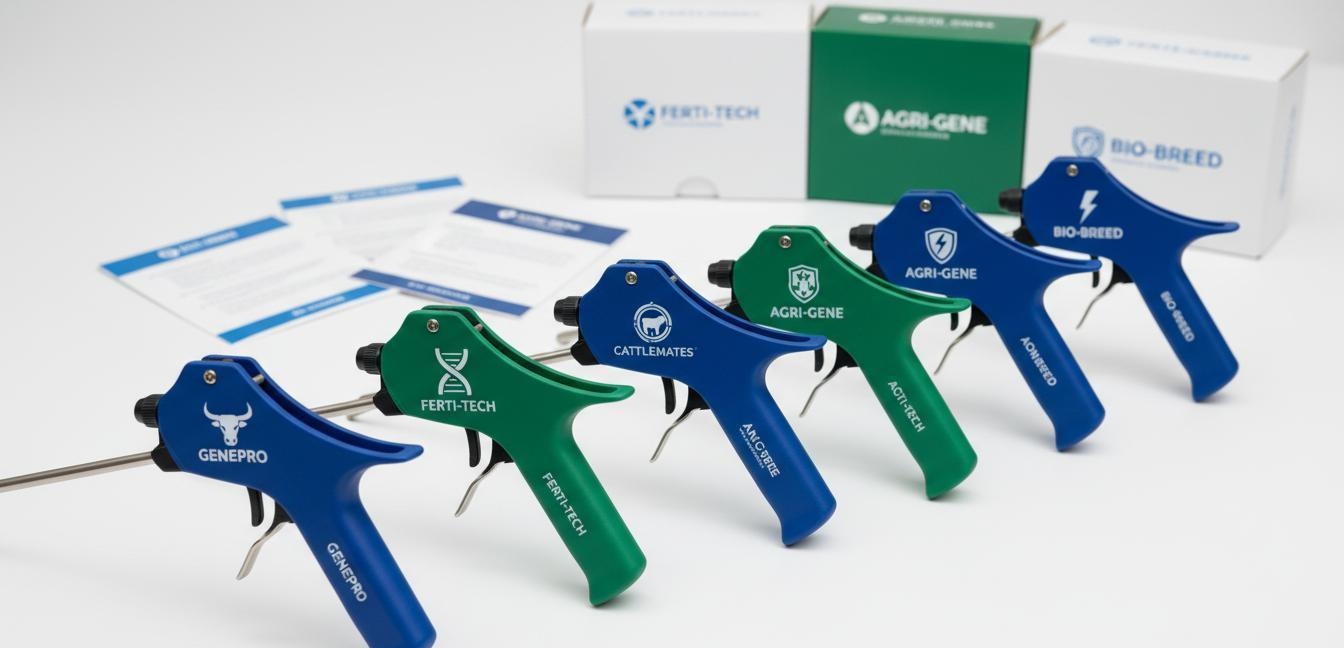
Logo Application Methods Compared: Laser Marking vs Pad Printing vs Silk Screen vs Embossing
Three primary logo application methods are available for aluminum AI gun bodies:
| Method | MOQ | Durability | Cost | Best For |
|---|---|---|---|---|
| Laser marking | 50 units | Permanent (lifetime of device) | Lowest (no tooling) | Fine detail logos, small text |
| Pad printing | 200 units | 12-24 months heavy use | Medium (printing plate) | 1-2 color logos |
| Silk screen | 500 units | 6-12 months heavy use | Medium-high | Large logos, full coverage |
| Anodized + laser | 100 units | Permanent + colored | +15-20% unit cost | Premium positioning |
Laser marking recommendation: For most private label orders, laser marking is the optimal choice. It requires no tooling (so no per-design setup cost), creates a permanent mark that won’t fade or wear, and has the lowest MOQ. The limitation is that laser marking produces a single-color mark (the color of the bare aluminum where the anodized coating has been removed) — it cannot reproduce full-color photographic images.
Instruction Insert Requirements: What Different Markets Legally Require
Instruction inserts are not just a customer service item — in most regulated markets, they are a legal requirement. Failure to provide compliant inserts can result in product seizure, fines, or market exclusion.
United States (FDA regulated products):
- Instructions must be in English (Spanish is recommended for US border markets)
- Required content: Intended use, operating instructions, warnings, maintenance
- Format: Minimum 8-point font for body text, illustrations required for operating steps
- FDA enforcement priority: Products that could cause user injury if misused
European Union (EU MDR 2017/745 and Product Safety Directive):
- Instructions must be in the official language of the destination member state
- Required content: Intended use, contraindications, warnings, operating instructions with illustrations, maintenance, storage, manufacturer info, EU Authorized Representative address (for non-EU manufacturers)
- Format: A4 or A5, minimum 80gsm paper, full-color recommended
- Insert must remain legible for the expected service life of the device (typically 5-10 years)
Australia (TGA requirements):
- Instructions in English
- Australian Authorized Representative address required on packaging if manufacturer is non-Australian
Retail Packaging Options: Blister Card vs Window Box vs Bulk Packaging for Farm Supply
Three primary retail packaging configurations for cattle AI guns and related equipment:
- Blister card packaging: The most common format for farm supply retail. The product is sealed to a printed card with a clear plastic blister bubble. Single unit per card. Front: product photo, product name, key specifications, barcode. Back: multi-language instruction summary, warnings. Cost: 0.80-1.50 USD per unit for card printing + blister materials.
- Window box packaging: Premium retail format with higher visual impact. Full-color box design (typically 150mm x 100mm x 50mm or similar). Product visible through clear window. Higher shelf presence than blister cards but significantly higher packaging cost (2.50-5.00 USD per unit) and shipping volume.
- Bulk packaging: Plain brown box, no retail branding, optimized for wholesale distribution. Typically 10-20 units per box. No retail barcode required. Cost: 0.20-0.40 USD per unit for plain box. Most distributors use bulk packaging as the base offering and blister cards as the retail-upgrade option.
MOQ Structure for Private Label Orders: What Makes the Economics Work
Lead Time Planning: Why Your Private Label Order Needs 6 Months, Not 6 Weeks
I’ve seen clients assume they can launch a private label program on a 6-week timeline — order the equipment, apply the logo, ship it. The reality is considerably more complex, and the timeline failures cost them market position and customer relationships.
A proper private label program for cattle AI equipment requires a minimum of 4-6 months from initial specification to first stock availability. Here’s why: logo design and approval process (2-4 weeks for revisions and multiple stakeholder sign-offs), tooling acquisition or modification for logo application method (4-8 weeks for laser marking setup or pad print screen制作), first article sample production and approval (2-3 weeks of back-and-forth on print quality and placement), bulk production scheduling (manufacturers typically run private label items in batches of 500-2,000 units and batch scheduling can add 4-8 weeks of wait time), and shipping from China (3-5 weeks for sea freight, 1-2 weeks for air freight at premium cost).
If you’re targeting a specific selling season (spring breeding season is the obvious example for cattle AI products), begin your private label procurement process at minimum 6 months before the season start. For the fall breeding season, start procurement in February or March. For spring breeding season, start in August or September of the prior year. The lead time is long, but the economics of private label are compelling enough to justify the planning horizon — you can typically achieve 25-40% gross margin on private label products versus 10-15% on equivalent generic products, because your customers are paying for the brand assurance, not just the equipment.
Managing Your Private Label Inventory: The Stock-Out Risk Is Worse Than the Overstock Risk
The fear that stops most operators from committing to private label inventory is the fear of overstock — having product sit unsold and represent working capital tied up in slow-moving inventory. In my experience, this fear is overblown relative to the opposite risk: stock-outs during peak selling season.
A stock-out at the peak of the breeding season is more costly than a moderate overstock position. When a retail customer or farm supply distributor runs out of your product during their busiest sales period, they don’t just delay the purchase — they find an alternative supplier and may not return to you the following season. The customer lifetime value loss from a stock-out during peak season typically far exceeds the carrying cost of a modest inventory surplus.
My recommendation for private label inventory management: target a 90-day supply buffer for your primary SKUs at all times. Calculate your average monthly consumption of each SKU, multiply by 3, and maintain that level. When inventory drops below 60-day supply, trigger a reorder. When inventory exceeds 120-day supply, pause new orders and run down the excess. This approach eliminates stock-outs for most operations while keeping inventory carrying costs at a reasonable level. The 90-day buffer handles the normal supply chain variability; the safety stock threshold at 60-day supply gives you lead time to reorder before you hit the critical zone.
The minimum order quantities for private label are determined by tooling costs and production economics. Here’s the math:
- Laser marking (MOQ 50 units): No tooling cost — the laser machine is programmed with your logo file. At 50 units, your unit cost increase over generic is typically 1.00-2.00 USD per unit for the marking process. Total minimum investment: 50-100 USD in added unit cost + your logo file preparation.
- Pad printing (MOQ 200 units): Printing plate tooling: 200-400 USD per color. At 200 units with a 2-color logo: tooling is 400-800 USD, added unit cost is 0.50-1.00 USD per unit. Total minimum investment: 500-1,000 USD tooling + 100-200 USD unit premium.
- Silk screen (MOQ 500 units): Screen tooling: 300-600 USD. At 500 units with a 1-color logo: tooling is 300-600 USD, added unit cost is 0.30-0.60 USD per unit. Total minimum investment: 300-600 USD tooling + 150-300 USD unit premium.
For first-time private label buyers, I recommend starting with laser marking at 50-100 units to test market demand before committing to higher-volume pad printing orders.
Download: Private Label Order Planning Guide
Ready-to-use MOQ calculator, logo file specification checklist, and instruction insert content template by market. Available for Sound-AI distributor partners.
Private Label Pricing Strategy: How to Position Your Branded AI Equipment in a Competitive Market
Setting the correct price for your private label AI equipment is a strategic decision that goes beyond simple cost-plus margin calculation. Price too low and you signal low quality to your buyers; price too high without an established brand reputation and you lose the competitive advantage that should come from private label. The optimal pricing corridor for private label cattle AI equipment is typically 15-25% above the equivalent generic branded product on the market.
The 15-25% premium is supported by the value proposition you are actually selling: the confidence that comes with a named brand, the reduced supplier search and evaluation cost, and the traceability to a known quality system. These are real economic value elements that buyers are willing to pay for, but only up to a point. Beyond the 25% premium, you are asking buyers to pay for brand equity that most new private label brands have not yet established.
When you first launch a private label product, start at the lower end of the premium range — 10-15% above generic equivalents. This allows you to build customer relationships and demonstrate quality without asking buyers to make a large leap of faith. As your quality reputation builds and you accumulate customer testimonials and field performance data, gradually increase your pricing to the 20-25% premium level. I have seen private label programs that tried to capture 40% premiums on first-year launch and struggled to acquire customers, while programs that started at 12-15% and grew organically achieved sustainable market penetration.
Track your price elasticity carefully in the first 12 months. If you are not seeing any resistance at the 15% premium level, test a further increase. If you are seeing significant conversion failures at the 12% level, investigate whether your product quality or brand presentation needs refinement before adjusting price downward. The data from your first-year pricing experiments will inform your pricing strategy for the foreseeable future.
Frequently Asked Questions
Post time: May-18-2026