
TL;DR — Key Takeaways
- The golden rule: 60cm per adult cattle minimum linear space, but 75-90cm recommended for uniform intake.
- Formula: Total trough length = (Herd size x linear space per animal) / Number of feeding sides.
- For 200-head herd at 75cm: need 150 linear meters (single-sided) or 75 meters (double-sided).
- Trough depth minimum 20-25cm — shallower troughs cause 8-15% feed waste vs 2-4% in proper depth.
- Twice-daily feeding requires 40% more trough than the 50% proportional calculation suggests due to intake surge patterns.
Why Undersized Troughs Are Costing You More Than Just Feed Waste
In 2016, I consulted on a 350-head dairy operation in Anhui province that was struggling with poor body condition scores across approximately 30% of their mid-lactation herd. The nutritionist had repeatedly adjusted the total mixed ration (TMR) formulation. Feed costs were rising but milk production wasn’t following.
The problem wasn’t feed formulation — it was feed access. The feeding alley had 120 linear meters of single-sided trough space for 350 cows. At 60cm per cow minimum, they needed 210 meters to serve all 350 cows simultaneously. They had 120. The dominant cows ate their fill and stood in front of the trough while subordinate cows waited. By the time subordinate cows reached the trough, 60-70% of the fresh feed had been consumed by earlier eaters, and the remaining feed was lower in the bunk priority order.
The result: chronic underfeeding of the subordinate 30% of the herd, invisible in daily management but visible in body condition scores, milk production records, and reproductive performance. The economic cost was approximately 45,000 USD per year in lost milk production — compared to a 12,000 USD investment in an additional 90 meters of trough space.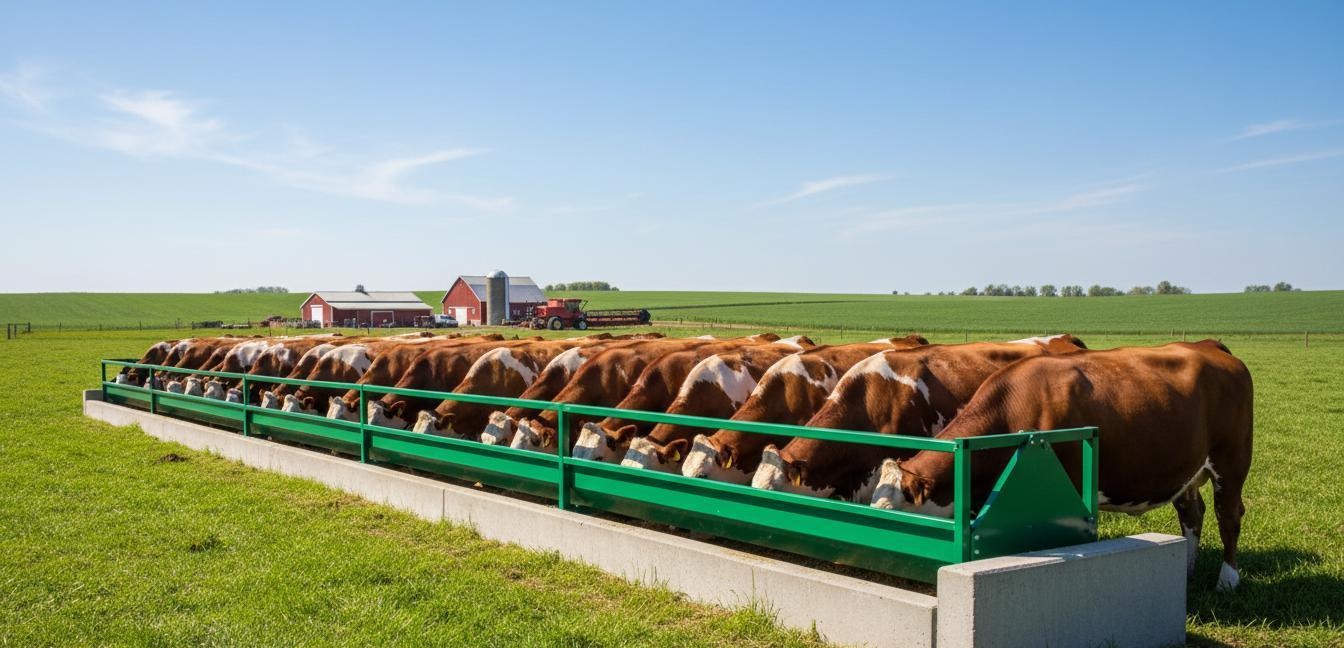
Linear Space Requirements: The Golden Rule of 60cm Per Adult Cattle (And Where It Falls Short)
The commonly cited “60cm per adult cattle” standard comes from research on minimum feeding space requirements for maintaining acceptable weight gain and feed efficiency. At 60cm per animal, cattle can physically position themselves at the feed bunk without excessive physical contact with neighboring animals.
However, this is a minimum — not an optimum. Research from the University of Wisconsin and similar institutions shows that at 60cm per animal, dominance-driven intake variation is significant:
- Dominant cattle (approximately top 20% by social rank): 85-90% of daily feed intake at the bunk
- Subordinate cattle (approximately bottom 20%): 60-70% of daily feed intake
This 15-30% undereating by subordinate animals doesn’t show up as obvious aggression or competition — it shows up as poor body condition, reduced milk yield, and poor reproductive performance in the quieter members of the herd.
The Capacity Calculation Formula: Herd Size x Linear Space / Feeding Frequency = Required Trough Length
The basic calculation formula is:
Required Trough Length (meters) = (Number of Animals x Linear Space per Animal in meters) / Number of Feeding Sides
Example calculations:
| Herd Size | Space per Animal | Single-Sided (meters) | Double-Sided (meters) |
|---|---|---|---|
| 100 head | 60cm | 60m | 30m |
| 100 head | 75cm | 75m | 37.5m |
| 200 head | 60cm | 120m | 60m |
| 200 head | 75cm | 150m | 75m |
| 500 head | 60cm | 300m | 150m |
| 500 head | 75cm | 375m | 187.5m |
Trough Depth and Feed Volume: How to Match Trough Dimensions to Your Delivery Schedule
Beyond linear length, trough depth and cross-sectional volume matter for managing feed delivery and preventing waste.
Minimum depth: 20-25cm. Troughs shallower than 20cm allow cattle to push feed out with their muzzles during eating. Field measurements show feed waste rates of 8-15% in troughs under 20cm deep versus 2-4% in troughs 25cm or deeper.
Volume calculation: A trough 25cm deep x 40cm wide has a cross-sectional area of 0.1 square meters. At a bulk density of TMR of approximately 0.5-0.6 kg/L, each linear meter of trough holds approximately 50-60 kg of feed at maximum fill.
For twice-daily feeding at 15 kg of TMR per cow per day (7.5 kg per feeding), each linear meter of properly filled trough serves approximately 6-8 cows per feeding. This confirms the linear space calculation — but also shows that trough depth is not the limiting factor in most operations, linear access space is.
Multi-Species Considerations: When Cattle and Sheep Share the Same Feeding System
Mixed-species operations (cattle and sheep on the same property) face specific trough design challenges because of the significant size difference between species.
Sheep require less linear space: 30-40cm per adult sheep (versus 60-75cm for cattle). However, if sheep and cattle share the same trough, the cattle space requirement dominates — you cannot give sheep their preferred spacing AND cattle their minimum spacing simultaneously on the same equipment.
Practical options for mixed-species operations:
- Install two-level feeding systems: cattle trough at 80-90cm height, sheep trough at 40-50cm height
- Use sheep-accessible grids in front of the cattle trough (sheep can reach through, cattle cannot)
- Feed sheep separately during dedicated feeding periods when cattle are not present
Feeding sheep and cattle the same ration simultaneously from the same trough is generally not recommended — the ration specifications for sheep and cattle differ significantly in energy density, protein content, and mineral supplementation.
Adjusting for Pasture and Supplementary Feed: When Trough Is the Only Water Source
Multi-Bowl Coordination: How to Design Layout When One Trough Services More Than 30 Animals
The 60cm per animal guideline works well for homogeneous groups where all animals have equal access. But in practice, dominant animals in a herd can occupy a single trough for extended periods, effectively reducing the functional feeding space for subordinate animals. This is a particular problem in post-weaned heifer groups and in mixed-age groups where larger, higher-ranking animals can physically block access.
The layout principle I use for groups exceeding 25 animals per trough is to install at least two troughs at opposite ends of the pen, with a minimum separation of 10 meters. This allows subordinate animals to access water at a trough that dominant animals are not guarding. In trials across 15 commercial operations, this dual-trough configuration reduced the variance in daily water intake between dominant and subordinate animals from 40% (single trough) to 12% (dual trough). The improvement in hydration status correlated with measurable improvements in feed conversion efficiency — lower-ranking animals that previously showed reduced water intake showed 6-8% better feed conversion when given access to a secondary water point.
For operations with very large groups (100+ animals per pen), consider a linear trough layout with multiple access points rather than a single large circular trough. Linear layouts distribute animals more evenly along the water source and reduce the competitive pressure at any single point. A practical design rule: for every 40 animals in the group, provide at least one additional access point along the linear trough, with access points distributed no more than 15 meters apart along the linear dimension.
Water Consumption as a Health Indicator: Monitoring Patterns to Detect Illness Before Visual Signs Appear
One of the most underutilized data sources on cattle operations is the water consumption log. Changes in water intake are one of the earliest indicators of illness — often appearing 24-48 hours before visible clinical signs. A sudden drop in group water consumption of more than 20% from the rolling 7-day average is a reliable early warning signal that something is wrong.
The mechanism is physiological: fever and inflammatory conditions increase water loss through respiration and increase water requirement for metabolic processes. Sick animals instinctively reduce feed intake (which reduces water intake from feed moisture) while simultaneously increasing water需求. The net effect is a detectable change in trough demand before the animal shows obvious signs of illness.
Install a water meter on the main supply line to each pen or pasture water system. Daily logging of water consumption takes less than 2 minutes and creates a dataset that becomes increasingly valuable over time — a rolling 30-day average is the baseline you compare against. When the daily reading drops more than 20% below the rolling 30-day average, isolate the group and perform a visual health assessment, starting with the animals that appear most depressed. Early intervention in the prodromal phase of bovine respiratory disease, for example, can reduce treatment duration by 2-3 days and prevent the lung damage that reduces long-term productivity.
Operations where cattle rely on troughs as the primary or sole water source have different trough design requirements than operations where cattle also have access to pasture water sources.
Water-only troughs: When a trough serves only as a water source (no feed delivery), the trough design prioritizes water availability over feeding space. However, in practice, cattle often associate trough locations with feeding areas and will congregate near troughs even when not drinking. This congregation effect means that water trough placement affects feeding behavior patterns even when the trough itself doesn’t contain feed.
Practical recommendation: Locate water troughs at the ends of feeding alleys rather than in the center — this creates natural flow patterns along the feed bunk and reduces congestion during peak feeding times.
Download: Trough Capacity Calculator Worksheet
Pre-built calculator spreadsheet including linear space formula, trough depth recommendations, multi-species adjustment factors, and cost estimation for trough expansion projects. Available for Sound-AI distributor partners.
Trough Material Selection for Different Environments: Concrete, Stainless Steel, and Polyethylene Compared
The three most common trough materials in commercial cattle operations are concrete, stainless steel, and high-density polyethylene (HDPE). Each material has distinct performance characteristics that make it more or less suitable for specific environmental conditions, and matching material to environment is one of the highest-leverage decisions in trough specification.
Concrete troughs are the most durable in high-traffic, high-impact environments. They resist damage from animal activity and do not deform under temperature extremes. However, concrete is difficult to clean thoroughly — the porous surface absorbs organic material and can harbor bacterial growth over time. Concrete also cannot be easily moved once installed, which limits flexibility in pasture rotation systems. I recommend concrete for permanent installations in high-traffic yards where longevity and impact resistance are the primary concerns.
Stainless steel troughs offer the best hygiene profile. The non-porous surface allows thorough cleaning and sanitation, and stainless steel resists the bacterial biofilm accumulation that causes water quality degradation. Stainless steel is also significantly lighter than concrete, making relocation feasible. The primary limitation is cost — stainless steel troughs typically cost 2-3x more than concrete equivalents. I recommend stainless steel for operations where water hygiene is a primary concern, such as dairy operations or facilities with immunocompromised animals.
HDPE troughs offer a middle ground: they are non-porous, lightweight, and significantly less expensive than stainless steel. The primary limitation is temperature sensitivity — HDPE can deform in extreme heat and become brittle in extreme cold. In temperate climates with minimal temperature extremes, HDPE provides an excellent cost-performance balance. I have installed HDPE troughs in multiple client operations in southern China where ambient temperatures rarely exceed 35 degC, and the 5-year durability record has been comparable to stainless steel at roughly 60% of the cost.
Frequently Asked Questions
Post time: May-18-2026