
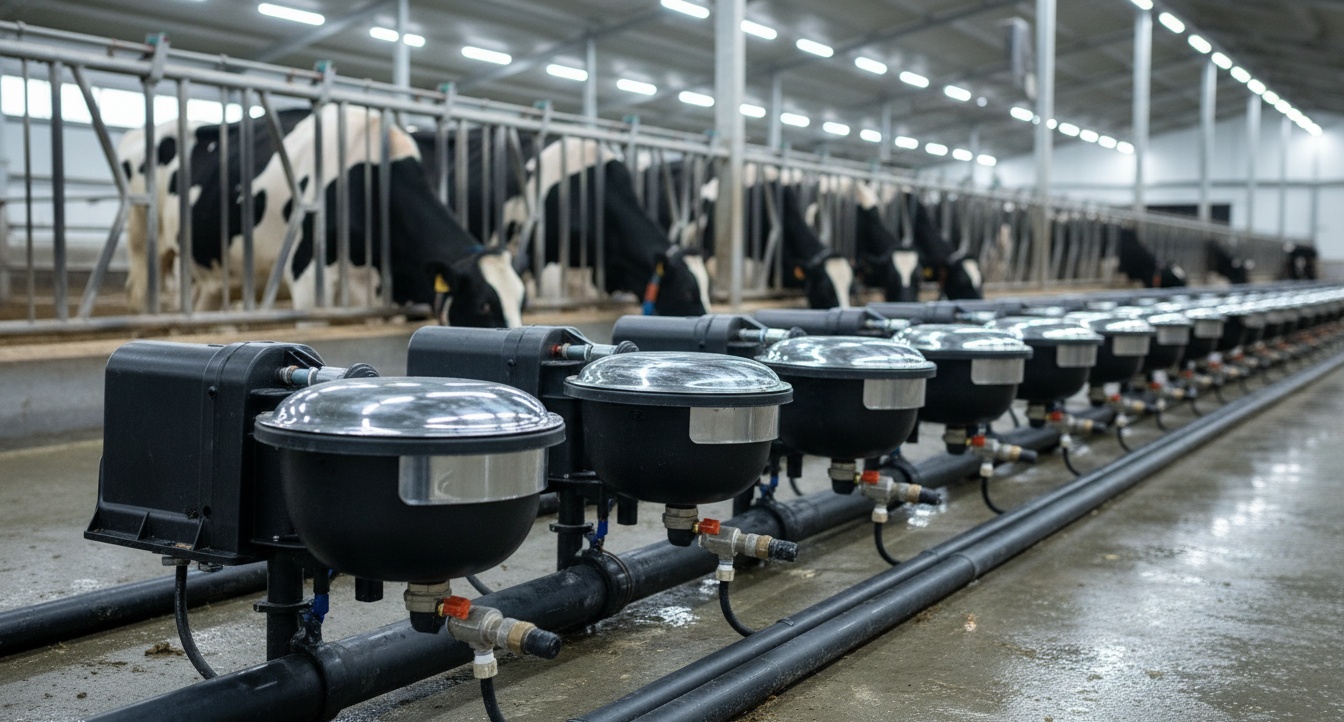
For dairy operations running 100 or more head, water delivery infrastructure is not a secondary concern — it is the primary driver of milk yield, feed conversion efficiency, rumen function, and herd health outcomes. A single malfunctioning float valve or an undersized trough can cascade into reduced dry matter intake, impaired thermoregulation during heat stress events, and measurable production losses that appear within days of a water access disruption. Unlike feed or healthcare interventions, which receive constant management attention, watering infrastructure tends to be installed and then neglected until a visible failure occurs. This article walks through the pressure valve specifications, material standards, installation geometry requirements, and procurement frameworks that wholesale buyers and farm managers need to evaluate when sourcing bulk livestock watering systems for large-scale dairy operations.
Research from USDA Agricultural Research Service dairy nutrition programs and field data from commercial operations confirm that water is the single most critical nutrient input for lactating dairy cattle.
Why Float Valve Pressure Ratings Are Non-Negotiable at Scale
In automatic drinking bowls designed for cattle, the float valve is the functional core of the water delivery mechanism. The valve responds to water level changes inside the basin: when an animal drinks and the water level drops, the float descends and the valve opens to admit fresh water from the supply line. When the water level rises and the float rises, the valve shuts off the flow. This mechanism sounds simple, but at 100-head scale, the pressure dynamics of this system become critically important.
The inlet water pressure tolerance of the float valve assembly determines whether the system delivers consistent, non-splash water delivery across the multiple stalls connected to the same water line. Most veterinary-grade or farm-grade plastic drinking bowls for cattle — including the SDWB13 9L Plastic Drinking Water Bowl from Sound AI — are rated for inlet pressures between 0.2 MPa and 0.5 MPa, which is approximately 29 to 72 psi. Operating above this rated range introduces a range of failure modes: constant dribbling through a compromised seat, accelerated fatigue in the valve’s spring mechanism, and premature seat failure that leads to continuous water waste. Operating below the minimum pressure rating, conversely, results in slow bowl refill rates that cannot keep pace with peak drinking demand, leaving animals waiting during the concentrated drinking periods that typically follow milking and feeding.
For operations with variable line pressure — a common situation in rural agricultural installations where one pump feeds multiple barns or where water is sourced from a gravity-feed system — selecting a valve with built-in pressure compensation or pairing the system with a dedicated pressure regulator at the manifold inlet becomes essential rather than optional. A pressure regulator installed at the farm manifold and set to 0.35 MPa provides consistent inlet pressure to all connected bowls regardless of upstream fluctuations, eliminating the refill rate variability that leads to herd-level water deprivation during peak demand periods.
The pressure rating of the valve body itself — not just the inlet fitting — also determines the system’s burst resistance. A bowl with a 0.5 MPa rated valve body that is accidentally connected to a line that spikes to 0.8 MPa during a pressure surge event (common when large pumps cycle on and off) will fail catastrophically, flooding the stall and potentially damaging barn flooring. Wholesale procurement specifications should require valves with a minimum burst pressure rating of 2x the working pressure, and buyers should request the manufacturer’s pressure test certificate for each production batch.
The FAO animal production guidelines on dairy herd water management establish baseline parameters for large-scale operations.
Material Composition: What Wholesale Buyers Must Verify
The SDWB13 9L Plastic Drinking Water Bowl exemplifies the material decisions that separate long-service-rate equipment from budget-priced alternatives that require replacement within two to three production cycles. This unit employs polyethylene (PE) as the primary bowl material, a polymer selected for its resistance to environmental stress cracking, UV photo-degradation, and repeated freeze-thaw cycling — the three primary degradation mechanisms that affect outdoor livestock watering equipment in temperate and continental climate zones.
Polyethylene also provides sufficient chemical resistance to tolerate the mineral scale buildup common in hard-water regions without becoming brittle or cracking. Many lower-cost bowls on the market use recycled polyethylene or polypropylene blends that have reduced molecular weight and reduced environmental stress crack resistance, resulting in premature failure when exposed to common barnyard cleaning agents or mineral buildup removal treatments. Wholesale buyers should request the material data sheet from the manufacturer confirming the polymer type and virgin/resin grade used in production.
The metal cover plate that shields the valve mechanism from external impact and debris infiltration — as well as from curious animals that may nudge or push against the assembly — is typically constructed from zinc-plated steel or an equivalent corrosion-resistant alloy. Buyers should confirm the metal cover specification because some lower-cost import alternatives substitute thin-gauge stamped steel that deforms permanently under a single moderate hoof impact. In a free-stall barn with active bulls or pushy lactating cows in a crowded pen, a thin-gauge cover can deform within one production cycle, leaving the float valve mechanism exposed to debris infiltration, accidental bending, and premature failure.
The plastic float valve inside the basin is the functional heart of the automatic water delivery system. It must maintain neutral buoyancy across a wide temperature range from sub-zero barns in winter to direct-sun exposure in summer paddock installations. It must resist algae adhesion in outdoor installations where sunlight penetrates the bowl and supports biological growth on wetted surfaces. It must respond to water level changes without stiction — the tendency of a moving part in a stationary position to resist the initial movement — or lag that results in an overshoot of the water level before the valve seats. High-quality float valves in production-grade bowls are molded from food-safe polypropylene copolymer or high-density polyethylene that maintains dimensional stability across the -20°C to +50°C operational range commonly encountered in uninsulated barns and outdoor paddock installations.
Buyers sourcing for operations in regions with poor-quality water — high iron, high manganese, high total dissolved solids — should additionally specify a bowl and valve combination that is rated for the specific water quality conditions. Mineral deposits on the float and valve seat that form in high-TDS water can add sufficient weight to the float to change its buoyancy characteristics, resulting in incorrect water level regulation. In extreme cases, mineral deposits can bind the valve in the open or closed position. A specification that includes a water quality compatibility requirement forces the manufacturer to select appropriate valve seat materials (stainless steel rather than brass, for example) that resist the specific scaling chemistry of the installation’s water supply.
Capacity Planning: The Mathematics of Bowl Sizing at Herd Scale
A 9-liter bowl such as the Sound AI SDWB13 plays a critical role in moderate-climate dairy operations where each stall receives dedicated water access through an individual bowl. At peak drinking, a lactating Holstein cow can consume 15 to 20 liters per drinking event, and research from university dairy science programs consistently shows 8 to 12 distinct drinking events per day for a well-managed lactating herd. The 9-liter bowl’s refill rate must therefore be fast enough to service demand before the basin runs dry during simultaneous multi-animal drinking rushes.
For 100-head and larger operations, the relevant design calculation is not simply total herd volume divided by bowl capacity. The critical parameter is peak demand per water line segment. If twelve stalls share one water supply line with a single pressure-regulated feed manifold, those twelve bowls effectively behave as a single large shared trough from a hydraulic standpoint. The combined peak demand during a post-milking drinking period can far exceed the refill capacity of the supply line if the bowls were sized for individual use without accounting for synchronization effects.
The valve orifice diameter — not merely the float mechanism — governs how rapidly the bowl refills. Larger-orifice valves with inlet diameters of 15 to 20 millimeters are strongly preferred for multi-stall manifolds because they reduce the bowl refill time from 45 to 60 seconds per cycle to under 20 seconds under normal operating pressure. This reduction in refill time directly translates to fewer incidents where a cow returns to drink from a bowl that has not yet refilled and must wait or move to an alternative stall.
Wholesale procurement specifications should mandate the orifice diameter alongside the float valve pressure rating. They should also request flow rate test data from the manufacturer at standardized pressures of 0.3 MPa and 0.45 MPa to enable accurate hydraulic modeling of the installation before any plumbing is committed. An installation designed without this data is essentially guessing at the system’s performance envelope.
The 5L Drinking Bowl with Plastic Flat Cover from Sound AI represents the smaller-capacity end of the product range appropriate for smaller operations or for groupings of younger stock where drinking volume per event is lower. For 100+ head operations, the 5L bowl is better suited as a secondary or supplementary water point rather than the primary stall water source for lactating cows.
Installation Geometry: The Details That Most Spec Sheets Omit
Beyond valve pressure ratings and material specifications, bulk purchasers frequently encounter specification gaps around mounting geometry — details that have an outsized impact on actual water consumption and herd productivity but that do not appear on standard data sheets.
For a 100+ head free-stall layout, the mounting height of the drinking bowl relative to the concrete floor directly influences water consumption patterns. Research from multiple university cooperative extension programs — including programs at Penn State, University of Wisconsin, and Cornell — consistently identifies the optimal mounting height for adult Holstein cattle as 600 to 750 millimeters above floor level, measured to the top rim of the bowl. At this height, cows can drink with neck and head in a natural, relaxed posture that encourages sustained drinking and adequate water volume per event. Mounting too high forces the cow to extend her neck uncomfortably; mounting too low encourages splashing and water wastage and can increase the risk of contaminant ingress into the bowl.
The SDWB13 unit is designed as a wall-mounted or rail-mounted bowl that allows adjustable height within this range. This adjustability is particularly valuable when retrofitting older facilities where floor-to-ceiling dimensions constrain standard mounting heights or where existing concrete floors have settled unevenly, creating height variations between stalls that must be accommodated individually.
The metal cover plate’s geometry also determines the effective drinking zone inside the bowl. A cover that protrudes excessively inward from the bowl rim reduces the effective opening through which the cow’s muzzle can access the water surface, increasing the time required for each drinking event and thereby reducing the total number of drinking events the cow can complete within a given time period. A properly engineered cover sits flush with the bowl rim or extends just enough to deflect dust, debris, and hoof impact without impeding the cow’s natural drinking arc. This geometric detail is one of the most frequently overlooked specifications in bulk procurement, and it is the detail most likely to be compromised in the lowest-cost manufacturing alternatives.
The drinking bowl’s distance from the stall’s rear edge also matters. Research on stall design and cow behavior indicates that locating water sources near the stall’s front or alley-side edge — rather than at the rear of the stall near the manure channel — increases water consumption by 10 to 15 percent in some studies, likely because cows prefer to drink in a forward-facing posture rather than turning around to access water at the rear of the stall. For operations redesigning stall layouts, this behavioral preference should inform the plumbing design.
Cold-Climate and Freeze-Protection Engineering
Dairy operations in northern climate zones, high-altitude ranges, or continental interiors with sustained sub-zero temperatures must factor freeze protection into wholesale specifications from the initial procurement decision, not as an afterthought addition. Standard polyethylene float-valve bowls are not inherently freeze-protected, and the failure modes associated with freezing are severe.
When residual water in the valve body or supply line freezes, the expanding ice can fracture the float mechanism, deform the valve seating surface, or bind the valve in either the open or closed position. A valve that freezes in the open position continuously floods the stall, creating ice hazards for both animals and workers and driving up water and heating costs. A valve that freezes in the closed position cuts off water access entirely, creating a dehydration risk that can progress to impacted rumen function and reduced milk production within 24 to 48 hours in a lactating cow with high water turnover requirements.
The Sound AI product line addresses freeze risk through the SDWB14 stainless steel drinking bowl series and through freeze-protected valve variants that integrate a thermostatically controlled heating element directly into the valve body housing. For 100+ head operations in climate zones with sustained periods below -10°C, the specification must require an integral heating element — not a supplementary external heat tape wrap or foam insulation cover, which are less reliable and more maintenance-intensive.
Field data from commercial dairies operating in northern China indicates that integrated heating elements reduce winter valve failure rates by 70 to 85 percent compared to unheated units in heavily insulated but non-heated barns. The heating element’s thermostat prevents continuous heating during mild weather periods, conserving energy and preventing the overheating of the valve body that can degrade polymer components over time.
Wholesale buyers in freeze-risk climates should also confirm that the bowl’s drain port is sized and positioned to allow complete water evacuation during scheduled winterizing procedures. A bowl that retains 200 to 300 milliliters of water in the valve body after draining — because the drain port is too small, positioned incorrectly, or partially blocked by mineral scale — becomes a freeze liability regardless of the heating element specification. Drain port diameter should be specified at a minimum of 20 millimeters to allow rapid evacuation and to minimize the risk of blockage from scale debris.
Electrical infrastructure planning must also account for the heating element’s power draw. A 100-stall barn with 100 heated bowls each drawing 15 to 25 watts represents a continuous electrical load of 1,500 to 2,500 watts — manageable for most farm electrical systems but requiring dedicated circuit planning and potentially a backup generator for operations in areas with unreliable power supply.
Supply Chain Documentation and Certification Requirements
When ordering 100 or more units through a wholesale arrangement, the procurement specification must address three supply chain variables that frequently determine total cost of ownership more than the per-unit purchase price itself.
First, material certifications. The buyer must confirm that the polyethylene used in the bowl body complies with the relevant food-contact material standards for the target market. For European Union buyers, this means compliance with EU Regulation 10/2011 on materials intended to come into contact with food — a standard that applies to materials that contact animal feed and water in agricultural settings. For North American buyers, compliance with FDA 21 CFR regulations covering food-contact polymers applies. A bowl that fails material certification at import creates a landed cost disaster that dwarfs any per-unit price savings achieved through the wholesale order, and it exposes the buyer to regulatory and liability consequences that far exceed the equipment cost.
Second, the quality inspection protocol. Reputable manufacturers pressure-test every production batch to 1.5 times the rated maximum working pressure and provide certificates of conformity upon request. The inspection protocol should also cover the float valve seat integrity at minimum and maximum pressure extremes, the metal cover plate’s torque and shear resistance under simulated hoof impact, and the bowl’s dimensional compliance with listed specifications. Buyers committing to 100+ unit orders should request the manufacturer’s quality plan and inspection data sheet template before issuing a purchase order.
Third, packaging for bulk freight. The SDWB13 ships with each unit individually poly-bagged and four units per export carton. For orders of 100 or more units, buyers should negotiate palletized container loading that meets international freight standards, reducing in-transit damage rates to below 0.5 percent. Loose carton loading in shipping containers is one of the most common sources of hidden loss in agricultural equipment wholesale procurement, and the damage is typically discovered only after the equipment reaches the destination warehouse, creating costly replacement cycles and installation delays.
Calculating Total Cost of Ownership for Large Installations
The per-unit cost of a float-valve drinking bowl represents a surprisingly small fraction of the true installed cost in a 100+ head operation. A realistic total cost of ownership model for a 120-stall dairy barn outfitting its water delivery system with automatic drinking bowls should include the following cost categories: bowl and valve hardware at 40 to 50 percent of total project cost, installation labor and plumbing fittings at 25 to 35 percent, winterization or freeze-protection upgrades at 10 to 15 percent, and ongoing maintenance and valve replacement reserves at 10 to 15 percent over a 10-year service life.
Selecting a bowl with a proven service life exceeding 8 to 10 years under commercial dairy conditions significantly reduces the maintenance reserve allocation and improves the annualized cost comparison between a higher-quality and a lower-priced alternative. The SDWB13′s polyethylene bowl body carries a typical service life of 10 or more years in non-freeze conditions, with float valve rebuild kits available for periodic in-place servicing — a critical consideration for operations that wish to avoid full fixture replacement cycles within a 15-year facility planning horizon.
The cost of a single incident of herd-level water deprivation — even at a conservative estimate of a 5 percent reduction in milk yield across a 120-cow herd for 3 days — typically exceeds the cost of an entire maintenance reserve allocation for the year. This calculus should inform the quality threshold that the specification establishes, favoring durable materials and robust valve mechanisms over lowest-unit-cost alternatives.
Matching Wholesale Specifications to Herd Size and Climate Zone
For dairy operations at or above 100 head, the minimum specification threshold for wholesale procurement should include all of the following parameters, each verifiable against manufacturer-provided test data or certifications.
The float valve pressure rating must be documented within the range of 0.2 to 0.5 MPa with test data from production batch testing rather than generic catalog specifications. The inlet orifice diameter must be 15 millimeters or larger for compliance with the refill rate requirements of a multi-stall manifold. The bowl body must use virgin polyethylene or equivalent polymer with documented UV-stability and environmental stress crack resistance data. The metal cover plate must have a minimum thickness of 1.5 millimeters with documented hoof-impact resistance test results. The mounting height adjustability must accommodate 600 to 750 millimeters above floor level. The manufacturer must provide a drain port for winterizing procedures, with drain port diameter of 20 millimeters or larger.
For operations in freeze-risk climate zones, the specification must additionally require an integral thermostatically controlled heating element in the valve body, rated for continuous operation at temperatures down to -25°C, with documented power consumption data that enables electrical infrastructure planning. The drain port must be proven to achieve complete water evacuation under field conditions.
Buyers who embed these parameters in their RFQs or purchase orders dramatically reduce the probability of receiving mis-specified or marginally compliant equipment. Reputable manufacturers with ODM and OEM capability such as Ningbo Beilun Sound Hardware Industrial and Trade Co., Ltd. (Sound AI) can provide complete technical data sheets, material certifications, and pre-shipment sample units for specification verification before the buyer commits to a volume order. This verification step is not a luxury — it is a risk management measure that protects the significant capital commitment that a 100+ stall installation represents.
Conclusion
Sourcing livestock watering systems at wholesale scale for 100+ head dairy operations demands specification rigor that goes well beyond selecting a bowl with adequate capacity. The pressure valve characteristics, material certifications, installation geometry, freeze-protection provisions, and supply chain documentation requirements embedded in the procurement specification collectively determine whether the installation performs reliably for a decade or generates chronic maintenance overhead from year two onward. Using this framework when evaluating manufacturers and drafting procurement documents ensures that the wholesale price translates into genuine herd-level performance return rather than false economy captured at the purchase order line and paid for across the equipment’s service life.
Cattle Drinking Bowl Product Range | Automatic Water Bowl Systems | SDWB12 LLDPE Plastic Drinking Bowl
Related Products:
SDWB13 9L Plastic Drinking Water Bowl for Horses and Cattle
5L Drinking Bowl with Plastic Flat Cover
Livestock Watering Equipment — Full Product Catalog
Post time: May-29-2026