
TL;DR — Key Takeaways
- Needle gauge: 22-25G for day-old chicks, 20-22G for 3-6 week broilers, 18-20G for adult breeders.
- Aqueous vaccines flow through 22-25G; oil emulsion vaccines need 18-20G minimum.
- Subcutaneous (wing web): 5-10mm depth, easier, lower risk. IM (breast): 10-20mm depth, higher titers but higher risk.
- Change needles every 500 injections or every 2 hours — dull needles cause tissue trauma and leakage.
- Never insert IM needle to hub in birds under 4 weeks — breast muscle depth is only 12-18mm.
Why Needle Selection Matters More in Poultry Vaccination Than in Mammal Injection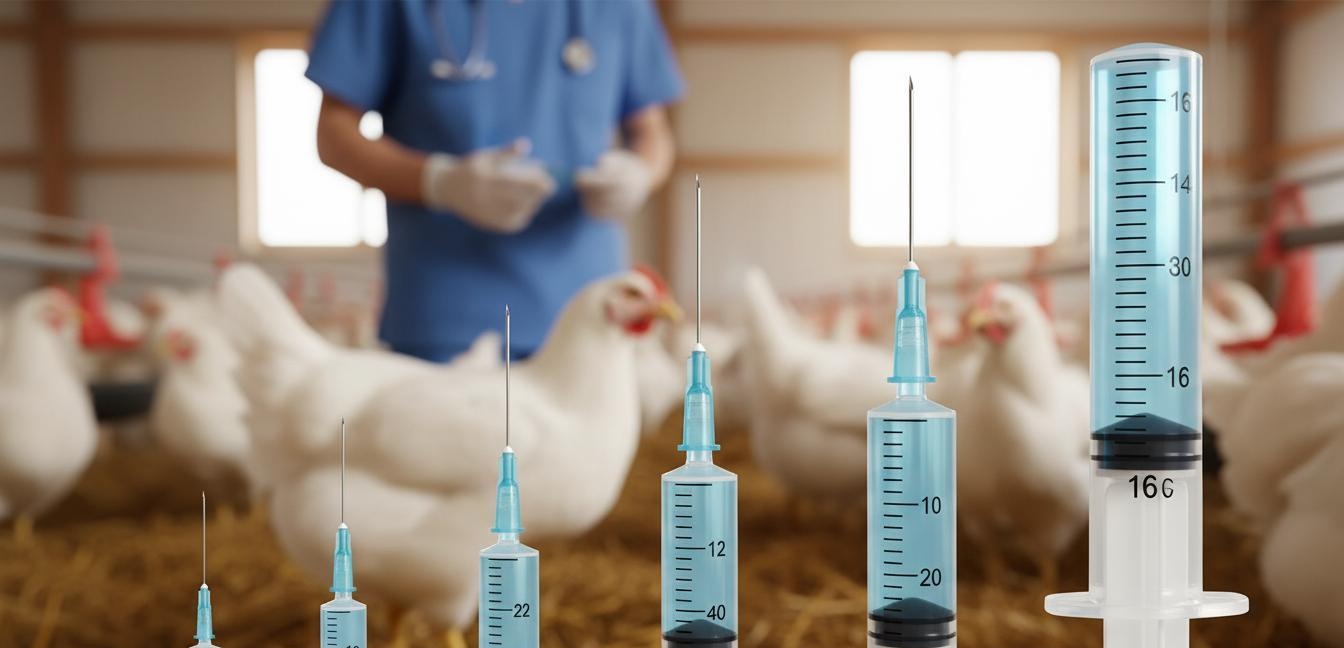
The poultry vaccination challenge is fundamentally different from cattle or other large-animal work because of anatomical scale and operational speed requirements.
A day-old chick weighs 35-45 grams. Its breast muscle is 3-5mm thick. Its wing web is 1-2mm thick. An adult broiler at 6 weeks weighs 2.0-2.5 kg and has a breast muscle depth of 15-20mm. The same injection error that would be trivial in a 600kg cow — hitting a bone, depositing vaccine in the wrong tissue layer, causing a hematoma — can be fatal in a small bird or cause significant carcase condemnation at processing.
At a large-scale poultry operation vaccinating 100,000 broilers per day, needle selection also directly affects throughput. A needle that’s too thin for an oil emulsion vaccine makes each injection take 3-4 seconds instead of 1 second — multiplying across 100,000 birds, that’s the difference between a manageable single-day vaccination program and an impossible logistical challenge.
Needle Gauge System Explained: Why Higher Gauge Number Means Thinner Needle
The Birmingham Wire Gauge (BWG) system used for medical and veterinary needles can be counterintuitive: a higher gauge number means a thinner needle. This developed historically from the Birmingham wire industry’s practice of measuring wire by the number of drawing dies it passed through.
| Gauge | Outer Diameter (mm) | Inner Diameter (mm) | Typical Use in Poultry |
|---|---|---|---|
| 18G | 1.27 | 0.84 | Oil emulsion vaccines, adult birds |
| 20G | 0.91 | 0.60 | Aqueous vaccines, adult birds |
| 22G | 0.71 | 0.41 | Aqueous vaccines, young birds |
| 25G | 0.51 | 0.26 | Day-old chicks, Marek’s vaccine |
Inner diameter matters for vaccination because flow rate through a needle is proportional to the fourth power of the radius (Poiseuille’s Law). A 22G needle (inner diameter 0.41mm) has approximately 1/16th the flow rate of an 18G needle (inner diameter 0.84mm) for the same pressure gradient. For aqueous vaccines this is acceptable; for oil emulsion vaccines it makes injection impractically slow through anything smaller than 20G.
Bird Age Matching Table: Day-Old Chicks, Broilers, Layers, and Breeder Pullets
Needle selection for poultry must match both the bird’s current size and the vaccine type. Here is the practical matching table I use with poultry clients:
| Bird Type / Age | Body Weight | Recommended Gauge | Needle Length | Injection Type |
|---|---|---|---|---|
| Day-old chicks (in-ovo) | 35-45g | 25G | 12-15mm | Subcutaneous (neck) |
| Day-old chicks (post-hatch) | 35-45g | 25G | 8-10mm | Subcutaneous (wing web) |
| 1-2 week brooders | 100-300g | 22-25G | 12-15mm | SC or IM (breast) |
| 3-6 week broilers | 1.0-2.5kg | 20-22G | 15-20mm | SC or IM (breast) |
| Pullet rearers (8-16 weeks) | 1.5-3.0kg | 20G | 20-25mm | IM (breast) preferred |
| Laying hens / breeders | 2.5-4.5kg | 18-20G | 20-25mm | IM (breast) preferred |
Vaccine Viscosity Impact: How Oil Emulsion vs Aqueous Vaccines Change Needle Requirements
Vaccine viscosity is the single most important factor determining practical needle gauge after bird age. Operators who try to inject oil emulsion vaccines through 22G or 25G needles quickly learn this lesson.
I visited a layer operation in Shandong in 2022 where the vaccination crew was using 22G needles for inactivated Newcastle Disease oil emulsion vaccine. Each injection was taking 5-7 seconds because the viscous oil was barely flowing through the narrow needle. The crew was applying excessive pressure, causing a significant percentage of injections to leak back out of the injection site immediately after needle withdrawal.
Oil emulsion vaccines have viscosity approximately 10-50 times higher than aqueous vaccines. At this viscosity, practical injection through anything smaller than 20G is extremely difficult. The minimum gauge for oil emulsion vaccines in adult birds is 18G; 20G is preferred.
Injection Depth Standards: Subcutaneous (SC) vs Intramuscular (IM) Placement and Needle Length
Two primary injection routes are used in poultry vaccination, each with specific depth requirements:
Subcutaneous (SC) Injection — Wing Web:
- Needle insertion: through the wing web (skin fold between humerus and radius-ulna)
- Angle: 20-30 degrees away from wing bones to avoid humerus
- Depth: 5-10mm — just through the skin fold, not into muscle
- Advantage: Technically easier, lower risk of bone hit, suitable for all bird sizes
- Disadvantage: Slightly slower immune response than IM for some vaccines
Intramuscular (IM) Injection — Breast Muscle:
- Needle insertion: into the superficial pectoralis major muscle
- Angle: 30-45 degrees to the skin surface
- Depth: 10-15mm (under 3 weeks), 15-20mm (3-6 weeks), 20-25mm (adults)
- Critical rule: NEVER insert the needle to the hub in birds under 4 weeks of age
- Breast muscle depth at 3 weeks: approximately 12-18mm — full needle insertion risks keel penetration
Needle Reuse and Sterilization: When Single-Use Protocol Actually Matters in Poultry Operations
Needle Breakage in the Field: Prevention, Detection, and Response Protocols
Needle breakage inside a bird during vaccination is one of the most serious quality failures in poultry operations. A broken needle fragment left in the muscle tissue is a physical hazard for anyone processing that bird at slaughter. Detecting and responding to needle breakage incidents is a critical but often inadequately covered protocol in field vaccination training.
Prevention starts with understanding the mechanics: needles break when they encounter resistance that exceeds their shear strength. This typically happens when a needle hits a bone (especially the keel bone in deep-breasted breeds like Cornish Cross broilers), when a needle bends and then breaks at the bend point after repeated use, or when excessive lateral force is applied during insertion (common when vaccinating moving birds in multi-person operations).
The primary prevention protocol is to change needles at maximum every 500 bird administrations — sooner if you notice any bending or dulling. Dull needles require more force to penetrate, increasing bending stress on the shaft. Bent needles create lateral stress that dramatically increases breakage risk. Maintain a needle change log and enforce the 500-bird maximum even when operators resist the interruption.
Detection: after each vaccination session, pass the needle through a piece of dense foam or rubber membrane and inspect it for any bending or tip damage that would have been missed during rapid visual inspection. Additionally, establish a bird processing inspection protocol for 30 days following any suspected needle break event — process a sample of birds from the vaccinated batch and inspect the muscle tissue in the vaccination site area for visible fragments.
Response: if a confirmed or strongly suspected needle breakage occurs, immediately quarantine the affected batch. Do not mix it with other flocks. Process the batch separately and implement the foam inspection protocol on 100% of birds from that batch before they enter the normal processing flow. Document the incident including the likely needle identification (lot number and gauge if known) and notify your vaccine supplier — some suppliers maintain lot traceability that can help identify whether a manufacturing defect contributed to the breakage.
Training Your Vaccination Team: Building Competence in Needle Selection and Use
The technical knowledge in this article is only valuable if your field team understands and applies it correctly. In my experience working with poultry operations, the gap between what the veterinarian specifies and what actually happens in the field is often significant.
The most common failure mode is needle selection drift: over time, operators tend to default to a needle gauge they’re comfortable with regardless of the vaccine or bird age specification. This drift is particularly common with new employees who weren’t present when the original protocol was established. Counter it by making the specification visible at the point of use — store the correct needle gauge with the vaccine bottle for each task, rather than expecting operators to remember the specification from training.
Conduct a practical competency check every 6 months: show operators photos of correctly sized versus incorrectly sized needles in use, have them demonstrate proper insertion technique on a training dummy or deceased bird, and quiz them on the consequences of wrong gauge selection. This takes 15 minutes per team member twice per year and dramatically reduces protocol drift. Document the training completion for each operator — this documentation is valuable if you ever face a regulatory audit or a customer complaint related to vaccination quality.
The economics of poultry vaccination create strong pressure to reuse needles. In large-scale operations, changing needles 50,000+ times per vaccination day is expensive and logistically complex. However, the infection transmission risk from needle reuse in poultry is measurably significant.
Studies on needle reuse in poultry vaccination show:
- After 500 injection cycles, needle sharpness degrades measurably — tissue trauma increases and injection site leakage becomes more common
- Needles that contact an infected bird (e.g., a bird with subcutaneous E. coli infection or systemic Salmonella) can transmit viable pathogens to subsequent birds via the needle
- In multi-age layer operations, needle reuse between flocks is a documented pathway for disease transmission
My recommendation: use a two-needle rotation system. Keep one needle in use while a backup needle is sterilized (autoclave at 121 degrees Celsius for 15 minutes minimum). Rotate between the two needles every 300-500 injections. This provides fresh sharpness without requiring 50,000 individual sterile needles per vaccination day.
Download: Poultry Vaccination Protocol Guide
Complete needle selection chart by bird age and vaccine type, injection depth reference table, and needle replacement protocol worksheet. Available for Sound-AI distributor partners.
Frequently Asked Questions
Post time: May-18-2026