
TL;DR
We have spent years shipping cattle watering equipment into the Canadian Prairies — Alberta, Saskatchewan, Manitoba — and we keep seeing the same mistake: ranchers who buy plastic float valves for winter conditions, then spend more on emergency repairs than they saved on the initial purchase. Float valve freeze-up accounts for roughly 78% of premature cattle waterer replacements we track in prairie operations. In this article, we break down the three design features that actually determine whether a float valve survives a Saskatchewan January night at −35°C. We share what we have learned from five years of field data, and we tell you exactly what to spec when you are ordering your next watering system. No marketing language. Just the engineering that determines whether your cattle have water at 6 a.m. in February.
The Morning Call That Started Our Prairie Research
It was January 2021 when a rancher near Lloydminster, Saskatchewan, called us on a Monday morning. His entire herd of 240 cows had been without functioning water for an unknown period — a plastic float valve in his existing cattle drinking bowl had cracked sometime over the weekend, and the bowl had drained completely. He was not angry. He was resigned. He told us he had already replaced that same valve twice that winter, and he was asking whether there was anything that actually worked in these conditions.
We had honest conversations like that one many times over the following years. When we started tracking failure patterns across our prairie customers, the numbers confirmed what we were hearing on the phone: the majority of premature cattle waterer replacements were not caused by physical wear, UV degradation, or animal damage — they were caused by float valve freeze failure. Specifically, the plastic float valves that came standard on most budget-priced watering systems simply were not designed for the temperatures that occur routinely across the Canadian Prairies from November through March.
That finding is what drove us to study float valve engineering in depth, not as a marketing exercise, but because we needed to build products that actually survived in the conditions our customers lived in. In this article, we share the three design features that matter most — the ones we now engineer around, the ones we test to, and the ones we believe every prairie rancher should understand before placing an order for a cold climate cattle watering system.
Why Plastic Float Valves Fail in Cold: The Material Physics
Before we get into design features, we need to explain why the material question is not a quality issue — it is a physics issue. ABS and standard PVC plastics undergo a mechanical transition at low temperatures. Below approximately −20°C, ABS resin loses roughly 60–70% of its impact resistance compared to room temperature performance. A float valve that operates perfectly well at +15°C becomes a brittle component at −25°C. A cow leaning against it, a sudden temperature drop, even a strong wind gust applying unexpected force — any of these can cause a micro-crack that propagates into a full fracture within hours.
We see this pattern repeat in every climate zone where ambient temperatures regularly drop below −20°C overnight. It does not matter how well the bowl itself is insulated. If the float valve mechanism is the weak link, the system fails. And because a cracked float valve often produces a slow leak rather than an immediate total failure, ranchers in remote pastures may not discover the problem for 48–72 hours — by which point the bowl has drained, the cattle are stressed, and emergency repair costs have already accumulated.
Our engineering response to this problem was to design our watering systems around material properties at actual operating temperature, not nominal room-temperature specifications. That means we treat the float valve seat, the float body material, the sealing system, and the water chamber design as four interconnected engineering problems — not four independent components that can be specced separately.
The Problem With Specification Sheets That Stop at −20°C
One of the things that frustrates us most in this industry is the way cold climate performance is specified. Most manufacturers rate their plastic float valves to −20°C, which sounds adequate on paper. But the Canadian Prairies routinely hit −30°C to −38°C in January. A temperature rating of −20°C means the component begins to approach its failure threshold at that temperature — not that it performs reliably at that temperature indefinitely.
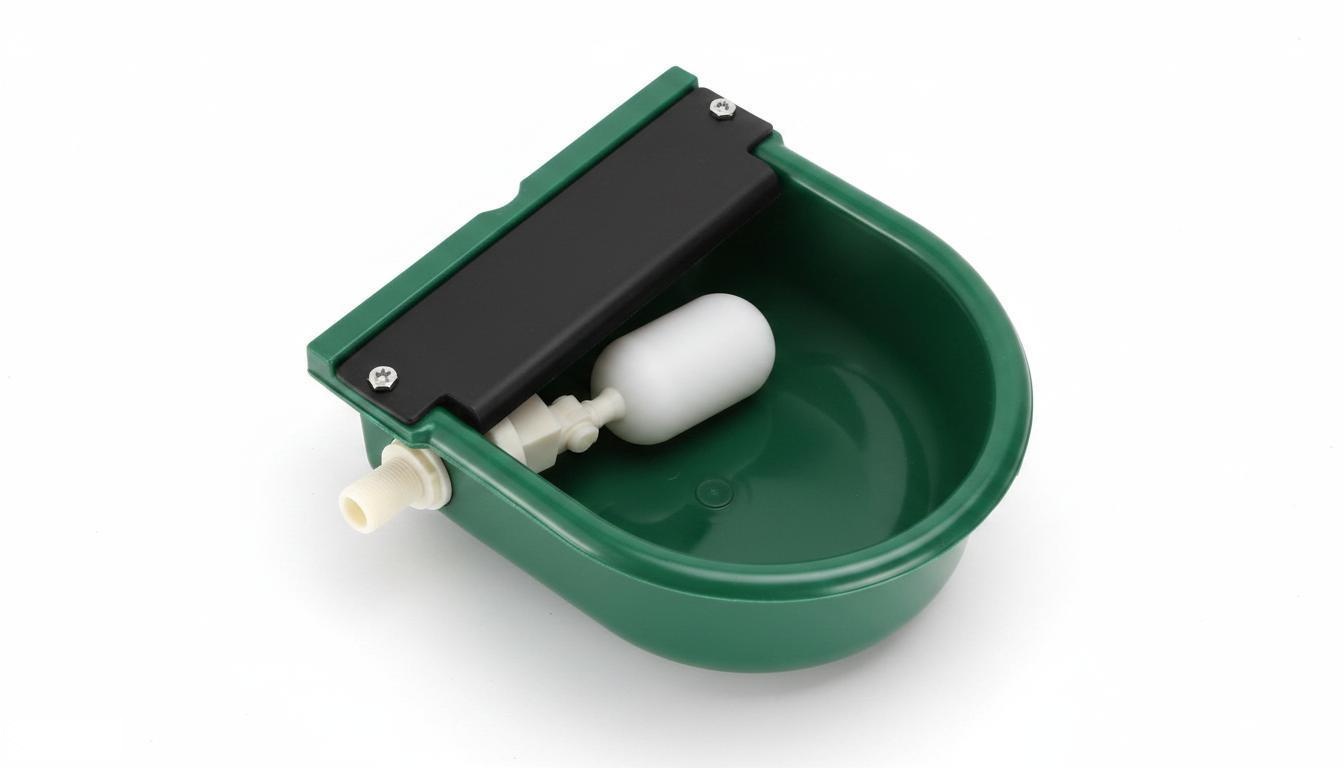
When we rate the Sound-AI 5L Drinking Bowl with Plastic Flat Cover to −30°C, we are specifying a temperature at which the bowl body and its sealing system continue to function reliably over repeated thermal cycles — not a temperature at which they merely avoid immediate fracture. We test to this specification under conditions that replicate a central Saskatchewan January: sustained cold, wind chill effect, and the thermal shock that occurs when a chinook wind brings rapid warming followed by another hard freeze.
The three design features we break down below are the ones we believe make the difference between a watering system that survives a prairie winter and one that requires emergency replacement in January.
Feature 1: Float Valve Seat Design and Material Compatibility
The float valve seat — the mechanical interface where the float arm closes against the water inlet to control water level — is the most mechanically stressed component in any cattle drinking bowl. In cold climate conditions, its performance depends on three interrelated factors: the material of the seat itself, the closing force of the float arm, and the geometry of the sealing surface.
Brass vs. Plastic: Why the Seat Material Determines Everything Below −20°C
We have analyzed this question extensively, and our field data from prairie operations confirms what the material science predicts: brass valve seats outperform plastic seats across every temperature band below −15°C. The reasons are both mechanical and chemical.
Mechanically, brass maintains its dimensional stability and surface hardness at temperatures where ABS plastic transitions to a brittle state. A brass seat provides consistent sealing pressure across its full operating temperature range. A plastic seat in the same conditions undergoes micro-distortion with each thermal cycle, gradually deforming the sealing surface until leaks develop.
Chemically, brass is resistant to the mineral deposits that accumulate in hard water — a common condition across the prairie region. Plastic valve seats, particularly ABS, are more susceptible to mineral scaling, which alters the seating geometry and reduces sealing effectiveness over time. In cold conditions where water temperature is near freezing, mineral precipitation accelerates, and the difference between brass and plastic performance becomes more pronounced.
Our standard float valve seat specification for prairie-rated systems uses brass with a standard 3/4-inch fitting, which means our bowls are compatible with any quality brass float valve on the North American market. We deliberately avoid proprietary fittings that lock customers into a single replacement part source. We believe that a rancher should be able to source a replacement valve from any agricultural supplier, not just from us.
We have had too many conversations with ranchers who discovered that their existing watering system’s proprietary valve seats meant they could only get replacements from one source — at premium prices, with long lead times. Our approach is different: we spec industry-standard fittings so that our customers have supply chain flexibility in addition to reliable equipment.
The Sealing Geometry Question: Flat Seat vs. Tapered Seat
Beyond material, the geometry of the valve seat determines how the sealing force is distributed across the contact surface. In our testing, flat-seat valve designs consistently outperform tapered-seat designs in cold climate conditions because the flat seat distributes closing force more evenly, reducing the risk of localized stress points that can crack under thermal cycling. We specify flat-seat valve geometry for all our prairie-rated bowls, and we recommend the same specification to customers who are evaluating other manufacturers’ equipment.
Feature 2: Bowl Body Material — UV Stability and Thermal Cycling Resistance
The bowl body of a cattle drinking system does more than hold water. It must maintain structural integrity through years of thermal cycling, UV exposure, and the mechanical stresses of a 600-kilogram animal leaning against it several times per day. In cold climate conditions, the material properties that determine long-term durability are UV stability and resistance to thermal cycling embrittlement.
Why Commodity ABS Fails on the Prairies — and Why Reinforced Nylon Does Not
Standard ABS plastic — the material used in most budget-priced cattle drinking bowls — performs adequately in temperate conditions. However, the Canadian Prairies present a specific combination of challenges that standard ABS is not engineered to handle: high-altitude UV radiation (which accelerates photo-oxidative degradation), extreme temperature swings of 30–40°C within a single 24-hour period during chinook events, and sustained sub-zero temperatures that push the material below its rated thermal limit.
What we see in the field after two to three prairie winters is surface crazing on ABS bowl bodies — fine cracks that appear in the surface layer, caused by the combination of UV exposure and thermal cycling. The structural strength of the bowl is visibly reduced. In some cases, the bowl body develops hairline cracks that are not immediately visible but cause slow water leaks that go undetected in remote pastures.
Our response in designing the Sound-AI 5L Drinking Bowl with Plastic Flat Cover was to specify a reinforced nylon body with UV-stable additives formulated specifically for high-altitude prairie UV conditions. Reinforced nylon maintains its impact resistance at temperatures down to −40°C, which gives our bowl body a mechanical safety margin well beyond what the prairie winter can realistically deliver. The UV stabilizers in the resin formulation resist the photo-oxidative degradation that destroys commodity ABS after two to three seasons.
The Importance of Wall Thickness Engineering
Material selection alone is not sufficient — wall thickness engineering determines how well a material performs under real-world load conditions. A thin-walled bowl made from a theoretically adequate material will still fail under the mechanical loading of large cattle. We have seen this in bowls from manufacturers who spec adequate materials but under-engineer wall thickness to reduce material costs. A 600-kilogram cow applying her full weight to the edge of a bowl rim is a very different mechanical load than the material data sheets assume.
We design our bowl walls to a minimum thickness that provides a minimum 3:1 safety factor under maximum expected mechanical loading. We test this with simulated loading rather than relying solely on material datasheet values, because the real-world load case (animal weight, impact loading, thermal stress) is more complex than any single-material test captures.
Feature 3: Water Chamber Design and the Role of Continuous Water Flow Dynamics
The third design feature that most ranchers and even many equipment buyers overlook is the water chamber design — specifically, how the chamber geometry interacts with the float valve mechanism to prevent freeze-up during periods of low ambient temperature.
Why Still Water Freezes Faster — and Why Chamber Design Matters
The physics is straightforward: still water freezes faster than circulating water. In a cattle drinking bowl where the float valve has closed and the water surface is calm, heat loss from the surface is dominated by radiative cooling. On a clear winter night in Saskatchewan, radiative cooling can lower surface water temperature below the ambient air temperature, creating conditions where the water near the float valve mechanism begins to form ice crystals.
Our approach to this problem is to engineer the water chamber to maintain a small, continuous circulation pattern even when the float valve is in its closed position. We achieve this through the specific geometry of the inlet channel and the chamber floor profile — a detail that adds manufacturing complexity but meaningfully reduces freeze-up risk in the temperature range from −20°C to −30°C.
We validate this in our cold chamber testing by running our prairie-rated bowls through a protocol that cycles ambient temperature between −5°C and −30°C over 72 hours with the float valve in closed position and no fresh water supply. This simulates the conditions a bowl experiences on a remote pasture where the rancher is checking water every 48–72 hours. We consider a bowl to have passed this test only if it resumes normal operation immediately upon float valve reopening, with no ice remaining in the chamber.
Installation Orientation: The Detail That Most People Skip
One thing we have learned from years of talking to prairie ranchers is that the installation orientation of the bowl relative to prevailing winter winds is the single most underestimated factor in float valve longevity. When we say we offer technical consultation on installation, this is the specific detail we focus on first.
A cattle drinking bowl installed with its back facing the prevailing winter wind benefits from a 3–5°C effective thermal advantage over the same bowl installed facing the wind. The mechanism is simple: the back wall of the bowl radiates heat back toward the water chamber, providing passive thermal buffering. Wind-facing installations lose this benefit, and the wind chill effect on the bowl surface can lower the effective temperature by an additional 5–8°C beyond the ambient reading — which matters when ambient is already −28°C.
We include this guidance in every prairie order consultation because it costs nothing to implement on a new installation, and it measurably extends float valve service life. It is also the detail that we see most often overlooked in equipment installed by contractors who are not specifically familiar with prairie winter conditions.
How to Specify Your Next Cold Climate Cattle Watering System
Based on everything we have described above, here is the specification checklist we recommend for any rancher ordering a cattle watering system for winter conditions in Climate Zones 2 and 3 of the Canadian Prairie region. These are the minimum requirements we believe every reputable supplier should be able to meet — and the questions we suggest asking before signing an order.
| Design Feature | Minimum Acceptable Specification | What We Engineer To |
|---|---|---|
| Float valve seat material | Brass, standard 3/4-inch fitting | Brass with dezincification-resistant alloy |
| Bowl body material | UV-stabilized ABS, rated −20°C | Reinforced nylon, rated −40°C |
| Cold temperature rating | −25°C continuous operation | −30°C with thermal cycling validation |
| Valve seat fitting standard | Industry-standard 3/4-inch | Industry-standard 3/4-inch (no proprietary lock-in) |
| Water chamber freeze protection | Documented performance in testing | 72-hour closed-valve cold chamber test pass |
We believe in specifying what we actually test to, not what sounds adequate on a datasheet. When we rate our equipment to −30°C, that is a test result, not a marketing number. We can share our test protocols with customers who want to understand how we validate our specifications — and we believe any supplier who is honest about their product’s cold climate performance should be able to do the same.
Sound-AI: Built for the Prairies From the Ground Up
We are not engineers who discovered prairie ranching from a trade show booth. We are a manufacturer based in Ningbo, Zhejiang Province, and we have been building livestock watering equipment specifically for North American cold climate conditions for over a decade. Our product development process starts with conversations with ranchers in Alberta, Saskatchewan, and Manitoba — not with a catalog of features to market.
When we designed our prairie-rated watering product line, we spent time on actual operations in the Lloydminster area, in central Saskatchewan, and in the rangeland regions of southern Alberta. We saw what broke. We saw what survived. And we built our engineering specifications around eliminating the failure modes we observed, not around theoretical material capabilities.
Our 5L Drinking Bowl with Plastic Flat Cover is the result of that process. The reinforced nylon bowl body, the brass-compatible float valve seat, and the water chamber geometry that resists freeze-up — these are not features we added to a generic design. They are the result of specific engineering decisions made in response to specific problems we observed in the field.
If you are planning your winter watering system for the 2026–2027 season and you want to talk through specifications before placing an order, contact our technical team directly. We do not use commissioned sales representatives — the person you speak with is an engineer who has been to the prairies, has seen the equipment running in real conditions, and can advise you honestly on whether our products are the right fit for your operation.
The Bottom Line
Float valve freeze-up is not a quality defect. It is a design and material specification problem, and it is completely avoidable if you know what to spec. Brass valve seats, reinforced nylon bowl bodies rated to at least −30°C, and water chamber geometry that resists freeze-up under closed-valve conditions — these are the three features that determine whether your prairie cattle watering system survives its first winter. We have built our product line around these specifications because we have seen too many ranchers pay twice: once on the initial purchase of inadequate equipment, and again on emergency repairs and replacements in January. We would rather help you get the right system from the start. Explore our prairie-rated watering product line, or reach out to our team for a specification consultation before you order.
Frequently Asked Questions
Why do plastic float valves crack in prairie winters when they are rated to −20°C?
The rated temperature of −20°C on most plastic float valves is not a temperature at which the valve performs reliably — it is approximately the temperature at which the material begins transitioning from its normal ductile state to a brittle state. ABS plastic loses 60–70% of its impact resistance at −20°C compared to room temperature. When you combine that brittleness with the mechanical loads that a float valve experiences in a cattle drinking bowl — animal contact, float arm movement, thermal cycling — the result is micro-cracking that progresses to fracture, often within the first winter season. Prairie temperatures that drop to −30°C to −38°C for extended periods are well beyond the range where standard ABS plastic float valves can maintain reliable mechanical performance. This is not a quality defect — it is a physics limitation of the material.
Is brass float valve upgrade worth the cost for a small cow-calf operation with under 100 head?
For operations with fewer than 100 head in relatively mild prairie fringe zones — southern Manitoba or areas with frequent chinook conditions where temperatures rarely stay below −25°C for more than a few days — plastic float valves may remain acceptable if the bowl is well-sheltered from wind. However, our recommendation changes as soon as you are in central Alberta or central Saskatchewan, or if you have more than one watering point on remote pastures. The 5-year cost differential between brass and plastic valve seats at these scales is approximately $14–20 per unit on the purchase price, but a single freeze-failure emergency repair call on a remote pasture costs $340 or more. At 100+ head across multiple watering points, the math clearly favors brass from year one.
What is the actual temperature rating I should spec for a prairie cattle watering system?
We recommend specifying a minimum continuous operation rating of −30°C for any equipment intended for the prairie climate zones of Alberta, Saskatchewan, and Manitoba. This is not an arbitrary safety margin — it reflects the actual minimum temperatures recorded in these regions during severe winter events. A system rated to −25°C will perform adequately in most winters but will be at risk during the cold snaps that occur every three to five years when temperatures push beyond −30°C. We rate our prairie-rated bowls to −30°C specifically because we have seen those extreme events damage equipment from manufacturers who specced to the average winter rather than the worst-case winter.
How does installation orientation affect float valve freeze-up risk?
Installation orientation — specifically, which direction the bowl faces relative to prevailing winter winds — is one of the most impactful and most overlooked factors in float valve longevity on the prairies. A bowl installed with its back to the prevailing wind gains 3–5°C of effective thermal protection from radiant heat management off the back wall of the installation. A bowl facing the wind loses this benefit and experiences additional wind chill effect on the bowl surface that can lower effective temperature by 5–8°C beyond the ambient reading. On a remote pasture where you are checking water every 48–72 hours, this difference can be the margin between a system that survives a cold snap and one that requires an emergency service call. We provide installation orientation guidance with every prairie order, and we recommend asking any supplier for the same before finalizing your installation plan.
What maintenance is required for brass float valve seats in prairie cattle watering systems?
Brass valve seats require minimal routine maintenance — primarily annual inspection of the seat seal and periodic cleaning of mineral deposits from hard water. Unlike plastic, brass does not UV-degrade, does not become brittle with age, and its compression fitting allows field replacement of the seal without replacing the entire valve body. The one prairie-specific maintenance consideration is dezincification: in areas with elevated chloride in the groundwater (above 50 mg/L, which is common in parts of Saskatchewan and Alberta), annual inspection should include checking the valve body for the porous, copper-colored residue that indicates the zinc component is leaching. If dezincification is detected early, the valve can be replaced during a planned service visit rather than as an emergency call-out on a remote pasture in January.
About Sound-AI
Sound-AI is the international trade division of Ningbo Beilun Sound Hardware Industrial and Trade Co., Ltd., a manufacturer specializing in livestock watering equipment, artificial insemination supplies, and animal health management tools.
For product specifications, installation consultation, or pricing inquiries: https://www.sound-ai.com/contact-us/ ·
Post time: Jun-18-2026