
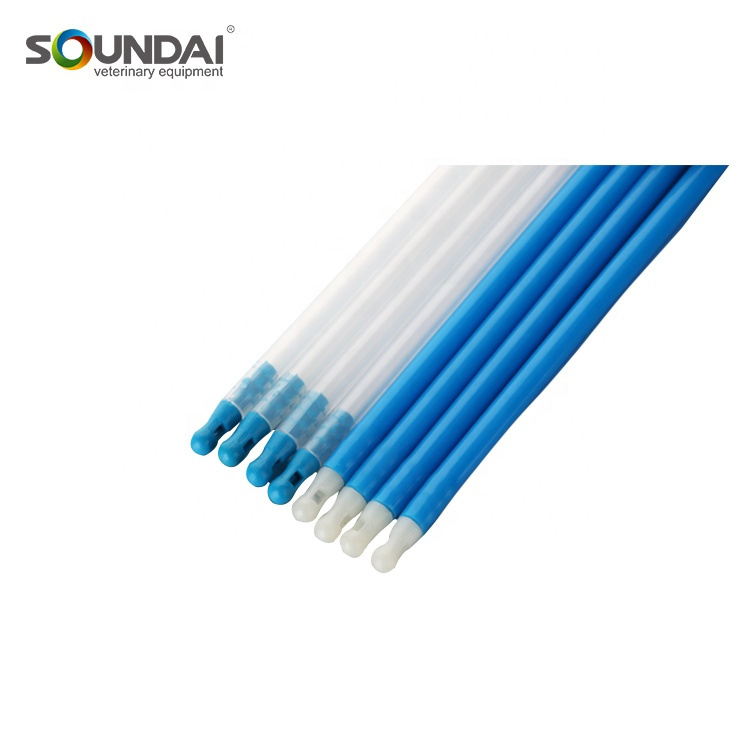
Why Brazilian Swine Genetics Buyers Ask for Deep Intra-Uterine Insemination Catheters
Brazil is the fourth-largest pork producer in the world and the largest pork exporter in Latin America, with commercial sow herds dominated by Landrace × Large White × Duroc crossbreds in high-parity commercial operations. As Brazilian swine genetics operations have moved toward batch management, fixed-time AI protocols, and high-throughput AI centers, PCAI (post-cervical artificial insemination) has become a meaningful adoption pathway because it allows a 50-60% reduction in semen dose per service without sacrificing conception rates — which directly reduces the number of boars that must be maintained for semen collection and the per-service consumable cost.
The deep intra-uterine catheter is the consumable that makes PCAI possible. Standard cervical AI deposits the semen at the cervix, which means much of the semen is lost to backflow during the 3-5 minute insemination window and the sperm has to swim through the cervix to reach the uterine body. PCAI bypasses the cervix by passing a long flexible catheter through the cervical canal and depositing the semen directly into the uterine body, which is closer to the sperm reservoir. The result is that fewer sperm are needed per dose and the conception rate is preserved or improved.
Brazilian swine genetics operations are uniquely positioned to adopt PCAI at scale because the AI center model (centralized boar studs that supply semen to multiple sow farms) lends itself to the PCAI dose reduction economics: the AI center saves on boar maintenance, the sow farms save on semen costs, and the genetics improvement is faster because more sows can be inseminated from the same high-merit boar. The SOUNDAI SDAI04 deep intra-catheter for pig insemination is the consumable that supports this model.
What “Deep Intra-Uterine” Means vs Standard Catheter
The deep intra-uterine catheter is fundamentally different from a standard cervical AI catheter in three physical dimensions: shaft length, tip design, and shaft stiffness. A standard cervical AI catheter is typically 50-55 cm long with a soft Sponge Tip that deposits semen at the external cervical os; the semen then has to traverse the cervix to reach the uterus. A deep intra-uterine catheter is typically 60-70 cm long with a soft Foam Tip that passes through the cervix and deposits semen in the uterine body.
| Specification | Standard Cervical AI Catheter | Deep Intra-Uterine Catheter (PCAI) |
|---|---|---|
| Shaft length | 50-55 cm | 60-70 cm |
| Tip type | Soft closed-cell Sponge Tip | Soft open-cell Foam Tip |
| Tip position at delivery | External cervical os (cervix entry) | Uterine body (past the cervix) |
| Shaft stiffness | Flexible (cervical deposition only) | Balanced (must pass through cervical canal) |
| Semen dose per service | 80-100 mL (3-4 billion sperm) | 30-50 mL (1-2 billion sperm) |
| Suitable for maiden gilts | Yes (cervical only) | Yes, but with operator skill |
| Suitable for multiparity sows | Yes | Yes (preferred use case for PCAI) |
The table shows that the deep intra-uterine catheter is physically longer, has a more compliant tip, and is designed to deposit semen past the cervix. The shaft stiffness is the most subtle difference: a deep intra-uterine catheter must be flexible enough to navigate the curve of the cervical canal without trauma, but rigid enough that the operator can feel the cervical passage and control the tip during insertion. The SOUNDAI SDAI04 deep intra-catheter for pig insemination is engineered to this balanced stiffness profile.
Spec 1 — Tip Type: Foam Tip vs Spiral Tip vs Sponge Tip
The tip is the most consequential specification on a deep intra-uterine catheter because the tip is the part that contacts the cervix and the uterine body during insertion. Three tip types are commonly used on sow AI catheters, each with a different mechanical behavior and a different use case.
| Spec | Foam Tip (preferred for PCAI) | Spiral Tip (cervical AI) | Sponge Tip (cervical AI) |
|---|---|---|---|
| Material | Soft open-cell polyurethane foam | Rigid molded plastic spiral | Soft closed-cell sponge (EVA or PE) |
| Endometrial trauma | Low (foam conforms to cervical canal) | Moderate (rigid spiral can scrape) | Low (soft sponge conforms) |
| Cervical passage feel | Tactile (operator can feel the canal) | Anchoring (spiral locks into cervical folds) | Soft (sponge compresses during passage) |
| Semen backflow rate | Low (foam seal at cervix) | Moderate (spiral allows some backflow) | High (sponge absorbs and releases slowly) |
| Suitable for PCAI? | Yes (preferred) | No (rigid spiral can cause trauma in uterine body) | No (soft sponge cannot pass cervix reliably) |
| Suitable for cervical AI? | Yes (overspecified) | Yes (typical choice) | Yes (typical choice for maiden gilts) |
| Cost per catheter | Higher (precision foam molding) | Moderate (injection molded plastic) | Lower (compression molded sponge) |
The table shows that the Foam Tip is the preferred tip for PCAI programs because it minimizes endometrial trauma, improves operator feel during cervical passage, and reduces semen backflow after deposition. The Spiral Tip is a typical cervical AI choice but is not suitable for PCAI because the rigid spiral can cause trauma in the uterine body. The Sponge Tip is the lowest-cost option but is too soft to reliably pass through the cervix for PCAI. Brazilian swine genetics operations that have moved to PCAI programs typically standardize on the Foam Tip across all multiparity sows and select the Spiral Tip or Sponge Tip as a cervical AI backup for maiden gilts and problem breeders.
Spec 2 — Length + Diameter + Stiffness
The dimensional specification on a deep intra-uterine catheter is critical because the catheter must reach the uterine body in a sow of any parity without causing trauma. Three dimensional parameters are typically specified in the RFQ: shaft length, outer diameter, and shaft stiffness.
| Spec | Maiden Gilt (parity 0) | Multiparity Sow (parity 1-3) | Multiparity Sow (parity 4+) |
|---|---|---|---|
| Recommended shaft length | 60 cm (shorter vaginal-cervix distance) | 65 cm (medium distance) | 70 cm (longest distance, larger uterus) |
| Recommended outer diameter | 4.0 mm (narrower cervical canal) | 4.0-4.2 mm (medium canal) | 4.2-4.5 mm (wider canal) |
| Recommended inner lumen diameter | 1.5 mm (lower flow rate is acceptable) | 1.5-1.8 mm | 1.8-2.0 mm (higher flow rate needed for larger dose) |
| Recommended shaft stiffness | Soft (cervix is tight in gilts) | Balanced (typical multiparity) | Slightly stiffer (larger uterus can accommodate firmer passage) |
| Operator skill required | High (force can damage cervix) | Moderate (cervix is more open) | Moderate (easier passage but longer reach) |
The table shows that the dimensional specification depends on the sow parity, which is the primary determinant of the vaginal-cervix-uterine body distance. Maiden gilts have a shorter distance and a tighter cervix, which favors a 60 cm catheter with a 4.0 mm outer diameter and a softer shaft. Multiparity sows (parity 1-3) have a medium distance, which favors a 65 cm catheter with a 4.0-4.2 mm outer diameter. Multiparity sows (parity 4+) have the longest distance and the largest uterus, which favors a 70 cm catheter with a 4.2-4.5 mm outer diameter. Brazilian swine genetics operations working with commercial crossbreds typically specify 65-70 cm length with 4.0-4.5 mm outer diameter as a single catalog SKU that covers all parities.
Spec 3 — End Plug + Locking Connector
The proximal end of a deep intra-uterine catheter (the operator’s end) must have an end plug and a locking connector to attach the semen container securely. Two specifications are typically called out in the RFQ: the end plug geometry and the locking connector type.
| Spec | End Plug with Luer-Lock | End Plug with Custom Bayonet |
|---|---|---|
| Compatibility with semen container | Standard luer-lock semen bottle (50-100 mL) | Custom semen bag or bottle with bayonet fitting |
| Seal reliability | High (luer-lock is a standard medical taper) | High (bayonet is a custom-fit positive lock) |
| Operator skill to attach | Low (twist-lock is intuitive) | Moderate (push-and-twist bayonet requires alignment) |
| Cost | Lower (luer is a standard component) | Higher (custom bayonet mold) |
| Reorder risk | Low (luer is widely available) | Moderate (custom bayonet locks the buyer to one supplier) |
| Typical use case | Standard AI centers with multiple suppliers | Integrated boar stud + AI center operations |
The table shows that the end plug with luer-lock is the more flexible choice because the luer-lock is a standard medical taper that fits widely-available semen bottles. The end plug with custom bayonet is a more secure choice for integrated operations that want to lock the consumable supply to a single supplier. For Brazilian swine genetics operations that source semen and catheters from multiple suppliers, the luer-lock is the typical choice. For integrated operations that control the entire boar stud + AI center + sow farm chain, the custom bayonet is acceptable because the lock-in is intentional.
Spec 4 — Sterility + EO Gas Validation
Sterility is the fourth specification on a deep intra-uterine catheter because the catheter is a single-use consumable that is inserted into the reproductive tract. Two specifications are typically called out in the RFQ: the sterilization method (and the SAL) and the packaging configuration.
| Spec | EO Gas Sterilization (standard) | Gamma Radiation Sterilization (alternative) |
|---|---|---|
| Sterility Assurance Level (SAL) | 10^-6 (industry standard) | 10^-6 (industry standard) |
| Material compatibility | Compatible with polyurethane foam + PE + PP | Compatible with most plastics, but can degrade some polymers |
| Cycle time | 12-24 hours (long cycle) | 2-4 hours (short cycle) |
| Residual EO/ECH concerns | Yes (must comply with ISO 10993-7 limits) | No residuals (cleaner) |
| Packaging compatibility | Tyvek + PE peel-pouch (allows EO penetration) | Tyvek + PE peel-pouch (compatible) |
| Typical use case | Standard for disposable medical consumables | Used for radiation-stable polymers |
| Brazilian MAPA documentation | Certificate of Sterility + Certificate of Conformity | Certificate of Sterility + Certificate of Conformity |
The table shows that EO gas sterilization is the industry standard for disposable sow AI catheters because it is compatible with the polyurethane foam, PE, and PP materials used in the catheter construction, and because it achieves the SAL 10^-6 required for single-use medical consumables. Gamma radiation is an alternative that has a shorter cycle time and no residual concerns, but is less commonly used for foam-tipped catheters because the radiation can degrade some foam polymers. For Brazilian MAPA (Ministry of Agriculture, Livestock and Food Supply) compliance, the catheter must be accompanied by a Certificate of Sterility (confirming the SAL 10^-6) and a Certificate of Conformity (confirming compliance with Brazilian veterinary device regulations). The SOUNDAI SDAI04 deep intra-catheter for pig insemination is supplied to the EO sterilization standard with full MAPA documentation support. Brazilian buyers sourcing consumables for AI center operations should verify that the supplier provides both certificates per shipment.
SDAI04 Deep Intra-Catheter: Brazilian Swine Genetics Reference Spec
The SOUNDAI SDAI04 deep intra-catheter for pig insemination is the reference product that ships to the 4 procurement specifications covered in this article. The SDAI04 is engineered for Brazilian swine genetics operations that have adopted PCAI programs at commercial scale and require a consumable that meets the dimensional, tip, connector, and sterility requirements for high-throughput AI center use.
The SDAI04 reference spec is: 65 cm shaft length (covers maiden gilts and multiparity sows parities 1-3; 70 cm option available on request for parity 4+ sows), 4.0-4.5 mm outer diameter (calibrated to the typical cervical canal of commercial crossbreds), 1.5-2.0 mm inner lumen (calibrated for the 30-50 mL PCAI dose flow rate), Foam Tip with soft open-cell polyurethane (the preferred tip for PCAI), End Plug with standard luer-lock connector (compatible with widely-available semen bottles), and EO gas sterilization to SAL 10^-6 in individual Tyvek + PE peel-pouch with EO sterilization indicator. Each catheter is individually wrapped for single-use sterility until the moment of use. The SDAI04 is part of the SOUNDAI disposable AI catheter family, which includes the SDAI03-2 disposable spiral catheter with end plug for cervical AI backups in problem breeders, and the SDAI02-2 disposable medium sponge catheter with end plug for standard cervical AI in maiden gilts. The SOUNDAI AI catheter family is manufactured under ISO 9001 quality management with batch-level traceability, and each lot is shipped with a Certificate of Sterility, a Certificate of Conformity, and the MAPA import documentation required for Brazilian swine operations.
5 Brazilian Swine Farm Scenarios Where PCAI Catheter Outperforms Standard
Five Brazilian swine farm scenarios show where the PCAI catheter outperforms the standard cervical AI catheter on either conception rate, dose economy, or operator efficiency. The 5 scenarios are not mutually exclusive — many Brazilian operations adopt PCAI for two or three of the scenarios simultaneously.
| Scenario | Cervical AI Performance | PCAI Performance | Why PCAI Wins |
|---|---|---|---|
| High-parity commercial sows (parity 4+) | Standard dose 80-100 mL; backflow moderate | Reduced dose 30-50 mL; backflow minimal with Foam Tip | PCAI saves 50-60% on semen cost per service in the herd segment that consumes the most semen |
| Batch farrowing programs with fixed-time AI | Requires 2 services per cycle to compensate for variation | Single service sufficient for most sows | PCAI reduces labor cost per cycle and improves batch synchronization |
| Boar-limited AI centers (small boar stud) | Boar capacity is the bottleneck | Each boar can serve more sows with PCAI dose reduction | PCAI effectively increases boar capacity by 50-100% |
| Synchronized estrus programs using P.G. 600 + Matrix | Variation in ovulation timing requires higher dose | PCAI places semen closer to the oocyte; less dependence on ovulation timing | PCAI improves conception in synchronized programs by 5-10 percentage points |
| High-merit genetic programs (top 10% boars) | Semen is precious; high dose is justified | PCAI allows lower dose without conception penalty | PCAI maximizes the genetic value per mL of semen from elite boars |
The table shows that the PCAI catheter outperforms the standard cervical AI catheter in all 5 scenarios, with the largest gains in high-parity commercial sows and boar-limited AI centers where the dose reduction directly translates to cost savings. Brazilian swine genetics operations that are scaling up AI center capacity should evaluate the PCAI catheter as the default consumable for the multiparity sow herd segment, with the standard cervical AI catheter reserved for maiden gilts and problem breeders.
4 Procurement Specs for Brazilian Swine Genetics RFQs
Four procurement specifications cover the deep intra-uterine catheter RFQ for Brazilian swine genetics operations. The buyer should specify all four in the RFQ and verify the supplier’s compliance documentation before approving the production run.
Spec one: tip type and dimension. Specify the tip type (Foam Tip, Spiral Tip, or Sponge Tip), the shaft length (60 cm, 65 cm, or 70 cm), the outer diameter (4.0 mm, 4.2 mm, or 4.5 mm), and the inner lumen diameter (1.5 mm, 1.8 mm, or 2.0 mm). The supplier should provide a sample of each spec for the buyer to validate.
Spec two: connector. Specify the connector type (luer-lock or custom bayonet), the semen container compatibility (50 mL bottle, 100 mL bottle, or 50 mL collapsible bag), and the seal reliability spec (leak-free at 0.5 bar internal pressure for 5 minutes). The supplier should provide a connector sample for the buyer to test against their semen container inventory.
Spec three: sterility. Specify the sterilization method (EO gas or gamma radiation), the SAL (10^-6 standard), the packaging configuration (individual Tyvek + PE peel-pouch), the EO sterilization indicator (color-changing strip), and the residual limits per ISO 10993-7. The supplier should provide a Certificate of Sterility per shipment.
Spec four: Brazilian import compliance. Specify the required documentation for Brazilian MAPA (Ministry of Agriculture, Livestock and Food Supply) import: Certificate of Sterility, Certificate of Conformity, Certificate of Origin, and commercial invoice with HS code for veterinary device. The supplier should be familiar with Brazilian veterinary device import requirements and should provide a MAPA compliance dossier on request. Reference Brazilian MAPA livestock inputs documentation for the official veterinary device regulatory framework.
Conclusion: Building a PCAI Program Spec into Your Brazilian Swine Genetics RFQ
For Brazilian swine genetics buyers and AI center managers who are building a PCAI program spec into a deep intra-uterine catheter RFQ, the right spec is a chain of four documents: tip type and dimension (Foam Tip, 65 cm length, 4.0-4.5 mm outer diameter, 1.5-2.0 mm inner lumen), connector (End Plug + Luer-Lock), sterility (EO gas SAL 10^-6, individual Tyvek + PE peel-pouch, ISO 10993-7 residual compliance), and Brazilian import compliance (MAPA Certificate of Sterility + Certificate of Conformity + Certificate of Origin). The buyer should specify all four in the RFQ and request a written compliance dossier from the supplier before approving the first production batch.
The PCAI program decision depends on the herd profile: a 50-60% dose reduction is achievable with the SDAI04 deep intra-catheter for pig insemination on multiparity sows, which directly reduces the boar stud capacity requirement and the per-service consumable cost. The 5 Brazilian swine farm scenarios where PCAI outperforms standard cervical AI (high-parity sows, batch farrowing, boar-limited AI centers, synchronized estrus programs, high-merit genetic programs) cover the majority of commercial Brazilian swine genetics operations, and the SDAI04 reference spec covers all five scenarios with a single consumable SKU.
For B2B buyers evaluating the SOUNDAI AI catheter family for a Brazilian swine genetics program, the SDAI04 deep intra-catheter for pig insemination is the consumable that enables the PCAI program at scale. For cervical AI backups in problem breeders, the SDAI03-2 disposable spiral catheter with end plug is the typical choice. For maiden gilt cervical AI, the SDAI02-2 disposable medium sponge catheter with end plug is the typical choice. The full SOUNDAI disposable AI catheter family is manufactured under ISO 9001 quality management with batch-level traceability, and each lot is shipped with a Certificate of Sterility, a Certificate of Conformity, and MAPA import documentation. Submit your PCAI program spec to the SOUNDAI international sales team for a per-spec quote and a MAPA compliance dossier.
Get a PCAI Program Spec Quote and MAPA Compliance Dossier
Ningbo Beilun Sound Hardware Industry & Trade Co., Ltd. (SOUNDAI) is a livestock equipment and artificial insemination tool manufacturer specializing in disposable AI catheters, semen tubes, semen bags, AI guns, and consumables for dairy farms and animal husbandry operations worldwide. With 10+ years of industry experience helping global distributors and farm buyers source reliable products from China, the SOUNDAI disposable AI catheter family includes the SDAI04 deep intra-catheter for pig insemination (PCAI programs in swine), the SDAI03-2 disposable spiral catheter with end plug (cervical AI for problem breeders), the SDAI02-2 disposable medium sponge catheter with end plug (cervical AI for maiden gilts), and the corresponding without-end-plug variants (SDAI01-2, SDAI02-1, SDAI03-1). The SOUNDAI quality system is built on ISO 9001 quality management with batch-level traceability, and each lot is shipped with a Certificate of Sterility, a Certificate of Conformity, and the import documentation required for destination-country veterinary device regulations. Submit your PCAI program spec to the SOUNDAI international sales team for a per-spec quote and a MAPA compliance dossier.
Frequently Asked Questions
Q1. What is a deep intra-uterine catheter for pig insemination and why does PCAI need it?
A deep intra-uterine catheter for pig insemination is a long flexible catheter (typically 60-70cm) with a soft Foam Tip that is designed to pass through the sow’s cervix and deposit semen directly into the uterine body or one of the uterine horns. PCAI (post-cervical artificial insemination) reduces semen dose from the conventional 80-100 mL (3-4 billion sperm) per cervical AI down to 30-50 mL (1-2 billion sperm) per PCAI dose because the semen bypasses the cervix and is deposited closer to the sperm reservoir in the uterus. The deep intra-uterine catheter is the key consumable that enables PCAI to use lower doses while maintaining or improving conception rates. The foam tip minimizes endometrial trauma during insertion through the cervix, which is critical for repeat-service sows.
Q2. How does the Foam Tip differ from a Spiral Tip or Sponge Tip on a sow AI catheter?
The Foam Tip is a soft open-cell polyurethane foam head that conforms to the cervical canal during insertion and releases semen in the uterine body. The Spiral Tip is a rigid molded plastic spiral that anchors in the cervical folds but can cause more trauma on insertion. The Sponge Tip is a soft closed-cell sponge that absorbs semen and releases it slowly into the cervix (used for standard cervical AI, not for PCAI). For PCAI programs that require passage through the cervix into the uterine body, the Foam Tip is the preferred tip because it minimizes endometrial trauma, improves operator feel during cervical passage, and reduces semen backflow after deposition. Brazilian swine genetics operations typically select Foam Tip for PCAI in high-parity sows and maiden gilts.
Q3. What length and diameter is correct for a deep intra-uterine catheter?
A deep intra-uterine catheter for sow insemination typically has an outer shaft length of 60-70 cm to reach through the cervix into the uterine body, an outer diameter of 4.0-4.5 mm to pass through the cervical canal without trauma, and an inner lumen diameter of 1.5-2.0 mm to allow semen to flow at the proper rate during the 3-5 minute insemination window. The shaft stiffness is calibrated to balance flexibility (for cervical passage) with rigidity (for control during insertion). The tip-to-handle length must accommodate the typical sow vaginal-cervix-uterine body distance of 55-65 cm depending on parity and breed. Brazilian swine genetics operations working with commercial lines (Landrace x Large White x Duroc crossbreds) typically specify 65-70 cm length with 4.0-4.5 mm outer diameter for multiparity sows.
Q4. Does a deep intra-uterine catheter require an end plug or locking connector?
Yes, a deep intra-uterine catheter for PCAI should have an end plug at the proximal end (the operator’s end) to seal the semen bottle or semen bag during the insemination, and a locking connector to attach the semen bottle or bag securely without leaking. The end plug must form a leak-free seal with the semen container (typically a 50-100 mL bottle or a 50 mL collapsible bag) so that the semen can be expressed by gravity or gentle pressure without loss. The locking connector (typically a luer-lock or a custom bayonet) prevents the semen container from detaching during the 3-5 minute insemination. Without an end plug and locking connector, the semen can leak from the proximal end of the catheter during use, which reduces the delivered dose and contaminates the work area.
Q5. What sterility and packaging specs does a deep intra-uterine catheter need for Brazilian swine operations?
A deep intra-uterine catheter for Brazilian swine operations must be sterilized by ethylene oxide (EO) gas to a Sterility Assurance Level (SAL) of 10^-6, which is the standard for single-use medical devices and consumables that contact the reproductive tract. The catheter must be individually wrapped in a single Tyvek + PE peel-pouch so that the sterility is maintained until the moment of use. The packaging must include an EO sterilization indicator (a color-changing strip) to confirm that the EO cycle has been completed. For Brazilian import compliance, the catheter must also be accompanied by a Certificate of Sterility, a Certificate of Conformity, and a Brazilian MAPA (Ministry of Agriculture, Livestock and Food Supply) veterinary device registration documentation when required for the destination farm operation. The SOUNDAI SDAI04 deep intra-catheter for pig insemination is supplied to all four specifications as a reference.
Post time: Jul-30-2026