
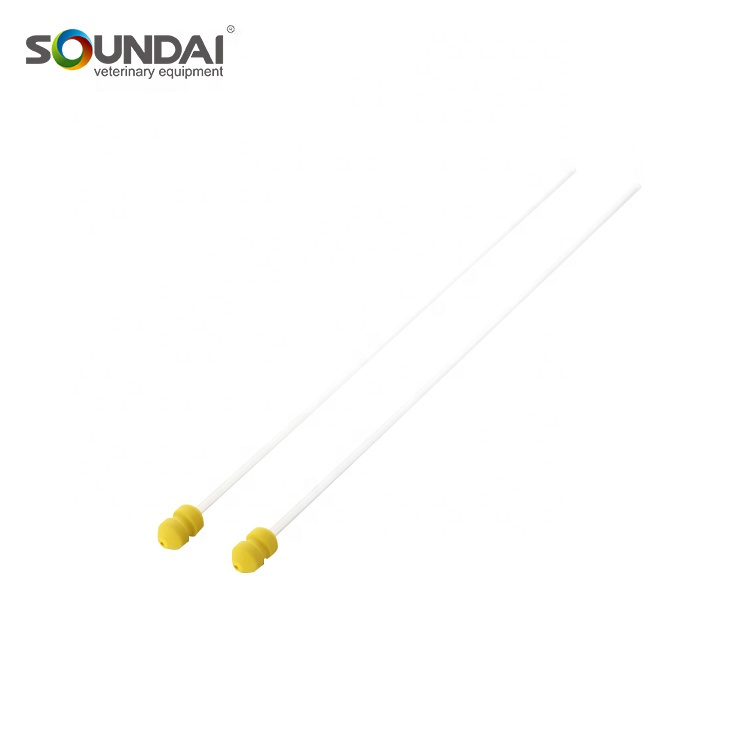
Why Distributors Care About Packaging Format for Disposable AI Catheters
Distributors of disposable AI breeding catheters care about packaging format because it directly affects three operational metrics: warehouse footprint, biosecurity liability, and per-catheter cost. The packaging format decision is made at the procurement stage, not at the customer delivery stage, so the distributor’s choice locks in a warehouse footprint, a biosecurity risk profile, and a per-catheter cost for the entire inventory turn cycle. Getting the packaging mix wrong means either overpaying for warehouse space (if everything is individually wrapped when 60% could be bulk-packed) or carrying biosecurity liability (if everything is bulk-packed when AI center customers require individually wrapped).
The packaging format decision also affects the supplier relationship. Most SOUNDAI disposable AI breeding catheter SKUs are available in both individually wrapped and bulk-packed formats, but the MOQ, the lead time, and the per-catheter price differ between the two formats. Individually wrapped typically has a higher per-catheter price (5-10 cents USD premium) and a longer production lead time (5-7 days extra for the individual packaging line). Bulk-packed has a lower per-catheter price and a shorter lead time, but requires the distributor to commit to larger minimum order quantities (typically 5,000-10,000 catheters per SKU to amortize the bulk packaging line setup).
For mid-size distributors serving a mix of AI centers, boar studs, and commercial sow farms, the packaging format decision is a 60/40 hybrid: 60% bulk-packed for high-volume SKUs going to commercial sow farms, and 40% individually wrapped for premium SKUs and AI center customers. The hybrid strategy preserves the cost optimization of bulk packaging while maintaining the single-unit sterility required by AI center customers, and it allows the distributor to serve both customer segments from a single inventory turn cycle.
What “Individually Wrapped” Means
Individually wrapped means each catheter is sealed in its own sterile barrier package, which is a 3-layer packaging structure designed to maintain sterility from the EO sterilization cycle through the moment of use. The 3 layers are the inner PE film (the primary sterile barrier), the Tyvek lidding (the bacterial barrier that allows EO gas penetration during sterilization), and the outer carton (the physical protection during shipping and warehouse storage).
| Layer | Material | Function |
|---|---|---|
| Inner PE film | Medical-grade polyethylene (PE) film, 60-80 micron | Primary sterile barrier; maintains seal integrity through the sterilization cycle and the shelf life |
| Tyvek lidding | High-density polyethylene (HDPE) flash-spun fabric, 65-75 g/m² | Bacterial barrier; allows EO gas penetration during the sterilization cycle; peelable for aseptic presentation |
| Outer carton | Corrugated fiberboard carton (typically 100 catheters per inner box, 10 inner boxes per outer carton) | Physical protection during shipping; UV barrier; labeling and lot identification |
The table shows that the individually wrapped format is a 3-layer sterile barrier system. The inner PE film + Tyvek lidding combination is the standard sterile barrier for single-use medical devices and consumables, and is recognized by the US FDA, the EU MDR, and the Brazilian MAPA as the reference packaging for EO-sterilized products. The outer carton is the physical protection during shipping and is not part of the sterile barrier. Each catheter is individually wrapped, which means each catheter can be used independently without affecting the sterility of the other catheters in the carton.
What “Bulk-Packed” Means
Bulk-packed means multiple catheters are sealed in a single inner bag inside an outer corrugated carton, which is a 3-layer packaging structure designed for cost-optimized high-volume distribution. The 3 layers are the inner PE bag (containing 25-50 catheters), the outer corrugated carton, and the optional intermediate box (for some SKUs that ship in 100-catheter intermediate boxes).
| Layer | Material | Function |
|---|---|---|
| Inner PE bag (containing 25-50 catheters) | Medical-grade polyethylene (PE) bag, 80-100 micron | Sterile barrier for the entire batch; sealed after EO sterilization |
| Outer corrugated carton | Corrugated fiberboard carton (typically 500-1,000 catheters per outer carton) | Physical protection during shipping; UV barrier; labeling and lot identification |
| Optional intermediate box (for some SKUs) | Corrugated fiberboard inner box (typically 100-200 catheters) | Subdivision of the outer carton for easier inventory management |
The table shows that the bulk-packed format is a simpler 3-layer packaging system compared to individually wrapped. The inner PE bag is the sterile barrier for the entire batch of 25-50 catheters, which means the sterility is maintained for the entire batch but is lost once the bag is opened. The outer corrugated carton is the physical protection and the intermediate box is optional. The cost saving comes from the reduction in packaging material (1 inner PE bag per 25-50 catheters vs 1 inner PE bag + 1 Tyvek lidding per catheter), but the biosecurity trade-off is that all 25-50 catheters are exposed to the ambient environment once the bag is opened.
Warehouse Math: Individually Wrapped Storage Footprint
The warehouse footprint differs by approximately 3-5x between the two formats for the same catheter quantity. The footprint difference is driven by the packaging material volume (Tyvek + PE peel-pouch per catheter vs inner PE bag per 25-50 catheters) and the resulting carton dimensions.
| Catheter Quantity | Individually Wrapped Footprint (m³) | Bulk-Packed Footprint (m³) | Space Ratio |
|---|---|---|---|
| 1,000 catheters | 0.4-0.5 m³ | 0.10-0.15 m³ | 3-4x |
| 5,000 catheters | 2.0-2.5 m³ | 0.5-0.75 m³ | 3-4x |
| 10,000 catheters | 4.0-5.0 m³ | 1.0-1.5 m³ | 3-4x |
| 50,000 catheters | 20-25 m³ | 5-7.5 m³ | 3-4x |
The table shows that the warehouse footprint is consistently 3-4x larger for individually wrapped catheters than for bulk-packed catheters, across all quantity tiers. For a distributor holding 50,000 catheters in inventory, the individually wrapped format requires 20-25 m³ of warehouse space while the bulk-packed format requires 5-7.5 m³. At a typical urban warehouse cost of $10-20 per m³ per month, the annual warehouse cost difference is $1,800-4,200 for 50,000 catheters. The space difference is significant for distributors operating in urban or suburban warehouses where the cost per cubic meter is high, and less significant for distributors operating in rural warehouses where the cost per cubic meter is low (typically $2-5 per m³ per month).
Biosecurity Math: Cross-Contamination Risk per Format
The biosecurity risk differs by 25-50x in blast radius per contamination event between the two formats. The blast radius is the number of catheters exposed to a single contamination event, which is 1 for individually wrapped and 25-50 for bulk-packed.
| Risk Dimension | Individually Wrapped | Bulk-Packed |
|---|---|---|
| Blast radius per contamination event | 1 catheter (only the catheter being opened is exposed) | 25-50 catheters (entire inner bag is exposed once opened) |
| Contamination probability per opening | Low (single catheter, single-use) | Low per catheter, but multiplied by 25-50 if the entire bag is exposed |
| Open-bag waste | None (each catheter is used or discarded individually) | 5-10% of inner bag (catheters not used within 24 hours of opening are discarded) |
| Sterility maintenance | Per-catheter (each catheter is sterile until opened) | Per-batch (entire batch is sterile until bag is opened; batch is compromised once opened) |
| Acceptable for AI center use? | Yes (mandatory for single-unit sterility) | No (batch sterility does not meet AI center SOP) |
| Acceptable for commercial sow farm use? | Yes (overspecified but acceptable) | Yes (typical choice for high-volume use) |
The table shows that the individually wrapped format is the only acceptable choice for AI centers and boar studs because the SOPs in those operations require single-unit sterility. For high-volume commercial sow farms, the bulk-packed format is acceptable if the inner bag is opened in a clean work area and the catheters are used within 24 hours of opening. The blast radius difference (1 vs 25-50) is the key biosecurity consideration, and it is the reason why most distributors offer both formats and let the customer choose based on the use case.
Cost Per Catheter Breakdown by Format
The per-catheter cost differs by approximately 5-10 cents USD between the two formats. The cost difference is driven by 5 dimensions: packaging material, EO sterilization, labor, warehouse space, and open-bag waste.
| Cost Dimension | Individually Wrapped (per catheter) | Bulk-Packed (per catheter) | Difference (per catheter) |
|---|---|---|---|
| Packaging material | 3-5 cents (Tyvek + PE peel-pouch + inner box + outer carton) | 1-2 cents (inner PE bag + outer carton) | +2-3 cents for individually wrapped |
| EO sterilization | 1-2 cents (each catheter sterilized individually, more cycle capacity) | 0.5-1 cent (batch sterilized in inner bag) | +0.5-1 cent for individually wrapped |
| Labor (packing) | 1-2 cents (each catheter packed individually) | 0.3-0.5 cent (batch packed in inner bag) | +0.7-1.5 cents for individually wrapped |
| Warehouse space | 0.5-1 cent (3-4x larger footprint) | 0.1-0.3 cent (compact storage) | +0.4-0.7 cents for individually wrapped |
| Open-bag waste | 0 (no batch waste) | 5-10% of inner bag (catheters not used within 24 hours) | -0.5-1 cent for bulk-packed (offset by waste) |
| Total per catheter | 5.5-10 cents | 2.4-4.8 cents | +3-5 cents net premium for individually wrapped |
The table shows that the total per-catheter cost difference is 3-5 cents USD in favor of bulk-packed, which translates to 30-50 USD per 1,000-catheter carton. The packaging material cost is the largest single cost dimension (2-3 cents difference), followed by the labor cost (0.7-1.5 cents) and the open-bag waste offset (0.5-1 cent). The bulk-packed format is more cost-efficient on a per-catheter basis, but the open-bag waste (5-10% of the inner bag) is a hidden cost that partially offsets the savings. Distributors that operate high-volume inventory turn (selling the entire inner bag within 24 hours of opening) realize the full savings; distributors that open inner bags and use only half the catheters before the 24-hour window expires lose 5-10% of the inner bag to waste, which reduces the net savings.
3 Distributor Scenarios Where Individual Beats Bulk
Three distributor scenarios show where the individually wrapped format is the better choice despite the higher per-catheter cost. The 3 scenarios are driven by the customer segment, the biosecurity protocol, and the inventory turn cycle.
| Scenario | Bulk-Packed Fit | Individually Wrapped Fit | Why Individual Wins |
|---|---|---|---|
| AI center / boar stud with strict biosecurity SOP | Poor (batch sterility does not meet SOP) | Excellent (single-unit sterility matches SOP) | Customer SOP mandates individually wrapped; distributor cannot sell bulk-packed to this segment |
| Export-qualified breeding program (PRRSV-negative, Aujeszky-negative) | Poor (contamination risk too high for export qualification) | Excellent (single-unit sterility is the export baseline) | Export programs require individually wrapped for veterinary certification |
| Veterinary clinic with small-lot dispensing (50-200 catheters per dispensing) | Poor (25-50 catheter inner bag does not match 50-200 catheter dispensing) | Excellent (1 catheter per dispensing matches the use case) | Clinic dispensing requires unit-of-use flexibility that only individually wrapped provides |
The table shows that the individually wrapped format is the clear winner in 3 distributor scenarios: AI center / boar stud, export-qualified breeding program, and veterinary clinic. The common thread is that the customer requires single-unit sterility and single-unit dispensing, which only the individually wrapped format provides. For these 3 customer segments, the per-catheter cost premium (5-10 cents) is justified by the customer requirement, and the distributor cannot sell bulk-packed to these segments regardless of the cost difference.
Hybrid Strategy: 60% Bulk + 40% Individual for Mid-Size Distributors
The hybrid packaging strategy is the optimal mix for mid-size distributors serving a mix of AI center, boar stud, export-qualified breeding program, and commercial sow farm customers. The hybrid strategy is 60% bulk-packed + 40% individually wrapped, with the mix optimized to the SKU and the customer segment.
The 60% bulk-packed portion covers the high-volume SKUs going to commercial sow farms, where the per-catheter cost savings (3-5 cents) and the warehouse footprint reduction (3-4x) justify the format choice. The 40% individually wrapped portion covers the premium SKUs (SDAI04 deep intra-catheter for PCAI programs, SDAI03-1 spiral without end plug for problem breeders) and the AI center / boar stud customers, where the single-unit sterility is mandatory.
The hybrid strategy reduces the per-catheter cost by 4-6 cents on average (compared to 100% individually wrapped) while preserving the flexibility to serve both customer segments from a single inventory turn cycle. For a mid-size distributor holding 100,000 catheters in inventory, the hybrid strategy saves $4,000-6,000 per year in per-catheter cost compared to 100% individually wrapped, and saves 12-15 m³ of warehouse space compared to 100% individually wrapped. The hybrid strategy is the recommended approach for distributors serving 3-4 customer segments simultaneously.
3 Procurement Specs for Distributor RFQs
Three procurement specifications cover the packaging decision in a distributor RFQ. The distributor should specify all three in the RFQ and verify the supplier’s compliance documentation before approving the production run.
Spec one: catheter SKU and quantity per packaging format. Specify the catheter SKU (SDAI01-2, SDAI02-1, SDAI02-2, SDAI03-1, SDAI03-2, SDAI04), the quantity per SKU, and the packaging format (individually wrapped or bulk-packed) for each SKU. The distributor should request a mixed-format quote that combines the 60/40 hybrid split for the optimal cost/sterility balance. Reference SDAI01-2 disposable small sponge catheter with end plug for the small-sponge SKU in individually wrapped format, SDAI02-1 disposable medium sponge catheter without end plug for the medium-sponge SKU in bulk-packed format, and SDAI03-1 disposable spiral catheter without end plug for the spiral SKU in bulk-packed format for problem breeders.
Spec two: packaging materials. Specify the inner sterile barrier (Tyvek + PE peel-pouch for individually wrapped, PE inner bag for bulk-packed), the EO sterilization cycle (SAL 10^-6 per ISO 11135-1), and the outer carton (corrugated fiberboard with lot identification and sterilization indicator). The supplier should provide a Certificate of Sterility per shipment confirming the SAL 10^-6 and the EO cycle parameters.
Spec three: labeling and traceability. Specify the labeling (lot number, expiration date, sterilization indicator, manufacturing date), the per-carton lot identification (for distributor inventory tracking), and the Certificate of Conformity per shipment. The supplier should provide lot-level traceability for each carton, including the manufacturing date, the sterilization cycle, the QC test results, and the destination country compliance documentation. Reference Brazilian MAPA livestock inputs documentation for the destination country regulatory framework when shipping to Brazilian swine operations.
Conclusion: Building a Packaging Mix Spec into Your Distributor RFQ
For mid-size distributors and veterinary supply wholesalers who are building a packaging mix spec into a disposable AI breeding catheter RFQ, the right spec is a chain of three documents: catheter SKU + quantity per packaging format (the 60/40 hybrid split between bulk-packed and individually wrapped), packaging materials (Tyvek + PE peel-pouch for individually wrapped, PE inner bag for bulk-packed, EO sterilization SAL 10^-6), and labeling and traceability (lot identification, expiration date, sterilization indicator, Certificate of Conformity per shipment). The distributor should specify all three in the RFQ and request a mixed-format quote from the supplier before approving the production run.
The packaging format decision depends on the customer segment mix: distributors serving 60% commercial sow farms + 40% AI centers / boar studs / export programs should adopt the 60/40 hybrid strategy, while distributors serving 100% commercial sow farms should adopt 100% bulk-packed, and distributors serving 100% AI centers / boar studs / export programs should adopt 100% individually wrapped. The per-catheter cost difference (3-5 cents USD) is small relative to the biosecurity risk difference (25-50x blast radius), so the choice should be driven primarily by the customer segment and the biosecurity SOP, not by the per-catheter cost.
For B2B buyers evaluating the SOUNDAI AI catheter family for a distributor program, the 6 disposable AI breeding catheter SKUs (SDAI01-2 / SDAI02-1 / SDAI02-2 / SDAI03-1 / SDAI03-2 / SDAI04) are available in both individually wrapped and bulk-packed formats. For PCAI programs, the SDAI04 deep intra-catheter for pig insemination is the consumable that enables the program at scale (covered in the companion PCAI specs article). For cervical AI in commercial sow farms, the SDAI02-1 medium sponge without end plug and the SDAI03-1 spiral without end plug are the typical bulk-packed SKUs. For cervical AI in AI centers, the SDAI01-2 small sponge with end plug and the SDAI02-2 medium sponge with end plug are the typical individually wrapped SKUs. The full SOUNDAI disposable AI catheter family is manufactured under ISO 9001 quality management with batch-level traceability, and each lot is shipped with a Certificate of Sterility, a Certificate of Conformity, and the import documentation required for destination-country veterinary device regulations. Submit your packaging mix spec to the SOUNDAI international sales team for a per-SKU packaging quote and a warehouse footprint calculation.
Get a Packaging Mix Quote and Warehouse Footprint Calculation
Ningbo Beilun Sound Hardware Industry & Trade Co., Ltd. (SOUNDAI) is a livestock equipment and artificial insemination tool manufacturer specializing in disposable AI catheters, semen tubes, semen bags, AI guns, and consumables for dairy farms and animal husbandry operations worldwide. With 10+ years of industry experience helping global distributors and farm buyers source reliable products from China, the SOUNDAI disposable AI catheter family includes the SDAI01-2 disposable small sponge catheter with end plug (cervical AI for maiden gilts, individually wrapped for AI center use), the SDAI02-1 disposable medium sponge catheter without end plug (cervical AI for sows, bulk-packed for commercial sow farm use), the SDAI03-1 disposable spiral catheter without end plug (problem breeder cervical AI, bulk-packed for high-volume use), the SDAI02-2 / SDAI03-2 / SDAI04 variants for end-plug and PCAI programs, and the corresponding without-end-plug and individually-wrapped variants. The SOUNDAI quality system is built on ISO 9001 quality management with batch-level traceability, and each lot is shipped with a Certificate of Sterility, a Certificate of Conformity, and the import documentation required for destination-country veterinary device regulations. Submit your packaging mix spec to the SOUNDAI international sales team for a per-SKU packaging quote and a warehouse footprint calculation.
Frequently Asked Questions
Q1. What is the difference between individually wrapped and bulk-packed disposable AI catheters?
Individually wrapped disposable AI catheters have each catheter sealed in a single Tyvek + PE peel-pouch so that the sterility is maintained until the moment of use. Bulk-packed disposable AI catheters have 25-50 catheters sealed in a single inner PE bag inside an outer corrugated carton, with the entire inner bag sterilized together by EO gas. The individually wrapped format preserves the single-use sterility for each catheter and supports flexible unit-of-use dispensing at the AI center or farm. The bulk-packed format reduces packaging material cost and warehouse footprint but requires the distributor or AI center to manage the inner bag as a single-use sterile field once opened. Most SOUNDAI disposable AI breeding catheter SKUs are available in both formats, with individually wrapped as the default for AI center use and bulk-packed as a cost-optimized option for high-volume sow farm operations.
Q2. How does the warehouse footprint differ between individually wrapped and bulk-packed AI catheters?
The warehouse footprint differs by approximately 3-5x between the two formats for the same catheter quantity. A typical individually wrapped disposable AI catheter occupies 0.04-0.05 cubic meters per 100 catheters (including the inner box, the outer carton, and the palletization), while a typical bulk-packed catheter occupies 0.01-0.015 cubic meters per 100 catheters. For a distributor holding 50,000 catheters in inventory, the individually wrapped format requires 20-25 cubic meters of warehouse space while the bulk-packed format requires 5-7.5 cubic meters. The space difference is significant for distributors operating in urban or suburban warehouses where the cost per cubic meter is high, and less significant for distributors operating in rural warehouses where the cost per cubic meter is low. Most distributors therefore use a hybrid strategy: 60% bulk-packed for high-volume SKUs and 40% individually wrapped for premium or specialty SKUs.
Q3. What is the biosecurity risk of bulk-packed AI catheters?
The biosecurity risk of bulk-packed AI catheters is the cross-contamination risk when the inner bag is opened. Once the 25-50 catheter inner bag is opened, all catheters inside are exposed to the ambient environment. If the operator’s hand, the work surface, or the ambient air carries a contaminant (bacteria, yeast, or environmental mold), all 25-50 catheters are exposed simultaneously. The contamination risk per catheter is the same as individually wrapped (each catheter is used only once), but the blast radius per contamination event is 25-50x larger for bulk-packed. For AI centers operating under strict biosecurity protocols (PCR-tested boar studs, PRRSV-negative sow herds, or export-qualified breeding programs), the individually wrapped format is mandatory because a single contamination event can compromise an entire batch of inseminations. For high-volume commercial sow farms operating under standard biosecurity protocols, the bulk-packed format is acceptable if the inner bag is opened in a clean work area and the catheters are used within 24 hours of opening.
Q4. How much does packaging format affect the per-catheter cost?
The packaging format affects the per-catheter cost by approximately 8-15% for the same catheter SKU. The individually wrapped format adds 3-5 cents per catheter in packaging material cost (Tyvek + PE peel-pouch + outer carton), 1-2 cents per catheter in EO sterilization cost (each catheter is sterilized individually, which requires more cycle capacity), 1-2 cents per catheter in labor cost (each catheter must be packed individually), and 0.5-1 cent per catheter in warehouse space cost. The bulk-packed format has lower packaging material cost (1-2 cents per catheter) and lower sterilization cost (0.5-1 cent per catheter), but slightly higher per-catheter waste cost if the inner bag is opened and not fully consumed (a typical 5-10% open-bag waste rate is common in AI centers). The net per-catheter cost difference is typically 5-10 cents (USD) per catheter, which translates to 5-10 USD per 100-catheter box or 50-100 USD per 1,000-catheter carton.
Q5. What is the hybrid packaging strategy for mid-size distributors?
The hybrid packaging strategy for mid-size distributors is to source 60% bulk-packed and 40% individually wrapped disposable AI catheters, with the mix optimized to the SKU and customer segment. High-volume SKUs (SDAI01-2 small sponge with end plug, SDAI02-2 medium sponge with end plug, SDAI03-2 spiral with end plug) are sourced in bulk-packed format for cost optimization, because the per-catheter savings at high volume outweigh the biosecurity risk for commercial sow farm customers. Premium SKUs (SDAI04 deep intra-catheter for PCAI programs, SDAI03-1 spiral without end plug for problem breeders) are sourced in individually wrapped format because the per-catheter cost is higher and the customers (AI centers, boar studs, export-qualified breeding programs) require single-unit sterility. The hybrid strategy reduces the per-catheter cost by 4-6 cents (USD) on average while preserving the flexibility to serve both customer segments from a single inventory.
Post time: Jul-31-2026