
Bulk Ordering Veterinary Equipment from China | Sound Hardware
TL;DR — Key Takeaways
- A 20GP container with mixed livestock equipment SKUs achieves 28-30 CBM or ~21,700kg payload — mixing heavy SKUs (steel troughs, magnets) with light SKUs (plastic syringes, AI sheaths) is the central optimization strategy to fill both weight and cube limits simultaneously.
- 30/70 payment terms (30% deposit, 70% before shipment) are the standard for first-time bulk buyers and provide the supplier with production startup capital while giving the buyer the leverage of withholding final payment until goods pass pre-shipment inspection.
- Bulk discount tiers typically offer 3-5% off unit pricing for a full 20GP, 5-8% for 3 container annual commitments, and 8-12% for annual framework agreements with quarterly production schedules.
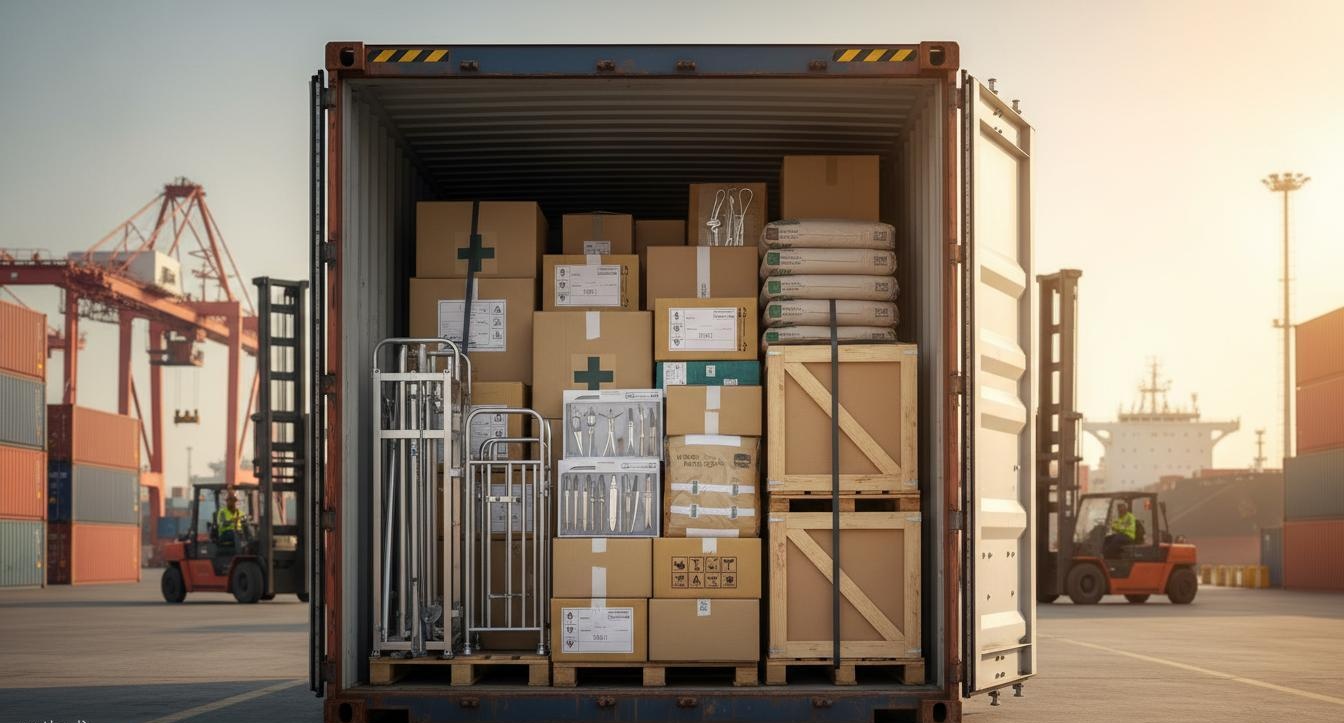
Why Most First-Time Bulk Buyers Order the Wrong Quantity Mix (And the Math Behind It)
Over twelve years of managing Sound Hardware’s export operations, I have seen the same cost mistake made by first-time bulk buyers dozens of times: they order a single SKU that fills a 20GP container — and they pay for 40-60% of the container’s weight capacity that goes unused because that single SKU fills the cube before hitting the weight limit. A 20GP container of AI gun cassettes (plastic, lightweight at ~200g per unit packed) fills 28 CBM with approximately 35,000 units weighing only about 7,000kg — only 33% of the container’s 21,700kg weight capacity. The buyer paid US$2,800 in freight for 28 CBM of space but used only one-third of the weight capacity they also paid for.
The better approach: mix heavy and light SKUs in proportions that fill both the cubic capacity and the weight capacity simultaneously. Example: 15,000 AI gun cassettes (light, 3,000kg, 12 CBM) + 200 cow magnets (heavy, 400kg, 2 CBM) + 300 galvanized drinking bowls with metal frames (heavy, 3,600kg, 6 CBM) + 5,000 veterinary syringes (light, 500kg, 4 CBM) = total 7,500kg and 24 CBM with room for packaging and dunnage to fill to 26,000kg and 28 CBM. The freight cost per unit drops by approximately 30-40% compared to shipping each of these SKUs individually in partial-container LCL shipments, because a single FCL container cost is amortized across all SKUs.
According to World Shipping Council container efficiency data, the optimal mixed-load container achieves 85-95% of both weight and cube capacity — the “dual-fill sweet spot” where neither cubic meters nor kilograms are wasted. At Sound Hardware, we provide dual-fill analysis for every bulk order inquiry because it is the single most impactful cost optimization that most buyers never consider.
Container Loading Optimization: How to Calculate the Ideal SKU Mix for a 20GP
The ideal SKU mix calculation requires four data points per SKU: packed weight per unit, packed dimensions (for cube calculation), cartons per pallet, and total order quantity. The calculation process: (1) list all SKUs with unit weight and unit cube; (2) calculate total weight and total cube for the proposed order quantities; (3) check if total cube exceeds 28 CBM (if yes, reduce quantities or remove low-margin SKUs); (4) check if total weight exceeds 21,700kg (if yes, reduce heavy SKU quantities — weight limit is the harder constraint); (5) if cube is near 28 CBM and weight is far below 21,700kg, add heavy SKUs to use weight capacity; (6) if weight is near 21,700kg and cube is far below 28 CBM, add light SKUs to use cube capacity.
For a typical mixed veterinary equipment order, the realistic achievable utilization is 24-26 CBM and 18,000-21,000kg — the upper 10-15% of capacity is lost to pallet gaps, dunnage bags, and the practical impossibility of perfectly packing irregular-shaped cargo. The remaining freight cost for unfilled capacity (approximately US$300-500 for 2-4 CBM of unused space) is generally acceptable and not worth the complexity of adding more SKU types just to fill marginal cube.
| SKU Type | Unit Weight | Unit Cube | Density (kg/CBM) | Category |
|---|---|---|---|---|
| AI gun cassettes (plastic) | 0.2 kg | 0.0007 CBM | 286 | Light (cube filler) |
| Veterinary syringes (boxed) | 0.05 kg | 0.0003 CBM | 167 | Very light |
| Drinking bowls (plastic) | 1.5 kg | 0.025 CBM | 60 | Medium-light |
| Cow magnets | 0.2 kg | 0.0001 CBM | 2,000 | Very heavy (weight filler) |
| Galvanized drinking bowls | 12 kg | 0.04 CBM | 300 | Heavy (weight filler) |
MOQ Structure for Common Livestock Equipment: AI Guns, Syringes, Cow Magnets and Drinking Bowls
Minimum Order Quantities (MOQs) for livestock equipment reflect the production batch economics of each product category. Products with high mold setup costs (injection-molded plastic components) or minimum raw material purchase quantities (specialty metals for magnets) have higher MOQs than products assembled from standard components.
| Product | Typical MOQ Range | MOQ Driver | Below-MOQ Surcharge |
|---|---|---|---|
| AI guns (complete units) | 50-200 sets | Assembly batch size, mold amortization | +15-25% |
| AI cassette sheaths (disposable) | 1,000-5,000 pcs | Injection mold minimum run | +10-20% |
| Veterinary syringes | 500-1,000 pcs | Assembly line minimum batch | +5-15% |
| Cow magnets | 200-500 pcs | Magnetization batch, raw material MOQ | +10-20% |
| Drinking bowls (plastic) | 100-300 pcs | Mold setup, raw material MOQ | +10-15% |
| Feeding troughs (galvanized) | 20-50 pcs | Sheet metal batch, galvanizing batch | +20-30% |
Combining multiple product types in one order often allows MOQ negotiation — a 3-SKU order totaling 500 units across all types is more attractive to the supplier than three separate orders of 150 units each, and MOQ minimums can often be relaxed for multi-SKU orders where the total production value meets the supplier’s production batch threshold. At Sound Hardware, we routinely accept orders below individual product MOQs when the total order value across multiple SKUs exceeds US$5,000.
Payment Term Negotiation: Why 30/70 Beats 50/50 for First-Time Bulk Buyers
The standard payment structure for first-time bulk livestock equipment orders from China is 30% deposit with order confirmation, 70% balance payment before shipment (after pre-shipment inspection approval). This 30/70 structure balances the supplier’s need for production startup capital (the 30% deposit covers raw material purchase costs) with the buyer’s need for quality assurance leverage (the 70% balance is not released until the goods pass inspection). The alternative 50/50 structure (50% deposit, 50% before shipment) is sometimes requested by suppliers for very large or custom orders, but it gives the buyer less leverage because the supplier has already received half the order value before production begins — reducing the incentive for quality response to inspection findings.
Payment methods for bulk orders: Telegraphic Transfer (T/T) is the standard for amounts above US$5,000 — 30% deposit by T/T, balance by T/T against shipping documents or before shipment. Letter of Credit (L/C) at sight is used for orders above US$50,000 by buyers who want bank-intermediated payment security, though L/C adds approximately 0.5-1.5% in bank fees to the transaction cost and requires precise documentation matching (discrepancies can delay payment by 2-4 weeks). For first-time bulk buyers with orders in the US$10,000-50,000 range, T/T with 30/70 terms provides the best balance of payment security and transaction simplicity. According to ICC Incoterms 2020, payment terms should be explicitly stated in the pro forma invoice and purchase order, not left to oral agreement.
Bulk Discount Tiers: How Volume Commitment Unlocks Better Unit Pricing
Bulk pricing in livestock equipment manufacturing follows a volume-commitment ladder: the larger and longer the volume commitment, the lower the per-unit cost. The discount tiers are driven by production efficiency gains (longer production runs reduce per-unit setup costs) and raw material purchasing leverage (larger raw material orders qualify for supplier volume discounts).
| Volume Tier | Typical Discount vs Sample Price | Commitment Type | Example Order Pattern |
|---|---|---|---|
| Sample/retail (1-50 units) | Base price (no discount) | None | One-off sample order |
| Small bulk (51-500 units) | 5-15% off sample price | Single order | 1 pallet mixed SKUs |
| Container bulk (500-5,000 units) | 15-25% off sample price | Single container | Full 20GP mixed SKUs |
| Multi-container (3+ containers/yr) | 20-30% off sample price | Annual volume commitment | Quarterly container shipments |
| Framework agreement | 25-35% off sample price | Annual contract + forecast | Monthly scheduled production |
The single largest price jump occurs between “sample order” and “container bulk” — typically a 15-25% unit price reduction — because container-scale production eliminates the setup cost overhead that dominates small-batch economics. The transition from container bulk to multi-container commitments provides an additional 5-10% reduction, primarily from raw material purchasing efficiency gains. At Sound Hardware, we publish our volume discount tiers transparently so buyers can plan their purchasing strategy around the tier thresholds.
Quality Assurance Beyond Price: Sample Verification Requirements Before Container Loading
Before a full container ships, the buyer should verify that the production units match the approved reference sample and meet the agreed quality specifications. The verification process: (1) reference sample — the approved pre-production sample that was signed off by the buyer, retained by both the buyer and the supplier, and matched against production units; (2) AQL inspection — a statistical sampling inspection per AQL 2.5 (cosmetic) / 1.0 (functional) of the completed production lot, conducted by the buyer’s appointed inspector or a third-party inspection company; (3) pre-shipment photos — comprehensive photographs of the finished goods, packaging, and container loading, sent to the buyer before the container is sealed; (4) shipping samples — 5-10 random units pulled from the production lot and shipped separately by express courier, arriving before the container so the buyer can physically inspect production quality.
The reference sample is the single most important quality document — all quality disputes are ultimately resolved by comparing the production units to the reference sample. If the reference sample is poorly documented (no photographs, no signed acceptance, no measurement records), the buyer has no objective basis for rejecting production units that differ from expectations. At Sound Hardware, every reference sample is photographed from 6 angles, measured on 12 key dimensions, and signed by both our QC manager and the buyer’s representative (physically or digitally) before production begins. This reference sample protocol has resolved every pre-shipment quality dispute we have encountered over 12 years without escalation to formal arbitration.
According to CSCMP supply chain quality standards, pre-shipment inspection is the most cost-effective quality intervention in international procurement because it prevents quality problems from becoming international logistics problems. For a US$20,000 bulk order, a US$500 pre-shipment inspection is 2.5% of order value and typically prevents quality-related costs (returns, discounts, lost sales) of at least 10-15 times the inspection cost.
Frequently Asked Questions
- Q1: How do I optimize container loading for multiple livestock equipment SKUs?
- Mix heavy SKUs (steel troughs, cow magnets) with light SKUs (plastic syringes, AI sheaths) to fill both weight (21,700kg) and cube (28 CBM) capacity. Calculate each SKU’s weight/volume, check against dual-fill targets, and use standardized pallets (Euro 1200x800mm). Loading sequence: heavy pallets front, light pallets rear. Include loading plan diagram with pallet positions labeled by SKU.
- Q2: What is the typical MOQ for bulk orders of veterinary equipment from China?
- Typical MOQs: AI guns 50-200 sets, syringes 500-1,000 pcs, cow magnets 200-500 pcs, drinking bowls 100-300 pcs, feeding troughs 20-50 pcs. MOQs are driven by production batch economics. Multi-SKU orders can negotiate relaxed MOQs when the total order value meets the supplier’s production threshold (typically US$5,000+).
- Q3: What payment terms are standard for bulk livestock equipment imports?
- Standard payment terms for first-time bulk buyers: 30% T/T deposit with order, 70% T/T balance before shipment (after pre-shipment inspection approval). For orders over US$50,000, Letter of Credit at sight adds bank-intermediated payment security. 50/50 terms give the supplier less quality incentive because they receive more money before production begins.
- Q4: How much can I save with bulk container orders vs LCL shipments?
- Full container (FCL) mixed-SKU orders save 30-40% on per-unit freight cost versus shipping the same SKUs individually in LCL. A 20GP container from Ningbo to Los Angeles costs approximately US$2,800-3,500, amortized across all SKUs. The same volume shipped in 4-5 separate LCL shipments costs US$3,800-5,200 total due to higher per-CBM LCL rates and multiple documentation/clearance fees.
- Q5: What quality verification should I require before my bulk order ships?
- Require: (1) reference sample comparison (production units matched against buyer-approved sample); (2) AQL inspection (2.5 cosmetic/1.0 functional) by buyer’s inspector or third-party; (3) pre-shipment photos of finished goods, packaging, and container loading; (4) shipping samples (5-10 random units sent by express courier arriving before container). Document reference samples with multi-angle photos, measurements, and signed acceptance.
External References: World Shipping Council · ICC Incoterms 2020 · CSCMP · ISM · CIPS · WTO · USITC Tariff Database · FIATA
Useful Links
Post time: May-20-2026