
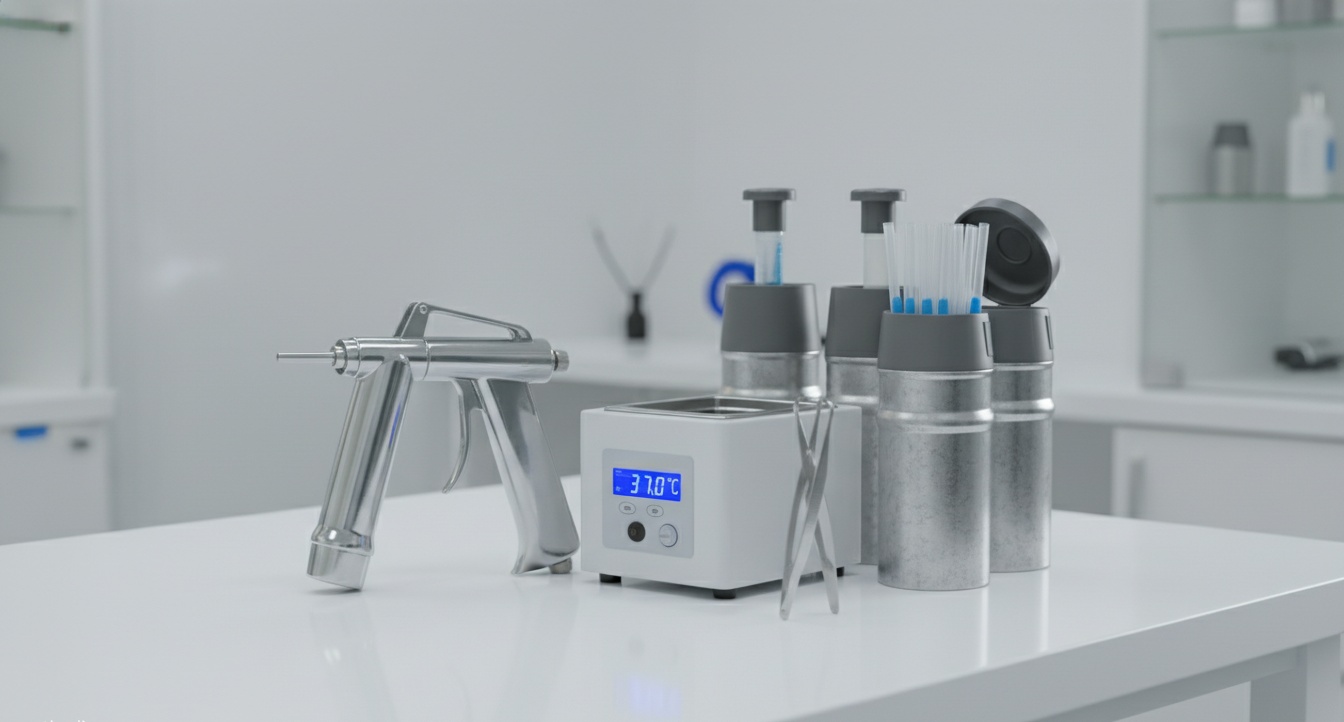
Veterinary clinics and breeding service providers operating at commercial scale face a recurring procurement challenge that directly affects their profitability: sourcing individual AI (artificial insemination) components on a piecemeal basis through multiple suppliers drives up per-unit costs, fragments quality accountability across vendors, and creates inventory management overhead that erodes the economics of high-volume breeding programs. For a clinic servicing 100-head or larger dairy and beef operations, the margin math on piecemeal procurement versus consolidated bundling can mean the difference between a sustainable breeding service revenue stream and an operation that generates technical complexity without commensurate financial return. This article examines how bundling AI guns with semen thaw kits and accessory components at the wholesale level delivers measurable cost and operational advantages for veterinary clinics serving commercial-scale cattle operations.
Industry data from the National Association of Animal Breeders indicates that equipment quality accounts for approximately 8-12% of conception rate variability in commercial AI programs.
The Economics of Bundled AI Equipment Procurement for Scale Operations
When a veterinary clinic sources AI guns, catheters, thaw kits, and semen storage containers through separate supplier relationships, the administrative overhead alone typically adds 8 to 15 percent to the effective landed cost of those items. Each additional supplier relationship introduces its own purchase order processing, quality verification procedures, inbound logistics coordination, and invoice reconciliation. For a clinic that bills on a per-insemination service fee, this overhead directly compresses net margin on every procedure performed.
The FAO animal production service publishes technical guidance on AI equipment standards for developing market procurement.
Wholesale bundling consolidates these inputs — ideally into a single SKU that can be specified, ordered, quality-verified, and received as one line item rather than four or five separate transactions. The Sound AI artificial insemination kit product line is architected for this bundling model, combining the gun, catheters, extenders, and collection and semen thaw components into a coherent, inter-compatible system. The advantage is not merely administrative: a bundled system from a single manufacturer ensures that every component is designed to work with every other component, eliminating the dimensional incompatibilities between products from different manufacturers that can affect conception rates in ways that are difficult to diagnose and attribute.
For clinics that service multiple farms across a regional territory, the reduction in procurement complexity translates into meaningful time savings across the management calendar. More importantly, it reduces the risk of discovering a component incompatibility mid-procedure — an event that wastes a valuable semen straw, creates animal stress from repeated handling, and potentially damages the professional relationship between the clinic and the farm.
AI Gun Construction Standards: Why Precision Engineering Drives Conception Rates
The artificial insemination gun is the most mechanically demanding component in the breeding kit, and it is also the component whose quality most directly affects conception rate outcomes. Its critical functional requirements can be stated precisely: the gun must have sufficient rigidity to navigate the bovine cervical passage without causing mucosal trauma; the barrel must maintain a hermetic seal that prevents semen backflow during insertion and deployment; and the plunger mechanism must deliver the semen charge with controlled deposition at the optimal uterine placement depth, which for most cows is at or near the body of the uterus, approximately 4 to 6 centimeters past the external cervical os.
The Sound AI artificial insemination gun is constructed from veterinary-grade stainless steel and medical-grade polymer components, designed for repeated use with standard clinic sterilization protocols. The gun’s barrel inner diameter is precision-machined to accept standard 0.5 milliliter and 1.0 milliliter semen straws without clearance-induced leakage, and the external barrel diameter is sized to pass through a standard AI sheath or catheter without binding at any point along the cervical passage. These dimensional tolerances matter: a barrel that is even slightly oversized creates resistance during insertion that induces uterine contraction, which shortens the effective placement depth and reduces conception rates in a manner that is difficult to attribute to the gun rather than to semen quality or cow condition.
Wholesale buyers should specify that AI guns meet or exceed the dimensional tolerances defined in the relevant national or international AI equipment standard. In the United States, alignment with guidelines published by the National Association of Animal Breeders (NAAB) provides an established reference framework. In the European Union, compliance with applicable EU veterinary device directives establishes conformance expectations. Confirming dimensional compliance at the procurement stage avoids discovering a non-compatible gun-catheter pairing only after the equipment has been shipped, received, and opened for use.
The gun’s ergonomic design is a performance parameter that is frequently undervalued in procurement decisions. A 500-head dairy with a 55-day voluntary waiting period generates a concentrated insemination workload that may require 15 to 25 inseminations per day during peak periods. A gun with a grip design that causes operator hand fatigue at the 10th procedure will meaningfully degrade placement accuracy by the 15th procedure as the operator’s fine motor control diminishes. Wholesale evaluation of AI guns should include documented operator hand-feel assessment or reference to published usability studies, not just dimensional and material specification sheets. An AI gun that costs 30 percent more but enables a 5 percent conception rate improvement across 500 annual procedures generates substantially more value than the price differential suggests.
Semen Thaw Kit Components and the Critical Importance of Thaw Protocol Precision
The semen thaw process is where many breeding programs unknowingly sacrifice conception rate without recognizing the cause. Frozen semen straws are stored at -196 degrees Celsius in liquid nitrogen, and the thaw protocol must rapidly bring the straw to a precise temperature range — typically 35 to 37 degrees Celsius for 0.5 milliliter straws — without exposing the semen to thermal shock that damages sperm cell membranes or to ice crystal formation that renders the sample unusable.
This is not a minor technical detail. Research in animal reproduction science consistently demonstrates that conception rate variability attributable to thaw protocol errors can range from 5 to 15 percentage points in commercial herds — a range that, across 500 annual procedures at a 30 percent conception rate baseline, represents the difference between 150 and 180 pregnancies per year, or 30 additional calf crops from the same semen inventory and herd.
A semen thaw kit bundled within the AI equipment package includes a controlled-temperature water bath or dry thaw incubator sized for the volume of straws used per breeding session, along with the thaw monitoring tools and semen handling tools required to execute the protocol without error. The digital thermometer must have accuracy of plus or minus 0.1 degrees Celsius — not the plus or minus 1 degree Celsius that is common in general-purpose lab thermometers — because a 0.5-degree error at the thaw temperature threshold is the difference between a fully viable sample and one with compromised motility.
For veterinary clinics operating at commercial scale, the thaw kit’s capacity matters as much as its temperature precision. A single-thaw unit that processes one straw at a time is workable for a small beef operation inseminating 3 to 5 head per week. It becomes a production bottleneck for a dairy clinic handling 20 or more straws per day across multiple farm calls, because each straw’s thaw must be individually timed and the operator must coordinate each thaw with the AI schedule at each stall. Multi-straw thaw baths that process 6 to 12 straws simultaneously at uniform temperature substantially improve throughput without proportional increases in labor time, and they reduce the probability of thaw timing errors by eliminating the cognitive load of managing multiple individual thaw timers.
The Sound AI artificial insemination kit includes thaw-kit components sized for medium-to-high volume operations, with optional expansion modules for clinics that want to scale throughput without upgrading the entire kit. The thaw water bath is designed to maintain temperature uniformity across all straw positions simultaneously, ensuring that no straw is subjected to a different thermal history than its companions in the batch.
Bundling Strategy: Component Architecture for Commercial Breeding Clinics
A properly configured AI equipment bundle for a commercial breeding clinic should include defined quantities and specifications for each component category, with the bundle architecture designed to match the clinic’s actual procedure volume and service territory.
The AI gun itself is the primary durable instrument in the kit. The gun must be autoclavable at 121 degrees Celsius minimum, with documented service life data and a recommended replacement interval based on inspection findings. It must ship with a protective barrel case to prevent deformation or contamination during transport between farm calls — a detail that is sometimes treated as optional and should not be. A bent or contaminated barrel is a silent conception rate killer that can persist for months before being identified as the cause.
Semen straws in 0.5 milliliter or 1.0 milliliter French format are typically supplied separately by the breeding program or semen supplier, so they are not included as standard in the kit. However, the kit must include compatible sheath and catheter components that mate with the gun and that accommodate both straw sizes in use in the target market. Sheath wall thickness, inner diameter, and length are all variables that affect insertion feel and placement precision, and all must be matched to the gun’s barrel geometry.
Semen thaw kit components include the calibrated digital thermometer, thermostatic water bath or dry thaw unit, and precision straw handling forceps that prevent straw damage during extraction from liquid nitrogen goblets. Forceps with inadequate grip surface can crush or crack a straw during extraction, wasting a valuable sample. The forceps should be constructed from materials that tolerate repeated autoclave sterilization without losing grip texture.
Extension and collection sets should include a minimum of 10 to 20 disposable catheters per standard kit order, 5 to 10 disposable syringe extenders, and 3 to 5 collection bottles for programs that perform on-farm semen collection alongside AI services. The kit should include lubricant sachets or bottles sized for the anticipated number of procedures per kit cycle. For a clinic performing 500 inseminations per year with an average of 2 to 3 procedures per farm call, a standard kit should contain sufficient lubricant for 60 to 80 farm calls before replenishment.
Documentation and training materials should accompany the kit as standard. For clinics adding AI services for the first time or expanding into new species, manufacturer-provided protocol documentation reduces the risk of operator error during the first season of use. This documentation should cover recommended thaw protocols per straw format, gun insertion depth guidelines for different uterine conformations, and hygiene and sterilization protocols between uses. Clinics that rely on informal training from sales representatives rather than written protocols frequently develop inconsistent technique that is reflected in variable conception rates across operators and farm locations.
Sterilization, Cross-Contamination Risk, and Biosecurity Management
For veterinary clinics providing AI services across multiple herds, biosecurity risk management is a clinical and liability concern, not merely a quality consideration. An AI gun that has been used in a herd with an undiagnosed infectious condition and that is insufficiently sterilized before use in a subsequent herd can become a vector for pathogen transmission, creating legal liability exposure that far exceeds the value of the equipment involved.
Bundled AI equipment should be specified with materials that tolerate the sterilization methods used in the clinic: autoclavable stainless steel for the gun body, and heat-resistant polymer for components that contact biological tissue. The gun’s reusability specification is a direct cost driver in the total cost of ownership calculation. A gun that requires replacement after 200 to 300 uses due to material degradation or mechanical wear has a much higher per-procedure depreciation cost than a gun rated for 1,000 or more uses with proper maintenance. Wholesale buyers should request the manufacturer’s documented service life data, expressed in number of sterilization cycles, not just the initial purchase price.
For on-farm use where the gun travels between operations, a protective transport case is a non-negotiable accessory. Some bundled kits include this as standard; others list it as an optional add-on at an additional per-unit cost. A clinic comparing kit prices should normalize for this inclusion, because the cost of a transport case is trivial relative to the cost of downtime and replacement if the gun is damaged or contaminated in transit without adequate protection.
The specification should also address the catheter and sheath single-use requirement explicitly. Disposable catheters and sheaths are designed for one-time use precisely to eliminate the cross-contamination risk associated with reuse. Any bundled kit that does not include a sufficient quantity of disposable catheters per procedure for the anticipated workload effectively incentivizes reuse of single-use components under production pressure — a biosecurity hazard that should be designed out of the procurement specification from the beginning.
Regulatory Certification and Compliance for Wholesale AI Equipment
AI equipment imported into most major markets is subject to product-specific regulatory oversight that applies regardless of whether the equipment is used in a veterinary clinical context or an agricultural production context. In the United States, veterinary AI equipment may fall under FDA oversight as applicable to animal health products. In the European Union, it falls under the Veterinary Medicines Directive and associated device regulations. Buyers importing for resale or for use in regulated clinical environments should confirm during the procurement stage that the manufacturer can provide three categories of compliance documentation.
First, a declaration of conformity with the applicable regulatory framework for the destination market, with batch-level traceability back to manufacturing lot records. This document is not a bureaucratic formality: it is the primary instrument that establishes the equipment’s legal status at the point of import, and its absence creates customs delays, storage costs, and potential product seizure.
Second, material safety data sheets for all polymer components that contact biological tissue or semen. These sheets identify the chemical composition of all materials in the device and establish their biocompatibility for their intended use. Without these sheets, the buyer cannot confirm that the materials are safe for their intended application, and regulatory liability for adverse events involving material failure is effectively unlimited.
Third, dimensional certification showing that gun barrels, catheter inner diameters, and sheath inner diameters are within tolerance for the target straw formats in use in the destination market. Straw formats vary by geographic market — the French format 0.5 milliliter straw is standard in most markets outside North America, while the North American 0.5 milliliter straw has slightly different internal dimensions — and equipment designed for one format may not be dimensionally compatible with another without verification.
Manufacturers like Ningbo Beilun Sound Hardware Industrial and Trade Co., Ltd. (Sound AI) with established export experience typically hold these certifications as standard documentation packages for wholesale buyers. Clinics importing equipment without these certifications risk product rejection at customs and potentially significant liability exposure if equipment failure during a procedure results in animal injury, breeding failure, or herd health incident.
Total Cost of Ownership: Beyond the Per-Unit Price Comparison
The total cost of ownership framework for AI equipment bundling should account for four cost categories: the per-procedure cost of consumables including catheters, extenders, and lubricant; the per-use depreciation of the durable gun; the kit’s usable service life in relation to the clinic’s procedure volume; and the labor cost associated with kit preparation and sterilization between procedures.
For a clinic performing 500 inseminations per year, a kit with a 2-year serviceable life and a 2,000 dollar all-in bundle cost breaks down to 2.00 dollars per procedure on the durable components alone. Consumables at 0.80 dollars per procedure bring the direct cost to 2.80 dollars per procedure, against which the clinic bills a service fee that typically ranges from 15 to 35 dollars per procedure depending on market conditions and the farm relationship. The margin per procedure on direct costs alone ranges from 12.20 to 32.20 dollars, which must cover the clinic’s overhead allocation, operator labor, and vehicle costs for farm calls.
By contrast, procuring the same components individually — even at individually lower per-unit prices for some items — typically results in a 3.50 to 4.50 dollars per procedure equivalent cost when labor and logistics overhead are included. This 0.70 to 1.70 dollar per procedure cost disadvantage represents 350 to 850 dollars of annual margin erosion at 500 procedures per year, a figure that does not account for the additional hidden cost of conception rate variability from component incompatibilities that is difficult to quantify but that is likely present in multi-vendor configurations.
Building a Sustainable Wholesale Supply Relationship
For clinics committing to high-volume breeding programs, the procurement relationship with the AI equipment manufacturer or distributor should include structural elements beyond transactional purchase orders.
A sample evaluation protocol before committing to a full kit order is the most important relationship-building step a clinic can take. Request sample units of the gun and thaw bath for operator evaluation across two to three weeks of actual use. This evaluation period identifies ergonomic mismatches, temperature calibration discrepancies, and documentation gaps before they become systemic problems that are embedded in a long-term supply contract.
A consumables replenishment schedule that commits to consistent pricing for 6 to 12 months eliminates the risk of consumable price volatility disrupting the clinic’s margin projections for the contract period. For a clinic with multi-year service contracts with farm clients, consumables price increases passed through to farm clients are at best awkward conversations, and at worst they create contractual disputes.
Technical support access from the manufacturer or distributor in the same time zone and language as the clinic is a meaningful differentiator in the equipment category. When a gun needs service or a thaw bath develops calibration drift, access to a qualified technical resource who can diagnose the issue and provide a resolution path within 24 hours dramatically reduces equipment downtime that would otherwise interrupt the clinic’s service schedule. Reputable manufacturers with established export operations offer remote troubleshooting support as a standard feature for wholesale accounts.
Conclusion
The shift from piecemeal AI component procurement to bundled wholesale AI equipment kits delivers compounding advantages across cost, operational efficiency, and quality consistency for veterinary clinics serving commercial-scale cattle operations. By evaluating kits on their total cost of ownership rather than initial per-unit price, by requiring complete technical documentation and compliance certifications from the supplier, and by establishing a structured supplier relationship that includes evaluation protocols and replenishment commitments, clinics can build procurement strategies that sustain profitable breeding service programs at 100-head scale and beyond. The equipment bundle is not merely a purchasing convenience — it is a foundational infrastructure decision that shapes clinical outcomes, client relationships, and program economics for the duration of the supply relationship.
Frozen Semen Straw Cutter | Continuous Syringe for AI | Veterinary Aluminum Hub Needles
Related Products:
Sound AI Artificial Insemination Gun — Veterinary Grade
Sound AI Artificial Insemination Kit — Complete Bundled Solution
Cattle Artificial Insemination Equipment Catalog
Post time: May-29-2026