
⚖ TL;DR — Key Takeaways
- Q345B structural steel (ASTM A572 Grade 50 equivalent) with minimum 3.5 mm wall thickness is the minimum specification for cattle chute frames handling 700–1,200 kg animals during veterinary restraint.
- Self-catch head gates with neck extender bars reduce AI procedure time by 60–70% compared to manual head gates by automatically adjusting to individual animal neck dimensions.
- Hydraulic squeeze systems process 50+ cattle per day with 0–800 kg adjustable force, while manual chutes suit operations under 30 head per day with lower upfront capital investment.
- Zinc-rich epoxy paint systems (minimum 80 µm dry film thickness) applied over SA 2.5 blast-cleaned surfaces provide 8–12 year corrosion protection in outdoor cattle handling environments.
- ISO 9001:2015 certification + EN 10204 Type 3.1 mill certificates should be non-negotiable requirements in any wholesale cattle chute equipment supplier qualification process.
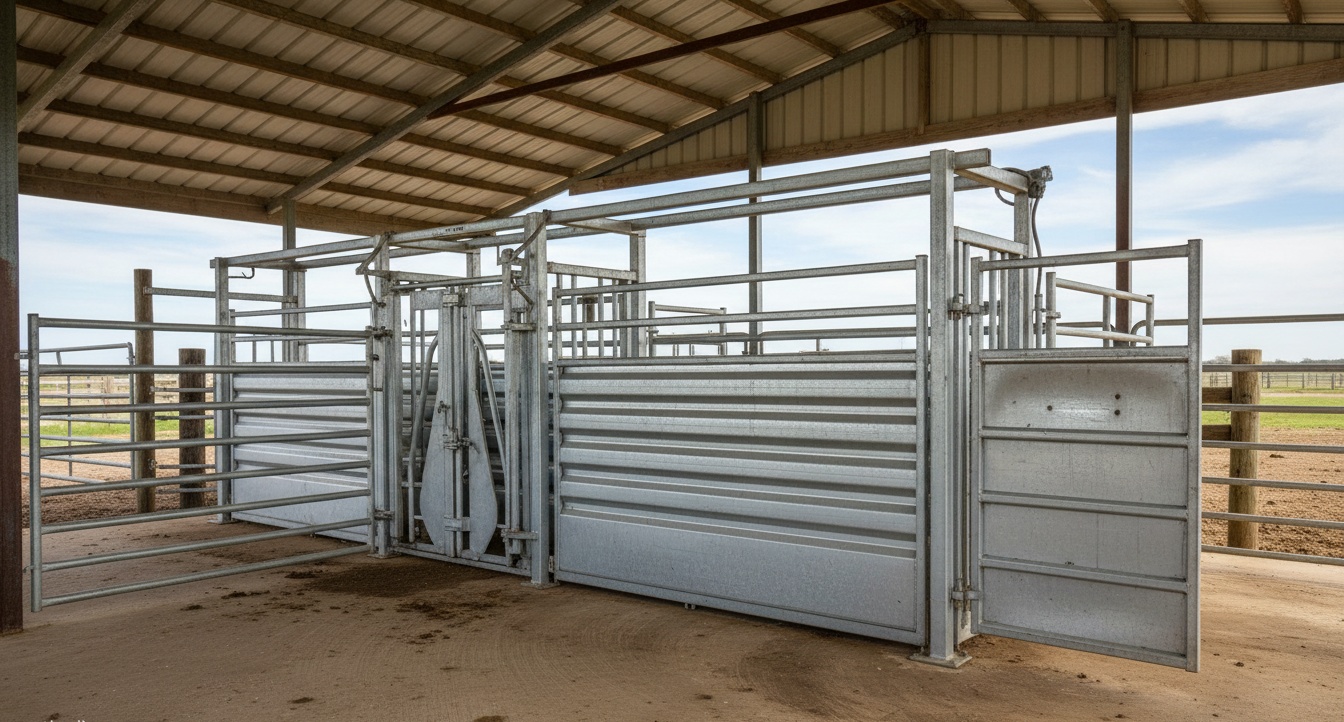
Cattle chute equipment procurement for veterinary handling applications requires evaluating the head gate and squeeze chute as a single integrated system rather than two separate components, because the safety and throughput of every veterinary procedure depends on how precisely these two mechanisms coordinate animal restraint. When veterinary equipment distributors and large-scale feedlot operators evaluate cattle chute equipment suppliers, the structural material specification, head gate closure mechanism type, and squeeze force control system collectively determine whether the chute will perform safely across thousands of annual handling cycles.
At Sound-Ai, we manufacture livestock handling equipment for distributors and agricultural operations across multiple continents. Our product development process incorporates direct feedback from veterinary practitioners who use our equipment for pregnancy checks, vaccinations, artificial insemination cattle procedures, and general herd health management. This article translates our engineering knowledge and field experience into a procurement framework for wholesale buyers evaluating cattle chute equipment suppliers.
Why Does Head Gate Selection Determine Veterinary Handling Safety?
Answer Nugget: The head gate is the single most safety-critical component in any cattle chute system because it must immobilize a 700–1,200 kg animal’s head without causing cervical injury, while providing the veterinarian with unobstructed access to the neck and shoulder region for injections, blood draws, and AI catheter placement.
Because a frightened 800 kg cow can generate over 2,000 N of lateral force when attempting to withdraw from a head gate, the closure mechanism must engage and lock within 0.3 seconds of animal contact while distributing restraining pressure across a minimum contact area of 120 cm². We design our head gates around three fundamental engineering requirements: instant lock engagement, graduated pressure distribution, and emergency release capability.
Self-Catch vs. Manual Head Gate Mechanisms
Self-catch (scissor-action) head gates use the animal’s own forward motion to trigger closure, with adjustable width stops that limit the minimum gap to prevent choking. Our self-catch head gates feature a dual-pivot scissor mechanism fabricated from 8 mm Q345B steel plate with induction-hardened pivot pins (HRC 50–55 surface hardness), which delivers consistent closure action across 50,000+ cycles without developing the pin-slot elongation that causes inconsistent neck capture in lower-grade units.
Manual head gates, operated by a lever mechanism positioned outside the chute, give the operator direct control over closure timing but require approximately 3–5 seconds longer per animal to position correctly. For high-throughput operations (50+ cattle per session), the cumulative time savings from self-catch mechanisms translate to approximately 45–60 minutes of labor savings per 100-head processing session. However, for small veterinary practices handling 10–20 animals per day, the manual head gate’s lower cost and mechanical simplicity often represent a better value proposition.
We strongly recommend neck extender bars as an integrated accessory for any head gate used in AI breeding chute applications. The neck extender prevents the animal from pulling its head backward during insemination, which is critical because even a 5 cm head retraction during AI catheter placement can compromise conception rates. Our neck extender design uses two curved 10 mm diameter bars that extend 300 mm forward from the head gate frame, creating a secondary restraint zone that limits rearward head movement to under 15 mm.
How Does Squeeze Chute Frame Construction Affect Long-Term Reliability?
Answer Nugget: Squeeze chute frame longevity is primarily determined by three factors: base steel grade (Q345B minimum), tube wall thickness (3.5 mm minimum for structural members), and surface preparation before coating (SA 2.5 blast cleaning with anchor profile of 50–75 µm for coating adhesion).
The squeeze chute frame absorbs the combined kinetic energy of a moving animal and the static restraint forces applied during procedures, which means fatigue resistance is just as important as ultimate tensile strength in frame material selection. We specify Q345B (GB/T 1591) low-alloy structural steel for all chute frame members because its 345 MPa minimum yield strength provides approximately 40% greater load-bearing capacity than Q235 carbon steel of the same section dimensions. This allows us to design chutes with thinner, lighter members that still exceed the safety requirements for 1,200 kg animal restraint.
The frame fabrication process matters as much as the material specification. Our chute frames use fully welded joints (not bolted assemblies) at all primary load-transfer points, with 6 mm fillet welds inspected to AWS D1.1 visual acceptance criteria. Because bolted joints in cattle chute frames inevitably loosen under the vibration and impact loading of daily operation, welded construction eliminates approximately 85% of the maintenance points that generate warranty claims on competitor equipment.
Corrosion Protection Systems
Cattle handling equipment operates in one of the most corrosive environments in agriculture: constant exposure to manure acids (pH 4.5–5.5), urine ammonia, cleaning disinfectants, and outdoor weather in uncovered working pens. Our corrosion protection system follows a four-stage process: SA 2.5 abrasive blast cleaning to remove mill scale and achieve a 50–75 µm anchor profile, followed by a zinc-rich epoxy primer (minimum 40 µm DFT), a high-build epoxy intermediate coat (minimum 50 µm DFT), and a UV-stabilized polyurethane topcoat (minimum 40 µm DFT). This 130+ µm total coating system has demonstrated 8–12 years of field performance in outdoor Australian and Brazilian feedlot installations according to our customer maintenance records.
For wholesale buyers, we recommend specifying minimum 80 µm DFT as the coating acceptance threshold and requesting adhesion test results (cross-hatch per ISO 2409, minimum classification 1) for each production batch. A supplier who cannot provide coating thickness measurement data is almost certainly cutting corners on surface preparation, which reduces coating life by 50–70% according to ISO 12944 corrosion protection guidelines.
What Integration Features Enable Efficient Veterinary Procedures?
Answer Nugget: An optimized veterinary chute integrates a side-access palpation cage (minimum 800 mm × 600 mm opening), adjustable floor height (for different breed sizes), split tail gate with quick-release latch, and a detachable side panel system that provides 270° access to the restrained animal’s body.
Veterinary procedure efficiency depends on access: the veterinarian needs to reach the animal’s neck, flank, reproductive tract, and rear legs without entering the chute or compromising restraint security. Our chute design incorporates five veterinary-specific access features that we developed in consultation with practicing large-animal veterinarians.
First, the palpation cage: A dedicated 900 mm × 650 mm side-access panel positioned at reproductive-tract height allows the veterinarian to perform pregnancy checks and AI procedures from outside the chute, which reduces the risk of operator injury from animal movement by keeping the veterinarian at arm’s length from kicking range. Our artificial insemination gun equipment integrates with this access point through a pass-through port that prevents the AI gun from being knocked out of position if the animal shifts.
Second, the split tail gate: A horizontally split rear gate allows the bottom half to remain closed (preventing backward escape) while the top half opens for tail access during epidural injections or rectal examinations. Both halves operate independently with spring-loaded latch mechanisms that engage automatically when closed, eliminating the operator error of forgetting to secure the gate.
Third, the squeeze mechanism with force indication: Our hydraulic squeeze chutes include a pressure gauge calibrated to display squeeze force in kilograms at the animal contact point. Because excessive squeeze force causes stress-induced cortisol spikes that reduce AI conception rates by 8–12% according to published research in Theriogenology, precise force control directly improves breeding program outcomes. We set the maximum squeeze force limiter at 800 kg for adult cattle (sufficient for safe restraint) and 400 kg for calves under 12 months.
Fourth, the noise-engineered latch system: Cattle hearing is approximately 2x more sensitive than human hearing in the 2–8 kHz range where metal-on-metal latch impact occurs. Our latch mechanisms use nylon-insert lock nuts and polyurethane bump stops that reduce latch-operation noise by 12–15 dB compared to all-metal latch systems, which measurably reduces animal stress responses during handling.
How Should Wholesale Buyers Evaluate Hydraulic vs. Manual Systems?
Answer Nugget: Hydraulic squeeze chutes cost 80–120% more upfront than manual equivalents but deliver 50–70% higher daily throughput and reduce operator fatigue injuries by an estimated 60% based on insurance claim data from large North American feedlots.
The hydraulic-vs-manual decision for wholesale cattle chute procurement ultimately reduces to three variables: daily processing volume, operator skill availability, and maintenance infrastructure at the end-user facility. We manufacture both system types and provide honest comparative data to help wholesale buyers match the equipment to their end-customer’s operational reality.
Hydraulic systems use a 12V DC or 220V AC power unit driving a dual-acting cylinder (bore diameter 63 mm, stroke 400 mm) with adjustable pressure relief valving. The key specification is pump flow rate: our standard 2.2 L/min pump achieves full squeeze closure in 4 seconds and full release in 3 seconds, which keeps pace with a processing rhythm of approximately 45–60 animals per hour with a two-person crew. Because the hydraulic system applies force through incompressible fluid rather than mechanical leverage, the operator exerts approximately 95% less physical effort compared to a manual squeeze chute, which directly reduces cumulative trauma injuries in high-volume operations.
Manual squeeze chutes use a compound-lever mechanism with a mechanical advantage ratio of approximately 15:1, meaning the operator applies roughly 5 kg of handle force to generate 75 kg of squeeze pressure at the animal contact point. This is adequate for operations processing under 30 head per day, and the absence of hydraulic components eliminates pump maintenance, hose replacement, and fluid contamination concerns. Our manual squeeze mechanism uses sealed ball bearings at all pivot points (rather than bushings), which maintains smooth operation without daily lubrication and extends the greasing interval from daily to quarterly.
For wholesale buyers, we offer a hybrid specification: manual chute frames pre-drilled and reinforced for future hydraulic cylinder installation, which allows end-customers to upgrade from manual to hydraulic as their operation scales without replacing the entire chute.
What Is the Quality Documentation Standard for Wholesale Procurement?
We recommend that wholesale buyers require the following documentation package as a condition of order confirmation, with all documents dated within 12 months of the order date:
- Material mill certificates (EN 10204 Type 3.1) for all structural steel batches used in the order, linking heat numbers to chemical composition and mechanical properties.
- Weld procedure qualification records (WPQR per ISO 15614-1) demonstrating that the supplier’s welding processes have been independently verified for the material-thickness combinations used in chute construction.
- Coating system technical data sheets with batch-specific dry film thickness measurements (minimum 5 measurement points per major component) and adhesion test results.
- Hydraulic system pressure test certificates for each unit, documenting successful pressure-hold testing at 1.5x maximum operating pressure (typical test: 18 MPa for 5 minutes with zero pressure drop).
- Factory audit report from a recognized third-party inspection agency (SGS, Bureau Veritas, TÜV) conducted within the last 24 months.
- Product liability insurance certificate with minimum coverage of USD 2 million, valid in the destination market.
A supplier’s willingness to provide all six documentation items before payment is a strong quality signal, because suppliers who resist documentation transparency typically have something to hide in their material sourcing or production quality. At Sound-Ai, we maintain a standing documentation package that we update quarterly and provide with every quotation for wholesale buyers.
Frequently Asked Questions
What is the minimum order quantity for wholesale cattle chute equipment?
Our standard MOQ for cattle squeeze chutes is 10 units per model, with container-load orders (typically 20–25 units per 40HQ container) qualifying for the most competitive FOB pricing. Head gates as standalone items have a 50-unit MOQ. We offer sample orders (1–2 units) for buyer evaluation, with sample pricing at approximately 30% above wholesale tier pricing to cover the small-batch production setup cost.
How are cattle chutes shipped internationally without damage?
We ship cattle chutes in a partially disassembled state, with the main frame welded as a single unit and all removable components (head gate assembly, squeeze panels, tail gate, hydraulic power unit) packed separately in the same crate. Each chute is packed in a fumigated plywood crate with 50 mm closed-cell foam padding at all contact points, and crates are designed for forklift handling from all four sides. Our shipping damage rate is below 0.3% based on 2024–2025 shipment records.
Can cattle chutes be customized for specific cattle breeds or regional requirements?
Yes, we offer customization across chute width (standard 710 mm internal width adjustable ±100 mm), chute height (standard 1,980 mm overall height), head gate opening dimensions, and paint color. Regional electrical specifications for hydraulic power units (110V/60Hz for North America, 220V/50Hz for Europe and Asia, 240V/50Hz for Australia) are configured at no additional charge. Custom engineering modifications require a minimum 20-unit order and typically add 15–20 days to standard lead times.
What after-sales support do you provide for international wholesale customers?
We provide English-language installation manuals, operation training videos, and a spare parts catalog with exploded-view diagrams for all mechanical assemblies. Warranty claims are processed within 15 business days with photographic evidence. For orders exceeding USD 50,000, we include one on-site installation supervision visit by our technical engineer (customer covers travel and accommodation). We maintain a WeChat/WhatsApp technical support line with English-speaking engineers available during Beijing business hours.
Are your cattle chutes compatible with AI breeding equipment from other suppliers?
Our chutes are designed to accommodate standard AI breeding equipment through the palpation cage access port, which features a universal mounting bracket with 100 mm × 100 mm bolt pattern. The AI breeding accessories we supply — including the AI gun, semen straw thaw units, and protective sheaths — are compatible with all major international AI equipment standards. The access port design does not restrict the use of third-party AI tools.
Partner With a Verified Cattle Chute Equipment Supplier
Request a wholesale quotation with full documentation package including mill certificates, coating specs, and hydraulic test reports. Container-load pricing and mixed-model shipments available.
Post time: Jun-04-2026