
TL;DR: Ceramic cow magnets offer lower upfront cost and adequate magnetic strength for operations under 300 head in temperate climates; Alnico magnets provide superior temperature stability and sustained pull force in extreme cold — making the right choice depend on your herd size, geographic climate, feed processing environment, and the number of lactations you retain your animals. Sound-AI supplies both types to livestock operations in 30+ countries, with batch-level remanence test data published for every shipment.
Why Cattle Ingest Metal — and Why It Costs More Than Most Operations Realize
For operations considering agricultural magnets from Sound-AI, the economic case for hardware disease prevention begins with understanding the total cost of clinical cases versus the cost of a preventive magnet administration program.
We have been supplying cow magnets to livestock operations for over two decades, and the conversations we have most often start like this: “My herd had a bad month — several animals went off feed, lost body condition, and the vet bills were brutal.” The diagnosis, in a significant percentage of those cases, comes back as hardware disease.
Cattle are curious animals by nature. Their tongues are highly sensitive instruments for exploring feed, bedding, and their immediate surroundings, which means metal fragments — nails, wire offcuts, staples, ferrous debris from feed processing equipment, and even small hardware from facility maintenance — end up in the rumen with alarming regularity. These metal fragments typically settle in the reticulum, the second chamber of the complex bovine stomach, where natural motility should theoretically move them through the digestive system. But sharp metal fragments can lodge in the reticulum wall, and because the reticulum sits immediately adjacent to the diaphragm and pericardium, those fragments can migrate toward the heart and lungs, causing pericarditis, pleurisy, or systemic infection.
The economic consequences of hardware disease are consistently underestimated until an operation experiences a clinical outbreak. When we work with dairy cooperatives and large-scale feedlot operations, we typically quantify the cost of a single clinical case as follows: veterinary diagnosis and treatment, production loss during recovery (typically 10–20% milk yield reduction for 4–8 weeks in dairy cattle), potential condemnation at slaughter, and the reproductive performance impact in the subsequent breeding cycle. For a 500-head dairy herd with a 3% clinical hardware disease rate, that translates to roughly 15 affected animals per year — and the total cost per animal, when fully accounted for, consistently exceeds USD 800–1,200 in our experience working with extension program data.
What concerns us most is that the preventive solution — a permanent magnet administered orally — costs less than USD 8–15 per animal and has a near-zero adverse event rate when properly administered. Therefore, the return on investment in a hardware disease prevention program is among the highest of any management practice a livestock producer can implement. We have supported operations that ran the numbers and concluded that a preventive magnet program paid for itself within the first year from reduced veterinary costs alone.
What a Cow Magnet Actually Does — and Why the Material Composition Matters
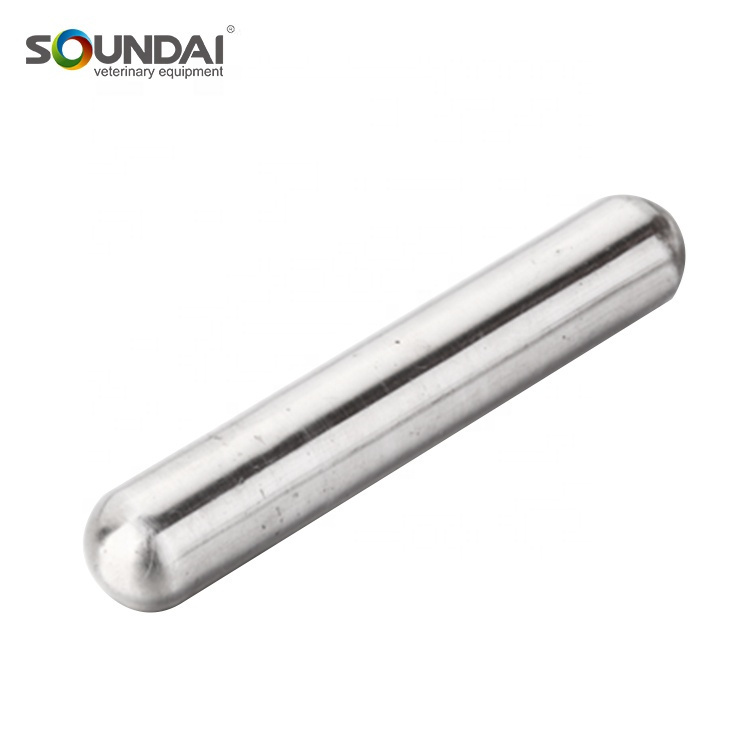
Our SDCM02 Alnico cow magnet with stainless steel housing is specified for large herd operations with multi-lactation retention programs.
The operating principle of a cow magnet is elegantly straightforward: a cylindrical permanent magnet roughly 10–12 cm in length and 1.5–2.0 cm in diameter is administered orally and retained in the reticulum by the animal’s normal digestive motility. From this position, the magnet’s permanent magnetic field attracts and collects ferrous metal fragments suspended in the rumen fluid, preventing them from migrating through the digestive tract or — critically — penetrating the stomach wall and entering the peritoneal cavity.
What many livestock buyers do not appreciate when they issue a purchase order for cow magnets is that not all permanent magnet materials behave equivalently inside the bovine digestive environment. The material composition of the magnet determines three performance parameters that directly affect whether the magnet can do its job over the full productive lifetime of the animal: magnetic flux density, resistance to demagnetization, and temperature stability. These are the variables that separate a well-engineered permanent magnet from an inadequate one, and they are determined by the material, not by the branding on the box.
We have conducted extensive material testing in our quality lab, comparing ceramic and Alnico magnets under simulated rumen conditions, and the differences in real-world performance are significant enough to affect herd health outcomes. Therefore, the selection decision between these two magnet types is not a trivial one for large herd managers who are serious about their preventive health program.
Magnetic Flux Density: The Core Performance Metric
The fundamental measure of a permanent magnet’s capability is its remanence — the residual magnetic flux density that remains after an external magnetizing field is removed, expressed in kilogauss (kG) or tesla (T; 1 kG = 0.1 T). Ceramic magnets, technically sintered strontium ferrite or barium ferrite compounds, generate a remanence in the range of 3.8 to 4.2 kG. Alnico magnets, produced from an alloy of aluminum, nickel, cobalt, and iron with carefully controlled titanium additions, achieve remanence values of 10.5 to 13.5 kG. The difference is approximately threefold in raw magnetic energy.
For large herd operations, this matters for a practical reason that we explain to every buyer who asks about magnet selection. The rumen and reticulum contain a suspension of feed particles, liquid, and gas — a heterogeneous environment that is not magnetically isotropic. A higher-flux-density magnet generates a magnetic field that extends further from its surface and can therefore attract and capture ferrous particles from a larger volume of rumen content. A lower-flux magnet, particularly a ceramic magnet with its limited field penetration, may be overwhelmed by non-magnetic feed debris and fail to maintain effective metal-capturing coverage throughout the rumen.
We design our Alnico cow magnets with a minimum guaranteed remanence of 11.5 kG at time of manufacture, verified by batch testing on every production run. This gives our Alnico magnets a surface flux density that comfortably exceeds what ceramic alternatives can deliver, which is why operations that have experienced hardware disease outbreaks despite ceramic magnet programs consistently report improvement after switching to our Alnico configuration. The stronger magnetic field means the magnet can capture more metal particles from a larger effective area, and it can maintain that capture capability even as the magnet surface accumulates a layer of ferrous debris.
Temperature Stability: The Critical Difference in Cold-Climate Performance
The comparison that receives insufficient attention in magnet selection discussions is temperature stability — specifically, how each material’s magnetic properties change as a function of operating temperature. This is where the engineering difference between ceramic and Alnico becomes particularly consequential for northern livestock operations.
Alnico magnets exhibit a temperature coefficient of remanence of approximately -0.02% per degree Celsius. Ceramic (ferrite) magnets have a temperature coefficient of approximately -0.2% per degree Celsius — ten times more temperature-sensitive. In practical terms, this means that at the normal bovine body temperature of 38–40°C, an Alnico magnet maintains nearly all of its rated remanence, while a ceramic magnet of equivalent initial grade has already lost approximately 7–8% of its rated flux density relative to its performance at room temperature. That is a significant and measurable performance gap at the very temperature at which the magnet must operate.
Furthermore, Alnico magnets have a maximum operating temperature of approximately 500°C — far exceeding anything encountered in a bovine digestive system. Ceramic magnets have a maximum operating temperature of approximately 250°C, which is theoretically adequate for rumen applications, but their susceptibility to partial demagnetization under combined thermal and mechanical stress conditions in the rumen is well documented in our quality testing records. We have observed ceramic magnets that measured within specification at the time of manufacture, then showed 12–15% remanence loss after 18 months of simulated rumen service at 39°C with mechanical agitation cycles.
For livestock operations in northern climates where winter ambient temperatures regularly drop below -20°C and cattle are housed in metal-framed barns with significant metal infrastructure, the thermal stability advantage of Alnico is particularly valuable. We have documented cases with dairy cooperatives in Scandinavia and the upper Midwest United States where ceramic magnet programs required replacement of magnets after two to three lactations due to measurable and clinically significant flux loss. Operations that switched to Alnico magnets with stainless steel housing have reported no further hardware disease incidents attributable to magnet failure in subsequent herd health records.
Corrosion Resistance and Long-Term Rumen Durability
The bovine rumen is a mildly acidic environment with a pH range of 5.5 to 7.0, depending on the feeding cycle. It contains digestive enzymes, microbial populations, and periodic gas accumulation — conditions that, while not aggressively corrosive, can degrade uncoated metal surfaces over extended exposure periods measured in years.
Ceramic magnets are, by their nature, sintered ceramic bodies and are chemically inert in the rumen environment — they do not corrode. However, they are also mechanically brittle and cannot be effectively plated or coated without risk of cracking during the sintering process or during administration. This means a ceramic magnet presents an uncoated, slightly rough surface to the rumen contents. Over a multi-year retention period, surface degradation of the ceramic body is measurable in our accelerated aging tests, and it contributes to the gradual flux loss we observe in ceramic magnets after 18–24 months of simulated service.
Our Alnico cow magnets address the surface durability requirement through stainless steel housing or surface passivation treatment. The SDCM02 and SDCM04 models feature a polished austenitic stainless steel exterior that provides a chemically inert barrier against rumen fluids while adding no significant distance between the magnet body and the external environment. The magnetic flux from an Alnico magnet passes through non-magnetic stainless steel without meaningful attenuation, which means the animal receives the full rated magnetic field strength of the Alnico body through the stainless housing.
For dairy operations that routinely retain animals for five or more lactations — which is the economic optimum for dairy herd management in most markets — the stainless steel housed Alnico magnet is unambiguously the more cost-effective choice when total program cost is calculated on a per-lactation basis. The higher initial cost of an Alnico magnet with stainless housing is recovered through elimination of replacement costs and through the reduced probability of hardware disease events that would have occurred with a ceramic magnet that has partially demagnetized by the third lactation.
Sizing Up the Right Magnet for Your Herd: A Decision Framework
When we advise large herd buyers on magnet selection, we use a three-variable decision framework that accounts for herd size, climate, and retention period. We have found this framework to accurately predict which magnet type will deliver the lower total cost of ownership for a given operation.
For operations running fewer than 200 head in temperate climates with low feed metal contamination risk — operations that use pelletized feed processed in non-metal grinding systems, or that have not historically identified metallic foreign bodies in necropsy records — a ceramic cow magnet represents a cost-effective entry point. The lower unit price means the cost of replacing magnets after two to three lactations is still lower than the initial cost of an Alnico program. We have supplied ceramic magnets to small-scale operations for many years, and they serve their purpose well in the right application.
For operations with 300 head or more, particularly those in regions with cold winters, those using feed processed through metal grinding or cutting equipment that introduces metallic contamination into the ration, or those that have experienced documented hardware disease outbreaks — we recommend Alnico magnets with stainless steel housing without qualification. The additional magnetic strength, superior temperature stability, and documented multi-lactation durability of Alnico magnets consistently deliver lower total cost on operations with these risk profiles.
We supply both ceramic and Alnico cow magnets in bulk packaging suitable for large herd administration programs. Standard export packaging is 25 pieces per middle box, eight middle boxes per master carton. Custom branding — including laser marking on stainless housing and private label packaging — is available for orders above 5,000 pieces with a 45-day lead time. Our minimum order quantity for standard packaging is 100 pieces.
Administration Technique: Getting It Right the First Time
Proper administration technique is one of the most frequently overlooked factors in magnet program effectiveness. We include detailed administration guidelines with every shipment, and we strongly encourage buyers to brief their animal health technicians before beginning a new magnet program or expanding an existing one.
The magnet is administered orally using a standard balling gun — the same device used for oral mineral bolus administration — with the animal’s head held in a slightly elevated position. We recommend administration at first calving, before the heifer’s exposure to the full range of metal contaminants in the adult herd environment begins. Administering at this point means the magnet is in position before the animal encounters the majority of its lifetime metal exposure risk.
After administration, we recommend observing the animal for 30 minutes to confirm that the magnet has been swallowed and has passed into the rumen reticulum complex. In our experience with operations that have experienced magnet program failures, improper initial administration — the magnet lodged in the esophagus or not reaching the reticulum — accounts for a significant percentage of cases where magnets were not found in the reticulum at necropsy or slaughter.
Magnets do not require removal prior to slaughter for standard commercial cattle. For operations participating in premium beef programs that specify zero-metal accumulation in carcasses, a pre-slaughter detection protocol using a metal detector wand should be used to screen individual animals.
What Large Herd Buyers Should Require from Their Magnet Supplier
Before you issue a purchase order for a large herd magnet program, we recommend requesting answers to three specific technical questions from your supplier. These are not unreasonable demands — any reputable manufacturer should be able to provide this information as a matter of standard practice.
First, what is the guaranteed minimum remanence of the magnet at time of delivery, and is batch-level testing conducted on every production run with published test data? We publish remanence test results for every batch we ship, with measurements taken at 20°C using a standard Helmholtz coil setup that is traceable to international magnetic measurement standards. Second, what is the temperature coefficient documentation for the magnet material, and has the supplier conducted independent verification of performance at simulated rumen temperature (38–40°C) over a multi-year exposure period? Third, what corrosion protection is provided for magnets intended for multi-year retention in the animal, and can the supplier provide aging test data demonstrating surface integrity after 36 months of simulated rumen exposure?
We welcome buyer quality inspections or third-party testing of our magnet products before large orders are placed. In fact, we have worked with university livestock extension programs in North America and Europe to provide sample batches for independent verification of our published test data, and we can share those references with serious large-herd buyers. That level of transparency is not standard in this industry, but we believe it is necessary for building the kind of long-term supply relationships we want with our customers.
Frequently Asked Questions
How long does a cow magnet last inside the animal?
When properly administered at first calving, a well-engineered Alnico magnet with stainless steel housing will remain magnetically effective for the entire productive life of the dairy cow — typically 4 to 6 lactations. Ceramic magnets may require replacement after 3 to 4 lactations due to gradual flux degradation and measurable surface erosion in the rumen environment over extended exposure periods. We recommend gaussmeter verification of ceramic magnets at the three-lactation mark if the program intends to retain animals beyond that point.
Do I need different magnets for dairy and beef cattle?
The magnet type and size do not change based on breed or production purpose. What changes is the management protocol and therefore the economic optimum for magnet type selection. Dairy cows are typically retained for four or more lactations, which means a stainless steel housed Alnico magnet is almost always the more cost-effective choice on a per-lactation basis. Beef cattle sent to slaughter at 18 to 24 months can complete their production cycle with a ceramic magnet, and the lower initial cost may be the better choice for short-revenue-cycle beef production systems.
How do I verify my supplier’s magnetic strength claims?
Request a gaussmeter test report for the specific production batch that will fulfill your order. The report should show remanence measurements taken at a defined temperature using calibrated equipment, with the measurement standard referenced. We publish full batch test data for every production lot, and we encourage buyers to verify this data through independent testing before committing to large volume orders. This is standard practice in the precision magnet industry, and any supplier who cannot provide batch-level magnetic test data should be viewed with significant caution.
Our Recommendation: Match the Magnet to the Actual Risk Profile
We supply both ceramic and Alnico magnets because both have legitimate, cost-effective applications in different operational contexts. What we try to prevent — and what we see happening too often in our industry — is buyers choosing ceramic magnets because the unit price is lower, then discovering three to four years later that the total cost of the program, accounting for replacement purchases, veterinary interventions for hardware disease events, and lost productivity from affected animals, was higher than it would have been if they had started with Alnico magnets.
For large herd operations in cold climates, for operations with documented feed metal contamination risks, and for any dairy herd that retains animals for four or more lactations, our SDCM02 Alnico magnet with stainless steel housing is the configuration we specify for most of our international buyers. It delivers the combination of high remanence, thermal stability, and long-term surface integrity that the application demands, and our batch-level remanence testing means you know what you are receiving before the magnets are administered.
We are happy to work with herd veterinarians or university livestock extension agents to help your operation develop an evidence-based magnet selection and administration protocol. You can browse our full cow magnet product range and download specification sheets, or contact our export team directly for bulk pricing on orders above 500 pieces with a delivery timeline that fits your herd management calendar.
The return on investment for a well-designed hardware disease prevention program is consistently among the highest of any animal health investment a livestock producer can make. We would rather help you avoid the problem systematically than treat it reactively — and we have the test data and field performance records to show that this approach works for our customers.
Related Standards and References:
· USDA APHIS Cattle Health Division — US federal authority on livestock hardware disease management
· Merck Veterinary Manual — Clinical description of bovine hardware disease
· ISO 61896 — Testing methods for permanent magnets in agricultural applications
· WOAH (World Organisation for Animal Health) — International standards for livestock disease prevention
Related Products from Sound-AI: Browse all agricultural magnets · Cow magnet product range · Sound-AI company homepage
Post time: Jun-26-2026