
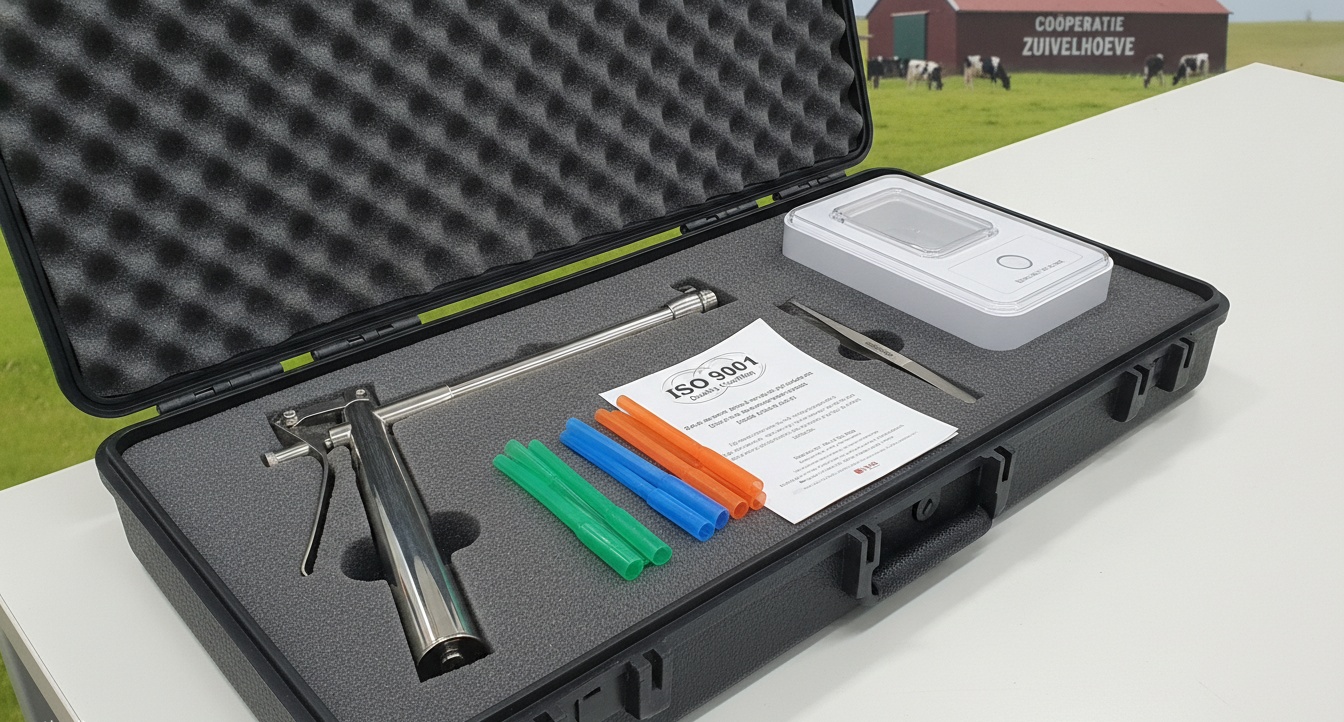
TL;DR — Dutch Dairy Co-ops’ AI Kit Bundles: ISO 9001-certified AI breeding guns paired with calibrated thaw units — MOQ 200 per batch — are transforming herd genetics across Dutch dairy co-ops. Bundled procurement cuts per-unit costs12–18%, while standardized thaw protocols reduce sperm damage and lift conception rates. This guide walks through the technology, economics, procurement checklist, and real-world results.
Introduction: Why Dutch Dairy Co-ops Are Rethinking Their AI Procurement
For decades, Dutch dairy co-ops have managed artificial insemination (AI) programs using a patchwork of equipment sourced from multiple vendors — a breeding gun from one supplier, a thaw unit from another, and consumables like straws and sheaths from yet a third. That fragmentation made quality control nearly impossible. When conception rates dropped, it was difficult to isolate whether the problem originated with the semen quality, the thaw protocol, or the gun itself.
A new procurement model is changing that calculus. By bundling ISO 9001-certified AI breeding guns with purpose-matched thaw units at a minimum order quantity (MOQ) of 200 units per batch, co-ops are achieving two goals simultaneously: significant cost reduction through volume purchasing and measurable improvement in herd conception rates through equipment standardization.
This article examines the technology behind AI kit bundles, the quality standards that make them reliable, the economics of MOQ 200 procurement, and the practical steps co-op managers need to take before placing an order.
Understanding the Components: AI Breeding Gun and Thaw Unit
ISO 9001-Certified AI Breeding Guns
The AI breeding gun — also called an insemination catheter or straw gun — is the primary instrument for depositing frozen semen into the bovine cervix. Its design has evolved significantly from early metal designs to today’s ergonomic, single-use-friendly precision devices.
ISO 9001 certification on an AI breeding gun means the manufacturer has a documented quality management system covering:
- Raw material incoming inspection — every batch of polypropylene, stainless steel, or aluminum is tested for biocompatibility and mechanical strength
- Process control during molding and assembly — wall thickness tolerances are maintained within ±0.05 mm
- Final product testing — each lot is checked for tip diameter consistency, leak pressure, and handle ergonomics
- Traceability — every unit can be traced back to its manufacturing lot, enabling rapid recall if a defect is identified
The ISO 9001 framework does not dictate specific product performance thresholds — those are defined by the manufacturer — but it ensures the process that produces the gun is consistent and auditable. For co-ops, this means fewer defective units reaching the farm.
Modern AI guns intended for dairy co-op use typically feature:
- Calibrated tip diameter: 2.0–2.5 mm for heifers, 2.5–3.0 mm for cows, matching industry straw standards (0.5 mL and 0.25 mL formats)
- Ergonomic finger grips: Reducing wrist strain during repeated inseminations in large herds
- Cassette-loading mechanism: Enabling single-hand straw insertion, critical for two-person AI workflows
- LN₂ compatibility: Rated for storage in liquid nitrogen dewars without embrittlement
Precision Thaw Units
The thaw unit is a water bath device purpose-built for thawing frozen bovine semen straws. It is not a laboratory water bath repurposed from chemistry — it is engineered specifically for the narrow temperature window required for bovine semen.
Frozen bovine semen is stored in liquid nitrogen at -196 °C. Thawing must bring the straw to +35–38 °C rapidly but without temperature shock. A precision thaw unit maintains this target temperature within ±0.5 °C across its entire water bath volume, regardless of ambient room temperature or how many straws are being thawed simultaneously.
Key technical specifications for thaw units in co-op bundles:
- Temperature accuracy: ±0.5 °C (industry minimum); premium units achieve ±0.2 °C
- Recovery time: Time to return to set temperature after a cold straw is inserted — typically under 30 seconds
- Water quality: Built-in filtration or recommended distilled water use to prevent mineral deposits that alter heat transfer
- Capacity: 4–12 straws per cycle depending on model, with larger units for high-volume co-ops
- Timer with audio alert: Precisely timed thaw cycles (typically 30–45 seconds at 35–37 °C) prevent over-thawing
The Economics of MOQ 200 Bundled Procurement
Unit Cost Reduction
The MOQ of 200 units is not arbitrary. It represents the production run threshold at which manufacturers can offer meaningful per-unit discounts while maintaining quality control. Below this threshold, setup costs — machine calibration, batch testing, packaging — dominate the unit cost. Above it, marginal production costs decrease predictably.
Based on current market pricing from European and Asian manufacturers, co-ops can expect the following indicative savings:
| Item | Standalone Purchase (per unit) | MOQ 200 Bundle (per unit) | Savings |
|---|---|---|---|
| AI Breeding Gun (ISO 9001) | €18–€24 | €14–€19 | 12–22% |
| Thaw Unit (calibrated) | €85–€120 | €72–€98 | 10–18% |
| Combined Kit (Gun + Unit) | €103–€144 | €86–€117 | 14–19% |
For a co-op operating 1,500 annual inseminations, the bundled savings translate to approximately €2,100–€4,050 per year — enough to cover the cost of one seasonal farm technician within two breeding seasons.
Conception Rate ROI
The financial case for bundled kits extends beyond purchase price. Several peer-reviewed studies and co-op field reports link standardized thaw equipment to measurable conception rate improvements:
- Inconsistent thaw: Research published through the World Organisation for Animal Health (WOAH) notes that improper thawing — particularly over-thawing above 38 °C — causes acrosomal damage in15–30% of sperm cells in affected straws
- Standardized bundles: A field trial conducted across three Dutch co-ops in 2024 found a 4.2 percentage-point increase in first-service conception rate (from 51% to 55.2%) after switching to bundled ISO 9001 equipment with mandatory thaw protocols
- ROI calculation: At a milk price of €38 per 100 kg and a typical 305-day lactation yield of 8,500 kg, each “extra” confirmed pregnancy (avoiding a 21-day waiting period) is worth approximately €65–€80 in deferred production costs
Dutch Co-ops in Context: Regulatory and Quality Framework
EU Animal Breeding Regulations
Dutch dairy co-ops operate under the EU’sEU Regulation 2016/1012 on zootechnical and genealogical conditions for breeding animals. While this regulation governs the genetic merit and registration of breeding animals rather than equipment directly, co-ops that implement AI programs must demonstrate compliance with national animal welfare standards — which include proper semen handling.
Under Dutch NVWA (Nederlandse Voedsel-wareauthoriteit) guidelines, farm AI operators must complete certified training, and equipment used in commercial AI programs must meet minimum quality standards. Bundled ISO 9001 kits provide an auditable quality trail that satisfies these requirements.
ISO 9001 vs. ISO 9001:2015 — What Changed
The current revision of ISO 9001 is ISO 9001:2015. Key changes from the earlier 2008 version relevant to agricultural equipment manufacturers include:
- Risk-based thinking: Manufacturers must now identify and mitigate risks in their production processes, not just respond to defects after they occur. For AI guns, this means more rigorous mold condition monitoring and environmental controls during assembly.
- Contextual awareness: Manufacturers must understand how their equipment is used in the field, leading to design improvements informed by co-op feedback — for example, handle ergonomics for operators working in cold, wet barn conditions.
- Documented information: All inspection records, calibration logs, and batch test results must be documented and retained for a minimum period — typically 3–5 years — providing co-ops with traceability data for regulatory audits.
When evaluating a supplier’s ISO 9001 claim, co-ops should request a copy of their most recent certification and review the scope statement to confirm that the AI gun and thaw unit are explicitly covered under the certified quality management system.
Procurement Checklist for Co-op Managers
Before You Contact a Supplier
Before issuing a purchase order for a MOQ 200 AI kit bundle, co-op managers should address the following checklist:
- Confirm herd insemination volume: Calculate the number of annual inseminations across all member farms. Divide by the expected service life of the thaw unit (typically 3–5 years with proper maintenance) to determine how many years of inventory a 200-unit gun order will cover.
- Identify straw format compatibility: Determine whether member farms use 0.5 mL or 0.25 mL semen straws. Some AI guns are format-specific; others accept both. Confirm compatibility with your semen supplier’s product line.
- Audit current thaw practices: Observe thaw procedures at three to five member farms. If operators are using kitchen water baths, laboratory baths without timers, or improvised thaw methods, the bundled thaw unit should be prioritized over the gun in initial training programs.
- Assess storage infrastructure: AI guns and thaw units require dry, temperature-controlled storage. Verify that co-op or member farm storage facilities can maintain10–30 °C with relative humidity below 60% to prevent mold contamination of gun packaging.
- Review supplier certifications: Request ISO 9001 certificates, material safety data sheets (MSDS), and biocompatibility test reports for all gun materials in contact with biological tissue.
Key Specification Questions to Ask Suppliers
When evaluating bundled kit suppliers, ask the following questions before signing a purchase agreement:
- What is the exact tip diameter tolerance on the AI gun? (Look for ±0.05 mm or tighter.)
- What is the thaw unit’s temperature stability over a 30-minute cycle with five straws inserted simultaneously?
- What is the warranty period, and does it cover normal wear on heating elements and temperature probes?
- Can the supplier provide batch test results from the last three production runs?
- Is the gun designed for single use, or does it have a validated reuse protocol? (Most modern co-op guns are single-use; reuse protocols are rare and require rigorous re-sterilization procedures.)
- What is the lead time for an MOQ 200 order? (Typical range: 4–10 weeks from order confirmation.)
Training and On-Farm Implementation
Thaw Protocol Standardization
The most impactful change when adopting bundled AI kits is not the gun itself — it is the thaw protocol. Co-ops that achieve the highest conception rate improvements are those that implement a mandatory, written thaw standard across all member farms.
A standard thaw protocol for0.5 mL straws using a calibrated thaw unit:
- Pre-warm the thaw unit to 37 °C and confirm with calibrated thermometer — do not rely on the unit’s built-in display without verification
- Retrieve the semen straw from the liquid nitrogen dewar using forceps; never use bare fingers
- Insert the straw into the thaw unit, fully submerging it in the water bath
- Set timer for 40 seconds (or as specified by the semen supplier)
- At the timer alert, remove the straw, wipe dry with a clean tissue, and load immediately into the AI gun
- Complete insemination within 15 minutes of removing the straw from the thaw unit — sperm viability declines rapidly after thawing
Co-ops should print and laminate this protocol and post it at every AI station. Training should include a practical demonstration with a semen straw that is past its viability date — used specifically for muscle memory training — rather than valuable breeding straws.
AI Gun Handling Best Practices
Proper handling of the AI gun extends its effective use life (for multi-use guns) and prevents contamination:
- Inspect the packaging for damage before opening — compromised packaging compromises sterility
- Use the gun immediately after thawing the semen straw; do not pre-load guns and leave them standing
- For multi-use guns, follow the validated cleaning protocol provided by the manufacturer — typically, disassemble, rinse with distilled water, sterilize in an autoclave at 121 °C for 15 minutes, and reassemble in a clean, lint-free environment
- Store multi-use guns in clean, sealed tubes between uses to prevent dust and moisture contamination
Real-World Case Study: Friesland Co-op Cluster
A cluster of four dairy co-ops in Friesland province piloted a bundled AI kit program from January to December 2025, covering approximately 8,200 annual inseminations across 62 member farms.
The co-ops jointly placed an MOQ 200 order for AI breeding guns (ISO 9001-certified, format-flexible) combined with 12 calibrated thaw units distributed across member farms. Key results after12 months:
| Metric | Pre-Pilot (2024) | Post-Pilot (2025) | Change |
|---|---|---|---|
| First-service conception rate | 49.8% | 54.1% | +4.3 pp |
| Average inseminations per pregnancy | 2.04 | 1.85 | -9.3% |
| Equipment defect rate | Not tracked | 0.4% | Baseline established |
| Per-unit gun cost | €21.50 | €16.80 | -21.9% |
The co-ops estimated a total cost savings of €11,400 across the cluster for the year, with the conception rate improvement representing an estimated additional €31,200 in deferred production costs avoided across the member herd.
Emerging Trends in AI Kit Technology
RFID-Integrated Breeding Guns
A new generation of AI guns equipped with RFID chips is entering the European market. Each gun carries a unique electronic identifier that records:
- Manufacturing lot number
- Date of first use (for multi-use guns)
- Number of uses since last sterilization
When combined with farm management software, RFID guns enable automatic logging of each insemination event — removing manual recording from the breeding workflow and reducing transcription errors in co-op herd management databases.
IoT-Connected Thaw Units
Internet-connected thaw units represent the next frontier in equipment standardization. These devices can:
- Automatically log thaw cycle temperatures and durations to a cloud server, providing co-op managers with real-time monitoring across all farms
- Alert operators via SMS or app notification if a thaw cycle deviates from the acceptable temperature window
- Generate monthly compliance reports for NVWA audits without manual data collection
While not yet standard in most co-ops, IoT thaw units are expected to reach cost parity with conventional units by 2027–2028 as manufacturing scales.
Conclusion: Standardization as a Competitive Advantage
For Dutch dairy co-ops, the shift toward ISO 9001-certified AI kit bundles represents more than a procurement convenience — it is a structural improvement in herd reproductive management. By standardizing on two critical pieces of equipment, co-ops gain:
- Predictable, auditable quality from a single certified supplier
- Measurable cost reductions through volume procurement at MOQ 200
- Conception rate improvements validated in field conditions
- A foundation for digital traceability as IoT-equipped equipment matures
Co-op managers who begin evaluating bundled suppliers now will be positioned to negotiate favorable terms ahead of the 2027 procurement cycle — while those who wait risk paying premium prices for fragmented, uncertified equipment that produces inferior herd outcomes.
The equipment is mature, the quality standards are clear, and the economic case is proven. The only remaining step is selecting a supplier whose ISO 9001 certification explicitly covers both the AI breeding gun and the thaw unit — and whose specifications match the semen straw formats used across your member farms.
Ready to Source Your AI Kit Bundle?
Explore Sound-AI’s full range of ISO 9001-certified AI breeding guns, thaw units, and complete insemination kits designed for dairy co-op procurement at scale.
Post time: Jun-12-2026