
Livestock Artificial Insemination Equipment Guide
TL;DR
- Proper AI equipment improves conception rates by protecting semen quality, improving hygiene, and supporting accurate insemination technique.
- Farms should match AI guns, sheaths, gloves, thawing tools, semen containers, and hygiene accessories to their livestock species and workflow.
- B2B buyers should evaluate a livestock AI kit supplier by product consistency, packaging, spare parts, documentation, and repeat-order support.
When a farm struggles with inconsistent conception, the cause is often not one dramatic failure. It is usually a chain of small losses: semen exposed to the wrong temperature, sheaths handled without clean procedure, AI guns that do not fit well, operators working with poor gloves, or kits that are missing essential accessories. Each issue may look minor alone. Together, they reduce confidence in the breeding result.
This guide explains how proper AI equipment supports conception performance and how buyers can evaluate a livestock AI kit supplier. SOUNDAI provides artificial insemination related products at https://www.sound-ai.com/artificial-insemination/ for farms, importers, distributors, and livestock supply businesses.
Why AI Equipment Matters for Conception Rates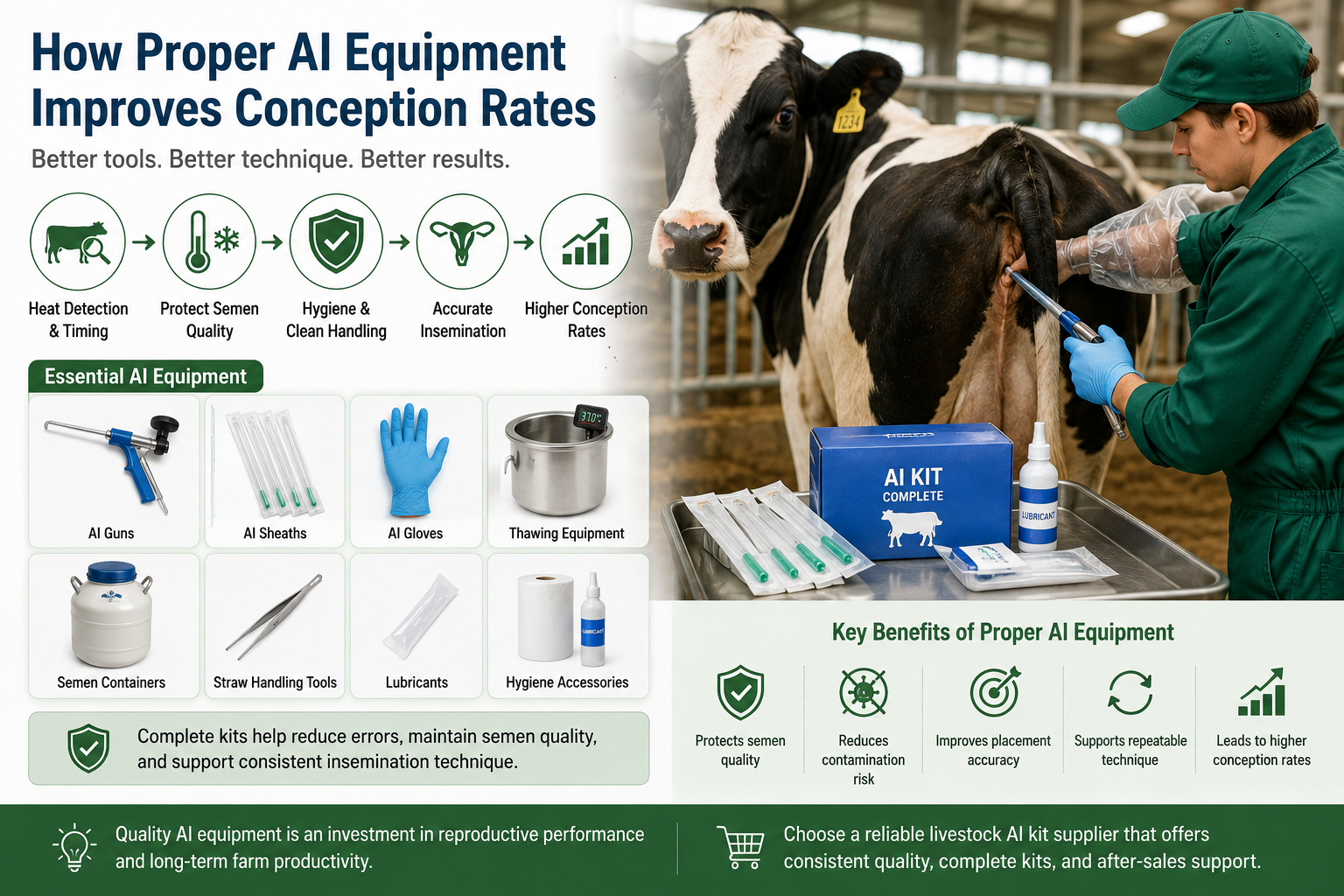
AI equipment matters because conception depends on timing, semen viability, hygiene, placement accuracy, and repeatable technique. If one part of the process is weak, even high-quality semen and good animals may produce disappointing results. Equipment is the bridge between reproductive planning and field execution.
In livestock breeding, artificial insemination is used to transfer selected genetics, improve production traits, manage breeding schedules, and reduce dependence on natural mating. The SOUNDAI artificial insemination page explains that AI can support directed mating, breed improvement, genetic diversity, and reproduction management. Those benefits are only realized when the actual field procedure is controlled well.
A suitable AI kit helps workers keep tools organized. It reduces improvisation during breeding. It gives the technician the correct gun, sheath, glove, lubricant, thawing support, and handling accessories. For larger farms, standardization is especially important because different workers may perform the same job on different days.
Good equipment does not guarantee conception, but poor equipment increases avoidable risk. That is why professional buyers treat AI tools as part of reproductive performance management, not just farm hardware.
Start with Heat Detection and Timing
AI equipment works best when it supports correct timing after accurate heat detection. If insemination is performed too early or too late, even the best AI gun and sheath cannot fully compensate. This is why buyers should think about equipment and farm procedure together.
Farms often focus on the AI gun first, but conception improvement usually begins earlier in the workflow. Workers need clear observation routines, reliable records, and enough time to prepare tools before insemination. If the animal is correctly identified and the breeding window is understood, equipment can then help the operator perform the procedure consistently.
For distributors, this is useful sales education. A livestock AI kit should not be presented as a magic tool. It should be presented as a professional kit that supports a disciplined breeding process. This positioning builds trust with farm managers because it acknowledges the reality of animal reproduction.
The stronger message is simple: the right equipment protects the good decisions the farm has already made.
Protect Semen Quality from Storage to Insemination
Semen quality is highly sensitive to handling, so AI equipment should help maintain temperature control, clean handling, and quick transfer from storage to use. If semen is exposed to poor thawing conditions, contamination, or unnecessary delay, conception rates may decline before insemination even begins.
Buyers should consider semen tanks, thawing containers, thermometers, timers, forceps, straw handling tools, and protective accessories. A farm team that must improvise during semen preparation is more likely to make mistakes. Even small handling errors can reduce consistency across breeding sessions.
For B2B sourcing, packaging the right accessories together can create stronger value than selling a single AI gun alone. Importers can offer starter kits for small farms, professional kits for service technicians, or replacement accessory packs for repeat customers. This helps the buyer become a solution provider, not just a product reseller.
When evaluating a supplier, ask whether the kit configuration supports the full semen handling process or only the final insemination step.
Choose the Right AI Gun for the Species and Straw Type
The AI gun should match the livestock species, semen straw format, sheath design, and operator preference. A mismatch can create poor fit, difficult handling, or inconsistent semen delivery. For farms, that can translate into wasted semen, slower work, or reduced confidence in results.
Different markets may require different AI gun styles. Cattle breeding programs may have different expectations from sheep, goat, or pig operations. Buyers should confirm length, diameter, material, plunger smoothness, compatibility with sheaths, and whether the gun is easy to clean. A good AI gun should feel controlled in the hand and should not create unnecessary resistance during use.
Material matters as well. Stainless steel or metal components may offer durability and a professional feel, while practical plastic or mixed-material accessories may reduce kit cost. The best choice depends on the customer segment. A veterinary service team may value durable professional tools. A small farm retailer may need a more affordable kit.
For a livestock AI kit supplier, clear compatibility information is one of the most important signs of professionalism.
Do Not Ignore Sheaths, Gloves, and Hygiene Accessories
Sheaths, gloves, and hygiene accessories directly affect contamination risk and operator consistency. These items may look simple, but they are essential to proper AI workflow. A high-quality gun paired with poor disposable accessories can still create problems in real use.
Buyers should confirm sheath fit, material quality, packaging hygiene, glove size, glove length, and whether lubricant or cleaning accessories are included. If sheaths are difficult to open, poorly packed, or inconsistent in size, technicians lose time and may handle tools less cleanly. If gloves tear easily or do not fit the target market, user satisfaction drops quickly.
In B2B catalogs, disposable accessories also create repeat-order potential. Farms may buy AI guns less frequently, but they need sheaths, gloves, and related consumables regularly. A supplier who can provide stable accessory quality helps distributors build recurring sales.
Improving conception is not only about the main instrument. It is also about the small items that protect each step of the process.
Standardize the AI Kit for Farm Teams
A standardized AI kit helps farm teams repeat the same breeding procedure with fewer missing tools and fewer last-minute substitutions. This is especially important when several technicians work across multiple barns, breeding groups, or farm locations.
A practical livestock AI kit may include AI guns, sheaths, long gloves, lubricant, straw handling forceps, thawing support, cleaning tools, record materials, and storage packaging. The exact configuration should match the farm species and sales channel. A distributor serving cattle farms may need a different kit from one serving pig or small ruminant operations.
Standardization also improves training. New workers learn faster when every kit is organized the same way. Farm managers can check inventory more easily. Distributors can create product tiers such as basic, professional, and OEM private-label kits.
For conception improvement, the kit should reduce operational noise. The fewer avoidable interruptions during breeding, the better the chance of consistent execution.
Training and Equipment Must Work Together
AI equipment improves conception only when operators know how to use it correctly. A well-designed kit supports training by making the correct process easier to follow. Poorly matched tools can make even trained workers slower and less consistent.
Farm teams need to understand semen handling, thawing time, hygiene, animal restraint, placement technique, and post-procedure records. Equipment can support these steps with clear packaging, correct fit, smooth operation, and simple maintenance. If the kit includes instructions or product photos, distributors can use them for sales education and after-sales support.
External animal-health organizations also emphasize that animal health and welfare are connected with professional care. Buyers can review the World Organisation for Animal Health for broader context on animal health and welfare, and the FAO animal health care worker manual for training-oriented animal care references.
For suppliers and distributors, supporting training creates a stronger product story than simply quoting unit price.
How B2B Buyers Should Evaluate a Livestock AI Kit Supplier
A reliable livestock AI kit supplier should provide compatible products, stable quality, clean packaging, clear specifications, sample support, and repeat-order consistency. Buyers should evaluate whether the supplier can support a complete breeding equipment program, not only one item.
Start with product range. Does the supplier offer AI guns, sheaths, gloves, semen handling tools, and related livestock accessories? Then check compatibility. Do the sheaths match the gun? Are the materials suitable for farm conditions? Are replacement and consumable items available for reorders?
Next, review packaging and documentation. A professional supplier should provide product photos, specifications, carton details, and clear communication about MOQ and lead time. For distributors, packaging quality affects resale. For farms, organized packaging affects daily efficiency.
SOUNDAI offers artificial insemination related products through SOUNDAI Artificial Insemination, with related categories such as AI Gun, Animal Syringe, Syringes, Feeding, and Watering.
Procurement Checklist for AI Equipment Orders
Before placing an order, buyers should define the target species, kit configuration, AI gun type, disposable accessories, packaging style, quantity, and expected sales channel. Clear requirements help the supplier quote accurately and reduce back-and-forth revisions.
- Confirm the livestock species and semen straw format.
- Check AI gun material, length, plunger feel, and sheath compatibility.
- Ask whether sheaths, gloves, lubricant, and cleaning accessories are included.
- Request packaging photos, carton size, gross weight, and net weight.
- Confirm MOQ, lead time, sample options, and mixed-order availability.
- Ask whether OEM packaging or neutral distributor packaging is available.
- Confirm repeat-order availability for consumables and replacement accessories.
- Prepare target market information so the supplier can recommend suitable kit levels.
Common Equipment Mistakes That Reduce AI Results
Common mistakes include using mismatched sheaths, handling semen too slowly, ignoring hygiene accessories, ordering weak gloves, and buying kits without replacement consumables. These errors are easy to overlook because they do not look dramatic during purchasing.
One farm may lose time because the gun and sheath do not fit smoothly. Another may contaminate tools because disposable accessories are not prepared before the animal is restrained. A distributor may receive complaints because the kit looked complete in photos but did not include the items needed for actual field work.
Buyers should also avoid selecting only by the lowest price. In AI equipment, the cost of a failed breeding attempt is often higher than the small difference between a weak kit and a better organized kit. A more reliable configuration can protect customer trust and improve repeat orders.
The practical goal is to remove small avoidable errors from the breeding process.
Field Workflow Details That Buyers Should Not Overlook
Field workflow details often decide whether AI equipment supports better breeding results or simply sits unused in a storage room. A kit should be easy to open, easy to check, and easy to carry to the working area before animals are restrained. If workers need to search for gloves, sheaths, or straw tools during the procedure, timing and cleanliness can suffer.
Buyers should think through the actual sequence of work. The technician identifies the animal, prepares the semen, checks the AI gun, opens disposable accessories, maintains hygiene, performs insemination, records the event, and cleans or stores reusable tools. Each step needs the right item available at the right moment. A missing accessory may not look serious in a quotation, but it can interrupt the farm’s breeding routine.
This is why professional distributors often build AI kits around workflow rather than product count alone. A slightly more organized kit can save time, reduce confusion, and make training easier for new workers. For farms with repeated breeding cycles, these small operational improvements become more valuable over time.
How Distributors Can Differentiate AI Equipment Lines
Distributors can differentiate AI equipment lines by creating clear kit levels for different customer groups. A basic kit can serve small farms that need essential tools at a practical price. A professional kit can serve breeding technicians who want stronger AI guns, better disposable accessories, and organized packaging. An OEM kit can serve private-label buyers who want brand presentation and repeat-order consumables.
This approach helps sales teams avoid forcing one product into every market. Instead, they can ask customers about species, breeding volume, operator experience, and replacement accessory needs. The answer guides the kit recommendation. It also helps the distributor manage inventory because consumables can be reordered separately from durable tools.
A supplier that understands kit tiering can support better catalog planning. SOUNDAI’s artificial insemination product category can be used as the main internal page for AI equipment inquiries, while related pages for AI guns, syringes, feeding, and watering help buyers build a broader livestock supply offer.
Buyers should also ask how the kit will be stored between breeding sessions. A reusable AI gun may perform well during the first use, but it still needs safe storage, clean separation from disposable items, and protection from bending or contamination. Storage packaging is especially useful for distributors selling to farms without dedicated breeding rooms. When tools return to the same organized place after each job, workers are less likely to lose parts or reuse damaged accessories.
Even simple color coding can help. Separate sleeves, labels, or storage positions make it easier for farm teams to identify clean accessories, used tools, and replacement items before the next breeding group is handled.
Conclusion
Proper AI equipment improves conception rates by supporting semen protection, hygiene, accurate placement, operator consistency, and repeatable farm procedures. It does not replace good animal management, but it protects the quality of each breeding decision.
For farms, the right kit reduces missing tools and inconsistent technique. For importers and distributors, the right supplier helps build a stronger artificial insemination product line with AI guns, disposable accessories, semen handling tools, and replacement consumables. For retailers, clear product positioning makes the kit easier to sell.
To source artificial insemination equipment or discuss livestock AI kit options, visit https://www.sound-ai.com/artificial-insemination/ or the SOUNDAI website at https://www.sound-ai.com/.
FAQ
Can AI equipment alone improve conception rates?
AI equipment can support better conception results by improving semen handling, hygiene, and placement consistency, but it must work together with heat detection, animal health, nutrition, and trained operators.
What should be included in a livestock AI kit?
A practical AI kit may include AI guns, sheaths, gloves, lubricant, semen handling tools, thawing support, cleaning accessories, and organized packaging.
How do I choose a livestock AI kit supplier?
Check product compatibility, material quality, kit configuration, packaging, MOQ, sample support, lead time, OEM options, and repeat-order availability for consumables.
Why are sheaths and gloves important in artificial insemination?
Sheaths and gloves help protect hygiene and support a consistent procedure. Poor disposable accessories can reduce the practical value of a good AI gun.
Where can I source AI equipment from SOUNDAI?
Buyers can visit https://www.sound-ai.com/artificial-insemination/ to review artificial insemination products and send an inquiry for kit details, packaging, and quotation support.
Request AI Equipment Information
Need livestock AI kits, AI guns, sheaths, gloves, or related artificial insemination accessories for wholesale or farm supply distribution? Visit SOUNDAI Artificial Insemination and prepare your target species, quantity, kit configuration, packaging style, and destination market.
Suggested inquiry format: “We are looking for a livestock AI kit supplier. Please send available AI gun models, sheath options, kit configurations, packaging details, MOQ, lead time, sample policy, and OEM options.”
Post time: May-09-2026