
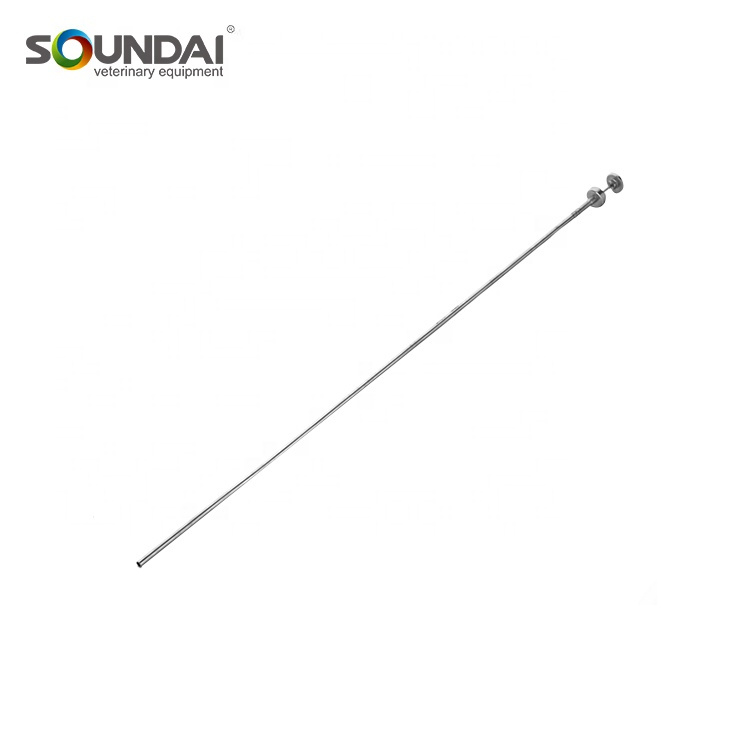
TL;DR: North American feedlot managers transitioning from natural service to fixed-time artificial insemination (FTAI) programs face two interconnected procurement decisions that directly affect conception rates: selecting the correct AI gun sheath length for the herd’s frame size, and implementing a semen thaw protocol that maintains sperm viability from the nitrogen tank to the cow. The AI gun itself — a stainless steel or brass device that holds the semen straw and guides the catheter — is the tool that connects these decisions. For feedlot managers ordering 200+ AI guns per season from Chinese manufacturers, understanding the sheath length options (standard 483 mm vs. extended 533 mm), the thaw procedure requirements (35°C for 40 seconds in a water bath), and the system-level compatibility between guns, sheaths, catheters, and semen bags determines whether a procurement delivers conception rates of 55-65% or below 45%. This article covers the product specification knowledge that translates into better procurement choices for North American feedlot operations.
Why Feedlot Managers Are Switching from Natural Service to Fixed-Time AI Programs
North American feedlot operations — particularly those in the US Great Plains (Nebraska, Kansas, Texas, Colorado) and the Canadian Prairies (Alberta, Saskatchewan) — are in the middle of a significant reproduction management shift. The proportion of feedlot heifers bred through FTAI programs has increased from an estimated 15% in 2015 to approximately 40% in 2025, according to industry surveys published by the Beef Reproduction Task Force. The drivers are economic and operational.
The economics are straightforward: a single high-genetic-merit Angus or Charolais bull costs $5,000-$15,000 and serves approximately 25-35 cows per season. FTAI with proven semen from the same genetics costs $15-$25 per straw (semen + AI gun consumables + labour) and achieves comparable or higher conception rates when properly executed. For a feedlot managing 1,000 replacement heifers, the FTAI program saves $50,000-$100,000 per season in bull purchase and maintenance costs while providing access to a wider range of sires and accelerating genetic improvement through targeted sire selection.
The operational advantage is equally significant. Natural service requires bulls to be rotated, monitored for injury and breeding soundness, and separated from calves. FTAI programs are scheduled — all heifers are synchronized through a CIDR-GnRH-PGF2α protocol, inseminated on a single day, and managed as a cohort through pregnancy diagnosis and calving. The labour requirement per bred heifer drops by 40-60%, and the calving window is compressed from 90-120 days to 45-60 days, simplifying calf management and reducing mortality from unattended dystocia.
For feedlot managers, the procurement decision has shifted from “which bull to buy” to “which AI gun, sheath, and consumables supplier to use.” The equipment quality — specifically the AI gun’s smooth plunger action, the sheath’s rigidity without brittleness, and the catheter’s flexibility without kinking — directly affects the inseminator’s ability to deposit semen at the correct uterine location. Sound AI’s breeding equipment range includes AI guns designed specifically for the FTAI protocols used in North American feedlot programs, with stainless steel barrel construction and smooth-tapered plunger action tested through 5,000-cycle durability validation.
Sheath Length Selection: Standard (483 mm) vs Extended (533 mm) for Different Cow-Calf Frame Sizes
The AI gun sheath is a single-use polypropylene tube that covers the gun barrel and guides the catheter to the cervix. Its length must match the animal’s reproductive tract length, which varies by frame size — a critical detail that is often overlooked in bulk AI gun procurement orders.
Standard sheath (483 mm / 19 inches): Suitable for heifers and small-to-medium frame cows (Angus, Hereford, and their crosses, which constitute approximately 70% of the US feedlot cowherd). In heifers, the reproductive tract is shorter and the pelvic area is smaller — the standard sheath length is sufficient to reach the uterine body without protruding beyond the cervix, minimising the risk of cervical trauma. For heifers weighing 320-400 kg at breeding, the standard sheath provides the correct working length for the inseminator to manipulate the AI gun through the cervix with one hand while palpating the reproductive tract rectally with the other.
Extended sheath (533 mm / 21 inches): Required for large-frame cows (Charolais, Simmental, Maine-Anjou, and their crosses), which have longer reproductive tracts. The extended sheath provides the additional 50 mm of reach needed to deposit semen at the uterine body — the correct deposition site — without stretching or tensioning the cervix during AI gun manipulation. Using a standard sheath on a large-frame cow forces the inseminator to advance the gun further forward, increasing the risk of cervical abrasion, triggering the cow’s straining reflex, and reducing the conception rate by an estimated 5-10 percentage points.
Feedlot managers ordering AI guns should specify the sheath lengths in their order. A typical feedlot with a mixed-frame herd should order a 60:40 ratio of standard to extended sheaths, matching the expected frame size distribution. Sound AI’s artificial insemination gun accepts both sheath lengths, and the sheaths are packaged separately so managers can select the correct length for each breeding group.
Semen Thaw Protocol in North American Feedlots: Water Bath Temperature and Timing Windows
The semen thaw protocol is the single most important factor affecting AI conception rates that is under the feedlot manager’s direct control. A frozen semen straw removed from a liquid nitrogen tank (-196°C) and thawed at the incorrect temperature or for the incorrect duration suffers significant sperm damage — reducing viability by 30-50% in poorly executed thaw protocols.
The standard thaw protocol for North American bull semen (certified by the National Association of Animal Breeders and universally adopted by AI studs including ABS, Select Sires, and Genex) is: 35°C water bath for 40 seconds. The straw is transferred from the liquid nitrogen tank directly into the 35°C water bath — no intermediate cooling step — and is placed in the AI gun within 15 seconds of removal from the water bath. The AI gun, with the sheath already loaded, is inserted into the cow within 2 minutes of the straw being thawed.
The deviation from this protocol that we most commonly observe in feedlot operations is the “batch thaw” practice — multiple straws thawed simultaneously in the same water bath, with the first and last straws experiencing different thawing durations. A straw that sits in the water bath for 2 minutes (the last one in a batch of 10 straws thawed at 12-second intervals) experiences a 25-35% reduction in post-thaw motility compared to a straw thawed for exactly 40 seconds. The feedlot practice should be a “single-straw protocol”: one straw removed from the tank, thawed for 40 seconds, loaded in the gun, inseminated, and only then is the next straw thawed.
Feedlot managers procuring AI guns should also procure a dedicated thawing unit — a temperature-controlled water bath (±0.5°C accuracy at 35°C) with a straw rack that holds straws in a vertical position. The thaw unit is part of the AI kit that supports the insemination team’s workflow.
The AI Gun as a System: Sheath, Catheter, Semen Bag, and Thaw Unit Compatibility
The AI gun does not function in isolation. It is the central component of a system that includes the sheath, the catheter (the flexible tube that carries the semen from the straw to the deposition site), the semen bag (a plastic sleeve that holds the loaded AI gun and protects the sheath from contamination during rectal insertion), and the thaw unit. System compatibility issues arise when components from different manufacturers are mixed.
For feedlot managers ordering from a single supplier, the compatibility is guaranteed. The sheath fits the gun barrel correctly, the catheter passes through the sheath without binding, and the semen bag covers the assembly without tearing. When components are sourced from different suppliers — a gun from manufacturer A, sheaths from manufacturer B, catheters from manufacturer C — the feedlot may discover incompatibility issues in the middle of an insemination session: the sheath does not seat fully on the gun barrel, the catheter catches on the sheath’s internal seam, or the semen bag splits when stretched over the loaded gun. The cost of a disrupted breeding session — wasted semen, missed cycles, and delayed calving — far exceeds the minor price savings of multi-supplier sourcing.
For feedlot managers ordering 200+ units per season, we recommend a complete AI kit specification: AI gun + 500 sheaths (mix of standard and extended) + 1,000 catheters + 500 semen bags + one thaw unit per insemination team member. The kit approach ensures system-level compatibility and simplifies the manager’s inventory management — all consumables have the same reorder cycle, and there are no orphan components that cannot be used because the matching gun has been retired.
Shipping and logistics for AI gun bulk orders to North America: The sea freight route from Ningbo to North America’s primary ports of entry — Los Angeles/Long Beach on the US West Coast and Vancouver on the Canadian West Coast — is among the most established shipping lanes from China. A 20-ft container holds approximately 2,000 AI guns in their individual packaging plus the associated consumables cartons (sheaths, catheters, semen bags). For a feedlot manager ordering 200 units, the shipment is typically sent as LCL (less-than-container-load) consolidated with other agricultural equipment orders from the same Ningbo-based exporter. The LCL freight cost for a 200-unit AI gun order (shipping volume approximately 1.5-2.5 m³) to Los Angeles or Vancouver is $300-$600, and the container typically clears US or Canadian customs within 2-3 days of arrival because veterinary equipment falls under the low-inspection-rate category for agricultural devices.
The customs documentation required for AI gun imports into the US includes: a commercial invoice (stating the HS code 9018.90.7580 for veterinary instruments, with the unit value and total value), a packing list (itemising the quantity of AI guns, sheaths, catheters, and semen bags in the shipment), and a certificate of origin (Form A for GSP preferential duty treatment — AI guns imported into the US under HS 9018.90 qualify for duty-free entry under the GSP program if the shipment value is below $2,500 or if the manufacturer meets the GSP country-of-origin requirements). For Canadian imports, the HS code is identical and the duty rate under the Most-Favoured-Nation tariff is zero for veterinary instruments — Canada does not require a certificate of origin for zero-duty medical devices from China. Both US and Canadian customs require the consignee (the feedlot or the feedlot’s customs broker) to have a valid importer number — an IRS number for US importers or a Business Number for Canadian importers.
Bulk Procurement for Feedlots: What a 200-Unit AI Gun Order Includes
A bulk order of 200 AI guns from Sound AI is structured to provide the feedlot manager with everything needed to equip the insemination team for a breeding season. The order includes: 200 AI guns (stainless steel barrel, brass plunger, ergonomic handle), packed in a hard plastic case (20 guns per case, 10 cases total, each case labelled with the gun model and serial number range for inventory tracking). Each AI gun is individually tested before packing — the plunger action is checked for smooth travel, and the barrel is inspected for internal burrs that could damage the catheter.
The consumables for 200 guns — sheaths, catheters, and semen bags — are packed in separate cartons with the quantity clearly marked on each carton. For a feedlot that inseminates 2,000 heifers per season (using 2 guns per insemination team, rotating 4 teams through the breeding day), the consumable pack should contain at least 2,500 sheaths, 3,000 catheters, and 2,500 semen bags — covering the 2,000 inseminations plus 25% additional for wastage and practice.
Payment terms for bulk orders: 30% deposit with order confirmation, 70% balance against copy of bill of lading. Lead time: 25-30 working days from deposit receipt to FOB Ningbo. Sea freight to US West Coast (Los Angeles, Long Beach) takes 18-22 days, to Canadian West Coast (Vancouver) takes 16-20 days. Total lead time from order placement to port arrival: approximately 7-9 weeks. Feedlot managers should place their order at least 10 weeks before the planned breed start date.
Q&A: North American Feedlot Managers Sourcing AI Guns from China
Q1: What is the MOQ for a custom-branded AI gun order?
A: MOQ for custom branding (logo laser-engraved on the gun barrel or handle) is 500 units. For unbranded standard AI guns in Sound AI’s catalogue, the MOQ is 100 units. For a trial order of 50 units, we can accommodate from existing finished goods inventory at the standard FOB price with a 10% surcharge for the smaller batch.
Q2: Do AI guns require FDA or USDA approval for import into the United States?
A: AI guns are classified as veterinary reproduction equipment and do not require FDA pre-market approval or USDA import permits. The product falls under FDA’s general-purpose veterinary device category, which is exempt from 510(k) notification. The main import requirement is a customs declaration that the product is a veterinary instrument made of stainless steel (HS code 9018.90.7580 for veterinary instruments). The consignee should have an FDA registration number for the importing entity (establishment registration), but the product itself does not require individual clearance.
Q3: What is the service life of a stainless steel AI gun?
A: A stainless steel AI gun with proper maintenance (cleaning after each use with warm water and mild detergent, drying, and light lubrication of the plunger mechanism) has a service life of 10,000-15,000 cycles — equivalent to 5-7 breeding seasons for a feedlot inseminating 2,000 heifers per season. The gun’s moving parts (plunger rod and trigger mechanism) are the wear points; Sound AI provides replacement plunger assemblies for field installation.
Q4: Can the same AI gun be used for both conventional and sexed semen?
A: Yes. The AI gun operates identically for both conventional and sexed semen straws. The key difference is in the catheter specification — sexed semen requires a catheter with a narrower internal diameter (0.5 mm vs 0.8 mm for conventional) to reduce the dead space volume and ensure the smaller number of sperm cells in a sexed straw are deposited at the correct uterine location. We recommend feedlots using sexed semen specify “sexed semen catheters” in their consumables order.
Q5: What happens if an AI gun is dropped during an insemination session?
A: The gun should be inspected immediately. A drop that impacts the barrel tip can bend the barrel or misalign the plunger path. A drop from waist height onto concrete typically bends the barrel by 1-3 mm, which is not visible to the eye but affects the catheter’s path through the cervix. We recommend feedlots carry 2 spare guns per insemination team — the dropped gun is set aside for inspection and the spare is used immediately. Sound AI provides an inspection jig with each bulk order that allows the feedlot to check barrel straightness and plunger alignment.
Q6: What training materials does Sound AI provide with a bulk AI gun order?
A: Each bulk order includes: a printed operator’s manual (English and Spanish versions), a QR code link to the AI gun assembly and cleaning video, a sheath length selection poster for the insemination station, and a semen thaw protocol reference card that can be laminated and posted at the AI laboratory station. We recommend the feedlot manager conduct a hands-on training session with the AI gun before the breeding season — the training takes 30 minutes and covers gun assembly, sheath loading, catheter threading, and cleaning.
About the Author: We are Ningbo Beilun Sound Hardware Industrial and Trade Co., Ltd., a Chinese manufacturer of veterinary reproduction equipment — AI guns, sheaths, catheters, and related consumables — serving feedlot and dairy operations in North America, South America, Europe, and Oceania since 2010. Our AI guns are tested to 15,000-cycle durability and exported to 40+ countries.
Social: Facebook
Post time: Jun-22-2026