
Poultry Vaccination Equipment Guide
TL;DR
- Stainless steel syringe parts usually last longer under repeated use.
- Plastic poultry vaccine syringes are lighter and more cost-friendly.
- Durability depends on seals, dosage accuracy, cleaning, and spare parts.
- B2B buyers should compare lifetime cost, not only unit price.
The real sourcing question is not simply plastic versus stainless steel. Importers, distributors, veterinary supply wholesalers, and poultry equipment retailers should compare total working life, dose consistency, operator comfort, spare parts, cleaning method, packaging, and target customer expectations. A low-cost syringe that fails early can become more expensive than a stronger model. A premium syringe that is too costly for the market can also move slowly in inventory.
This guide explains how to evaluate a poultry vaccine syringe, when plastic is suitable, when stainless steel is worth the upgrade, and how B2B buyers can source poultry vaccination tools from SOUNDAI at https://www.sound-ai.com/syringes/.
What Is a Poultry Vaccine Syringe?
A poultry vaccine syringe is a dosing tool used to deliver vaccines or veterinary liquids to birds in controlled volumes during poultry health programs. It may be used in small farm settings, hatchery-related work, veterinary service routines, or commercial poultry operations, depending on the syringe type and dosing design.
In B2B sourcing, poultry vaccine syringes are rarely judged by appearance alone. Buyers need to consider how the tool performs when used repeatedly, how easy it is to set the dose, whether the operator can handle it comfortably, and how quickly the farm can clean or replace parts. These details determine whether the product receives repeat orders.
Poultry vaccination work can involve frequent handling and careful dose control. A syringe that feels stable and has clear dosage adjustment can reduce operator frustration. A syringe that leaks, jams, or loses scale visibility can create complaints even if the initial price looks attractive.
The best poultry vaccine syringe is the one that matches the farm’s vaccination workflow, cleaning habits, and budget expectations.
Plastic Poultry Vaccine Syringes: Where Do They Fit Best?
Plastic poultry vaccine syringes fit buyers who need lightweight handling, competitive pricing, simple stock movement, and broad resale potential. They are often attractive for farm supply shops and distributors serving customers who care strongly about purchase cost.
Plastic models can be easier for workers to handle during long treatment routines because they are usually lighter than metal-heavy designs. They can also be easier to position in a catalog as an entry-level or practical option. For importers who sell through multiple retail channels, plastic syringe models may create faster turnover because the price point is easier for many customers to accept.
The main limitation is durability under heavy repeated use. Plastic barrels, handles, and connection points can wear faster if the tool is dropped, cleaned roughly, exposed to unsuitable chemicals, or used beyond its intended workload. This does not mean plastic is a poor choice. It means buyers should match plastic syringes with the right market segment.
Plastic poultry vaccine syringes are best when the customer needs affordability, light weight, and simple daily use rather than the longest possible service life.
Stainless Steel Poultry Vaccine Syringes: Why Do They Last Longer?
Stainless steel poultry vaccine syringes often last longer because metal components can resist wear, repeated handling, and cleaning stress better than basic plastic structures. They are usually positioned for customers who value working life and professional feel.
Stainless steel can improve strength in the handle, body, piston, or connection areas, depending on the design. These parts matter because vaccination tools are used in real farm environments, not in perfect laboratory conditions. Operators may work quickly, tools may be placed on work surfaces, and parts may be cleaned many times. Stronger structural components can help the syringe stay stable longer.
However, stainless steel does not automatically make every syringe better. Buyers still need to check seals, valves, dosage adjustment, scale marking, connector quality, and spare parts. A poorly assembled stainless steel syringe can still perform badly. A well-made plastic model can outperform a weak metal model in some markets.
Stainless steel is valuable when the whole syringe system, not just one visible part, is designed for repeated professional use.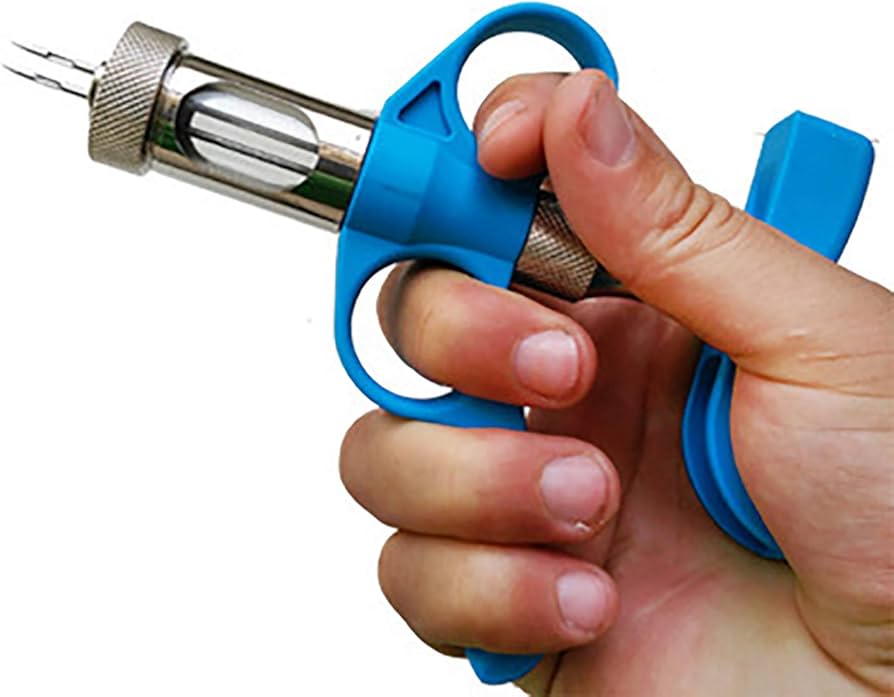
Which Type Lasts Longer in Real Farm Use?
In repeated farm use, stainless steel poultry vaccine syringes generally last longer, but the longest working life comes from a good combination of material, seals, maintenance, and operator care. Material is important, but it is not the only factor.
A stainless steel model may resist physical wear better, but if the seals are low quality or spare parts are unavailable, the syringe may still be retired early. A plastic model may have a shorter structural life, but if it is used for lighter work and cleaned correctly, it can deliver good value. This is why B2B buyers should evaluate lifetime cost instead of looking only at the purchase price.
For distributors, the practical answer can be split by customer type. Large farms and veterinary service teams usually benefit from stronger models that can handle repeated work. Smaller farms or retail buyers may prefer lower-cost plastic tools, especially if vaccination volume is moderate. A balanced catalog can include both types.
Durability is a system result: material strength, seal quality, dose mechanism, cleaning method, and spare part support all work together.
Plastic vs Stainless Steel: B2B Comparison Table
B2B buyers should compare plastic and stainless steel poultry vaccine syringes by service life, cost, weight, cleaning tolerance, market positioning, and reorder potential. A structured comparison helps prevent emotional purchasing based only on price or appearance.
| Factor | Plastic Syringe | Stainless Steel Syringe |
|---|---|---|
| Typical advantage | Lower cost and lighter handling | Longer service life and stronger structure |
| Best sales channel | Retail, price-sensitive farms, general farm stores | Professional farms, veterinary supply, higher-value distributors |
| Main risk | Faster wear under heavy repeated use | Higher initial cost and slower movement in low-price markets |
| Procurement focus | Cost, packaging, scale clarity, basic reliability | Material grade, seals, spare parts, cleaning tolerance |
What Specifications Should Buyers Check Before Ordering?
Before ordering poultry vaccine syringes, buyers should check dosage range, material structure, scale visibility, needle compatibility, seal quality, spare parts, cleaning guidance, packaging, MOQ, and lead time. These specifications directly affect field performance and customer satisfaction.
Dosage range is especially important because poultry applications may require accurate small-volume delivery. The scale should be easy to read, and the adjustment mechanism should remain stable during repeated use. If the syringe is used with a bottle, tube, or automatic feed system, connection quality must be confirmed before bulk ordering.
Buyers should also request clear photos of the barrel, handle, connectors, seals, and packaging. If possible, they should test samples before placing a larger order. A sample review can reveal whether the handle feels comfortable, whether the dose setting is easy to adjust, and whether the product looks suitable for the buyer’s sales channel.
A serious supplier should be able to explain not only the product size, but also the use case and maintenance expectations.
How Do Cleaning and Maintenance Affect Service Life?
Cleaning and maintenance can shorten or extend syringe life more than many buyers expect. A strong material can still fail early if the syringe is cleaned with unsuitable methods, stored wet, dropped often, or used without replacing worn seals.
Plastic parts may become weaker if exposed to aggressive cleaning chemicals or rough handling. Stainless steel parts may resist wear better, but connectors, rubber seals, and moving parts still need proper care. For this reason, buyers should ask the manufacturer for cleaning guidance and replacement part availability.
Maintenance instructions are also useful for resale. A distributor can include simple care notes in the product listing or package insert. This reduces misuse and helps customers understand why a higher-quality syringe may last longer. It also protects the distributor’s reputation because fewer problems are caused by unclear use instructions.
Longer syringe life is usually achieved through good material plus correct cleaning, not material alone.
Why Spare Parts Matter for Poultry Vaccine Syringe Buyers
Spare parts matter because many syringe failures come from wearable components such as seals, washers, tubes, valves, and connectors rather than the main body. If replacement parts are unavailable, a syringe with a strong body may still become unusable too soon.
B2B buyers should ask whether the supplier can provide spare seals, hoses, bottle connectors, repair kits, or other consumable parts. They should also confirm whether spare parts are packed with each syringe or sold separately. This information is important for importers that want to offer after-sales support or build a professional product line.
For stainless steel models, spare parts protect the higher purchase value. For plastic models, spare parts can improve customer satisfaction and extend practical working life. In both cases, spare part planning helps buyers reduce complaints and support repeat orders.
A poultry vaccine syringe supplier with spare part support is usually a safer long-term partner than a supplier that only quotes the finished tool.
How Should Importers Position Each Product Type?
Importers should position plastic syringes as cost-effective practical tools and stainless steel syringes as longer-life professional tools. Clear positioning helps sales teams and customers choose the right model without confusion.
Plastic models can be listed for smaller farms, general farm supply stores, online shops, and customers who need basic function at a competitive price. Stainless steel models can be listed for commercial poultry farms, veterinary service providers, distributors serving professional buyers, or customers who ask for longer working life.
This positioning also helps with inventory planning. Buyers do not need every model in every market. In some regions, plastic syringe models may sell faster because price matters most. In other regions, professional buyers may prefer stainless steel because tool life and working reliability are stronger selling points.
The best catalog often includes both plastic and stainless steel poultry vaccine syringes, with each product assigned to a clear customer segment.
How to Choose a Poultry Vaccine Syringe Supplier
A reliable poultry vaccine syringe supplier should provide clear product specifications, consistent quality, practical packaging, spare part support, and responsive communication. These points matter more than a low unit price when buyers plan repeat orders.
Start by asking the supplier to compare plastic and stainless steel models. If the supplier can explain the differences clearly, it is easier to match products to your market. Then request samples, photos, packaging details, MOQ, lead time, and available accessories. If you plan to sell under your own brand, confirm private label or neutral packaging options early.
Buyers should also check whether the supplier offers related veterinary and livestock tools. A broader product range can reduce sourcing complexity and support mixed shipments. SOUNDAI provides syringe-related products through SOUNDAI Syringes and also supports related categories such as Animal Syringe, AI Gun, Feeding, Watering, and Cow Magnet.
For wider animal-health context, buyers can also review the World Organisation for Animal Health, which discusses animal health and welfare as part of global livestock management.
Clear model naming also helps warehouse teams avoid picking errors during repeat shipments.
Procurement Checklist for Bulk Orders
Before confirming a bulk poultry vaccine syringe order, procurement teams should document the target market, syringe material, expected use intensity, packaging requirement, and spare part plan. This reduces misunderstanding and protects the buyer’s margin.
- Confirm whether the market needs plastic, stainless steel, or both product types.
- Check dosage range, scale clarity, and adjustment method.
- Request material details for barrel, handle, piston, seals, and connectors.
- Ask for cleaning guidance and replacement part availability.
- Confirm needle compatibility, tube connection, and bottle connection if applicable.
- Review packaging photos, carton quantity, carton size, gross weight, and net weight.
- Ask about MOQ, sample time, production lead time, and mixed shipment options.
- Confirm whether private label, neutral packaging, or distributor labels are available.
Common Mistakes When Comparing Plastic and Stainless Steel Syringes
The most common mistake is assuming that stainless steel is always the best choice or that plastic is always the cheapest practical choice. The correct decision depends on the customer, application, and expected working life.
Some buyers order stainless steel models for markets that mainly want low-price tools, then discover that inventory moves slowly. Other buyers order only plastic models for professional users, then receive complaints about wear under heavy use. Both problems come from poor product positioning, not necessarily poor product quality.
Another mistake is ignoring packaging and instructions. Poultry vaccine syringes are functional tools, but packaging still affects resale, storage, and customer trust. A clear label, organized accessories, and simple use guidance make the product easier to sell and easier to support after delivery.
The safest approach is to test samples, define the target customer, and compare lifetime value before scaling the purchase order.
Conclusion
Stainless steel poultry vaccine syringes usually last longer than plastic models in repeated professional use, but plastic models can still be the right choice for cost-sensitive and lightweight applications. B2B buyers should not choose by material alone. They should compare full working life, dose reliability, cleaning method, spare parts, packaging, and customer expectations.
For importers and distributors, the strongest strategy is often to carry both options. Plastic syringe models can support broad market coverage and fast-moving price points. Stainless steel models can support professional users who want stronger tools and better long-term durability.
To request model details, dosage options, packaging information, and quotation support for poultry vaccine syringes, visit https://www.sound-ai.com/syringes/ or review SOUNDAI at https://www.sound-ai.com/.
FAQ
Which poultry vaccine syringe lasts longer, plastic or stainless steel?
Stainless steel models usually last longer under repeated professional use, but final service life also depends on seals, cleaning, spare parts, and operator care.
Are plastic poultry vaccine syringes still worth buying?
Yes. Plastic models are useful for lightweight handling, lower cost, entry-level markets, and customers who do not require the longest service life.
What should importers check before ordering poultry vaccine syringes?
Importers should check material, dosage range, scale clarity, needle compatibility, seal quality, spare parts, packaging, MOQ, lead time, and supplier communication.
Can SOUNDAI supply syringe products for poultry-related use?
Buyers can review SOUNDAI’s syringe category at https://www.sound-ai.com/syringes/ and send an inquiry with required material, quantity, dosage range, and packaging needs.
Should a distributor stock both plastic and stainless steel syringes?
In many markets, yes. Plastic syringes serve price-sensitive customers, while stainless steel models serve professional buyers who value longer working life.
Request Poultry Vaccine Syringe Information
Need plastic or stainless steel poultry vaccine syringe options for wholesale, distribution, or farm supply resale? Visit SOUNDAI Syringes and prepare your target market, quantity, material preference, dosage range, packaging style, and required delivery schedule.
Suggested inquiry format: “We are sourcing poultry vaccine syringes. Please send plastic and stainless steel model options, dosage range, packing details, MOQ, lead time, sample availability, and spare part information.”
Post time: May-09-2026