
Veterinary Syringe Sourcing Guide
TL;DR
- Continuous syringes are built for fast repeated dosing.
- Automatic syringes improve consistency in vaccination work.
- Plastic steel syringes balance durability, cost, and handling.
- B2B buyers should compare dosage range, material, spare parts, packaging, and supplier support.
For a distributor, importer, veterinary supply wholesaler, or farm supply retailer, choosing the right syringe type is not only a product decision. It affects customer satisfaction, after-sales questions, reorder frequency, and brand trust. A buyer who understands the difference between syringe structures can build a stronger product line and avoid ordering mismatched inventory.
This guide explains the main syringe categories, how they are used, what procurement teams should check, and how to evaluate a veterinary syringe manufacturer before placing a bulk order. Buyers can review SOUNDAI’ syringe category at https://www.sound-ai.com/syringes/ and the company website at https://www.sound-ai.com/.
What Are the Main Types of Veterinary Syringes?
The main types of veterinary syringes include continuous syringes, automatic syringes, plastic steel syringes, and standard animal syringes used for routine livestock care. The best choice depends on animal species, treatment frequency, operator skill, dose accuracy needs, cleaning method, and target market price.
Veterinary syringes are used across cattle, sheep, goats, pigs, poultry, and other animal care settings. In B2B trade, the same product may be sold to commercial farms, breeding centers, veterinary clinics, feed stores, farm supply shops, and e-commerce sellers. Because the end users are different, one syringe type rarely fits every customer. For broader animal-health context, buyers can also review the World Organisation for Animal Health as an external authority on animal health and welfare.
A continuous syringe can help large farms work faster because the operator does not need to refill after every single dose. An automatic syringe can help maintain a repeated dose volume with less manual adjustment. A plastic steel syringe can serve customers who want a durable tool but still care about cost and easy handling.
A strong product catalog should explain not only what the syringe is, but also which farm situation it fits best.
How Does a Continuous Veterinary Syringe Work?
A continuous veterinary syringe is designed for repeated dosing, usually by drawing liquid from a bottle or connected container while the operator treats multiple animals in sequence. This makes it useful for vaccination, medication, or dosing work where speed and workflow matter.
The main advantage is efficiency. Instead of stopping frequently to reload a small barrel, the operator can continue working across a group of animals. This is especially valuable in commercial livestock operations where time, labor, and animal handling stress all matter. If the syringe works smoothly, the farm team can complete treatment faster and keep the animal line moving.
For B2B buyers, important checks include dose adjustment range, handle feel, hose connection, bottle connection, valve quality, needle compatibility, and ease of cleaning. If the product includes spare washers, tubes, or repair parts, that should be clearly listed in the quotation. Spare parts are not a minor detail; they directly affect customer satisfaction after the product has been used in the field.
Continuous syringes are best for buyers serving farms that treat many animals at once and need faster repeated dosing.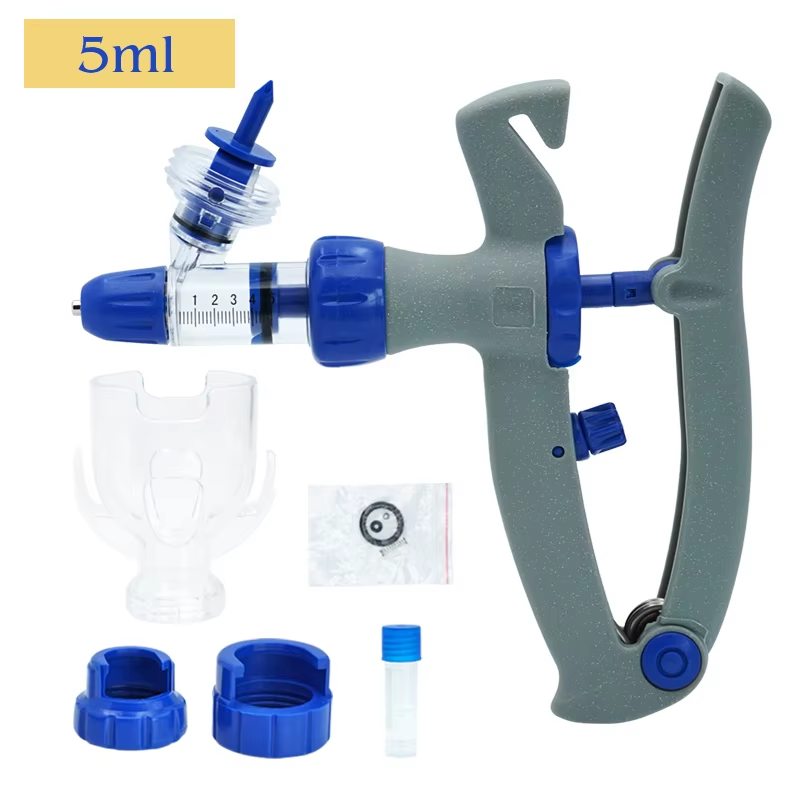
When Should Buyers Choose an Automatic Veterinary Syringe?
An automatic veterinary syringe is the better choice when repeatable dosing and operator efficiency are more important than simple one-time use. The product is often selected for vaccination programs, herd health routines, and animal treatment work where the same dose must be given repeatedly.
The word automatic can mean different things depending on product design, so buyers should not rely only on the product name. They should check whether the model offers adjustable dosage, clear scale markings, smooth trigger action, reliable reset, and suitable connection parts. A good automatic syringe should feel stable in repeated use and should not require complicated adjustment during routine work.
Distributors should also consider user training. Automatic syringes are easier to sell when the supplier can provide photos, short instructions, and clear product descriptions. If the customer knows how to set the dose, clean the unit, and replace wearable parts, the product has a lower risk of complaints.
Automatic veterinary syringes fit buyers who want to offer a more professional tool for repeated treatment work.
What Is a Plastic Steel Veterinary Syringe?
A plastic steel veterinary syringe usually combines practical plastic components with metal or steel-reinforced parts to improve durability, handling, and cost control. This type is popular because it gives buyers a middle position between basic low-cost syringes and heavier premium tools.
The exact structure depends on the manufacturer, so buyers should ask for product photos, material details, and specification sheets. Some models emphasize a strong barrel, some emphasize a metal handle, and some focus on practical farm use at a competitive price. Clear material information helps importers position the product accurately in their market.
Plastic steel syringes are often attractive to farm supply retailers because they look more durable than basic disposable-style tools while remaining easy to stock and sell. They can also be useful in markets where buyers want a product that feels strong but does not carry the price of a fully premium model.
Plastic steel syringes are useful for buyers who need a durable, practical, and market-friendly product for broad livestock supply channels.
Continuous vs Automatic vs Plastic Steel: Which Type Fits Your Market?
The right syringe type depends on the buyer’ customer base: large farms usually value speed, veterinary channels value consistency, and retail customers often value durability and price. A distributor should not select only one type unless the customer group is very narrow.
Continuous syringes are strong for large-volume treatment work. Automatic syringes are strong for repeatable dosing programs. Plastic steel syringes are strong for general livestock supply sales where the customer wants a reliable tool at a practical price. A balanced importer may keep all three categories in the catalog, then position them for different buyer groups.
For example, a farm supply wholesaler may sell continuous syringes to pig farms and cattle farms, automatic syringes to vaccination service teams, and plastic steel syringes to farm shops. This product-line logic creates more flexible sales coverage and reduces dependence on one SKU.
A veterinary syringe manufacturer should help buyers match syringe type with species, workflow, and sales channel.
Key Specifications B2B Buyers Should Check
B2B buyers should check dosage range, material, scale clarity, connection parts, needle compatibility, cleaning method, spare parts, packaging, and MOQ before ordering veterinary syringes. These details decide whether the product performs well after import.
Dosage range is important because different animals and treatment routines need different volumes. Scale clarity matters because operators must read settings quickly. Connection quality matters because leaks, loose tubes, or poor fittings can create complaints. Cleaning convenience matters because veterinary tools may be used repeatedly in demanding farm conditions.
Buyers should also ask about product weight, carton size, inner box design, and whether instruction materials are included. For e-commerce sellers, product photos and packaging quality may be especially important. For farm supply distributors, spare parts and reorder stability may matter more than visual presentation.
Specifications are not just technical details; they are the evidence buyers use to decide whether a supplier is professional.
Why Material and Build Quality Matter
Material and build quality matter because veterinary syringes are handled repeatedly, cleaned frequently, and used in farm environments where weak parts fail quickly. A low-priced product can become expensive if it causes returns, complaints, or customer distrust.
Buyers should inspect the barrel, handle, piston, seals, valves, hose, fittings, and scale markings. The syringe should feel stable in the hand and should not have rough edges or loose parts. The dose adjustment should be smooth enough for daily use. If the model has metal or steel parts, buyers should ask whether the material is corrosion-resistant and suitable for normal farm cleaning routines.
Material choice also affects product positioning. A lightweight plastic model may be suitable for price-sensitive customers, while a stronger plastic steel model can be sold as a more durable option. A continuous or automatic model with better components can be positioned for farms that care about labor efficiency.
Good material selection helps a veterinary syringe manufacturer support different price levels without sacrificing basic reliability.
How Should Veterinary Syringes Be Packaged for Export?
Export packaging should protect the syringe, organize accessories, support warehouse handling, and make resale easier for importers. Packaging is part of product quality in B2B trade because damaged cartons, missing parts, or unclear labeling can create extra cost after arrival.
Buyers should confirm inner box quantity, carton quantity, carton dimensions, gross weight, net weight, label content, and whether spare parts are packed separately. If the syringe includes a tube, bottle connector, needle connection, or repair washer, each item should be easy to identify. A simple packing list can prevent many after-sales problems.
For distributors, branded packaging may help retail sales, while neutral packaging may be better for private-label or wholesale channels. The right choice depends on the buyer’ business model. A professional supplier should be able to discuss both options clearly.
Good packaging reduces damage, speeds up inspection, and makes veterinary syringes easier to resell.
How to Evaluate a Veterinary Syringe Manufacturer
A reliable veterinary syringe manufacturer should provide clear specifications, stable quality, export-ready packaging, responsive communication, and support for repeat orders. Buyers should evaluate the supplier as a long-term sourcing partner, not only as a one-time price source.
Start by checking whether the supplier can explain the difference between product types. If a manufacturer can clearly describe continuous, automatic, and plastic steel syringes, the buyer is more likely to receive suitable recommendations. Next, ask for photos, samples, material notes, packaging details, and available spare parts. Then compare lead time, MOQ, customization options, and mixed-order support.
Communication speed is also important. Veterinary syringes may seem simple, but orders often include different sizes, accessories, and packaging requirements. A supplier who confirms details carefully before production can help prevent costly mistakes.
The best manufacturer is not always the cheapest one; it is the one that can keep quality, communication, and delivery stable over time.
Small specification differences can also affect customer reviews, because farm operators quickly notice leaking fittings, unclear scales, or handles that feel unstable during repeated treatment work.
Procurement Checklist for Veterinary Syringe Orders
Before placing a veterinary syringe order, procurement teams should prepare the target animal species, syringe type, dose range, quantity, packaging style, and destination market. A clear inquiry helps the manufacturer quote faster and reduces revision cycles.
- Confirm whether the order needs continuous, automatic, plastic steel, or mixed syringe types.
- Ask for dosage range, product dimensions, material, and scale marking details.
- Check whether spare parts, tubes, washers, or connectors are included.
- Request product photos, packaging photos, and carton information.
- Confirm MOQ, lead time, payment terms, and sample availability.
- Ask whether private labeling or neutral packaging is available.
- Check whether syringes can be combined with other livestock supply products.
- Clarify the intended sales channel: farms, vets, wholesalers, retailers, or e-commerce.
Common Ordering Mistakes to Avoid
The most common ordering mistakes are choosing by price only, ignoring spare parts, failing to confirm dosage range, and ordering packaging that does not fit the resale channel. These mistakes are preventable when buyers ask the right questions before production.
Some buyers order a syringe that looks suitable in photos but does not match the target animal or workflow. Others forget that accessories and replacement parts affect long-term usability. Another common issue is unclear packaging, especially when a product is intended for retail display or e-commerce fulfillment.
Importers should also avoid mixing too many untested models in one first order. A better approach is to sample key syringe types, confirm customer response, then scale the order based on real sales feedback. This reduces inventory risk and helps build a stronger product line.
A careful first order often creates a smoother second order because the buyer and supplier have already aligned on specifications.
Why Source Veterinary Syringes from SOUNDAI?
SOUNDAI is a practical sourcing option for veterinary syringe buyers because it supplies syringes within a broader livestock equipment and farm supply product range. This helps importers and distributors combine related categories under one sourcing plan.
Buyers can review the syringe category at SOUNDAI Syringes. The broader product ecosystem also includes Animal Syringe, AI Gun, Feeding, Watering, Cow Magnet, and other livestock-related tools. That category range is useful for wholesalers who want to simplify supplier management.
For buyers searching with the keyword veterinary syringe manufacturer, the optimized destination is https://www.sound-ai.com/syringes/. The page supports procurement intent for syringe products and related inquiries.
A supplier with multiple livestock categories can help buyers reduce sourcing complexity and build more complete farm supply catalogs.
Conclusion
Continuous, automatic, and plastic steel veterinary syringes serve different buyer needs, so the best sourcing decision starts with the end user’ workflow. Continuous syringes support fast repeated dosing. Automatic syringes support consistent treatment routines. Plastic steel syringes offer a practical balance of durability, price, and broad market appeal.
For importers, wholesalers, retailers, and farm supply distributors, the goal is not simply to find a low price. The goal is to build a syringe product line that is easy to explain, easy to package, easy to reorder, and reliable enough for real livestock use.
To request product information, size options, packaging details, or mixed livestock supply support, visit SOUNDAI Syringes or contact SOUNDAI through https://www.sound-ai.com/.
FAQ
What is the difference between continuous and automatic veterinary syringes?
A continuous syringe is designed for repeated dosing with fewer refill interruptions, while an automatic syringe focuses on repeatable dose delivery and smoother treatment routines.
What is a plastic steel veterinary syringe used for?
A plastic steel veterinary syringe is used when buyers want a practical mix of durability, handling comfort, and competitive cost for livestock care.
How do I choose a veterinary syringe manufacturer?
Check product specifications, material details, sample quality, packaging options, spare parts, MOQ, lead time, communication quality, and ability to support repeat orders.
Can veterinary syringes be ordered with private labeling?
Many B2B buyers request neutral packaging or private labeling. The exact option depends on MOQ, packaging design, and supplier capability.
Where can I source veterinary syringes from SOUNDAI?
Buyers can visit https://www.sound-ai.com/syringes/ to review syringe-related products and send an inquiry for quotation, packaging, and order details.
Request Veterinary Syringe Product Details
Need continuous syringes, automatic syringes, plastic steel syringes, or mixed veterinary supply orders? Visit https://www.sound-ai.com/syringes/ and prepare your quantity, destination country, target animal species, preferred packaging, and required syringe type.
Suggested inquiry format: ‘淲e are looking for a veterinary syringe manufacturer for continuous, automatic, and plastic steel syringes. Please send available models, dosage range, packing details, MOQ, lead time, and sample options.’?/p>
Post time: May-09-2026