
TL;DR
Nipple valves reduce water wastage by 60-75% compared to float valves, saving 15-25 liters per cow daily. For a 100-cow operation, this means annual water savings of 550,000-900,000 liters and $15-30 per animal in reduced costs.
Float valves suit tie-stall barns best due to their simple, maintenance-light design — no cow training required, constant water availability, and minimal mechanical failure points. However, expect 20-30% water wastage from spillage and overflow.
Paddle valves offer intermediate water savings with natural drinking behavior — best for free-stall operations seeking 40-50% water reduction without the training requirements of nipple systems. Plan for 6-12 month seal replacement cycles.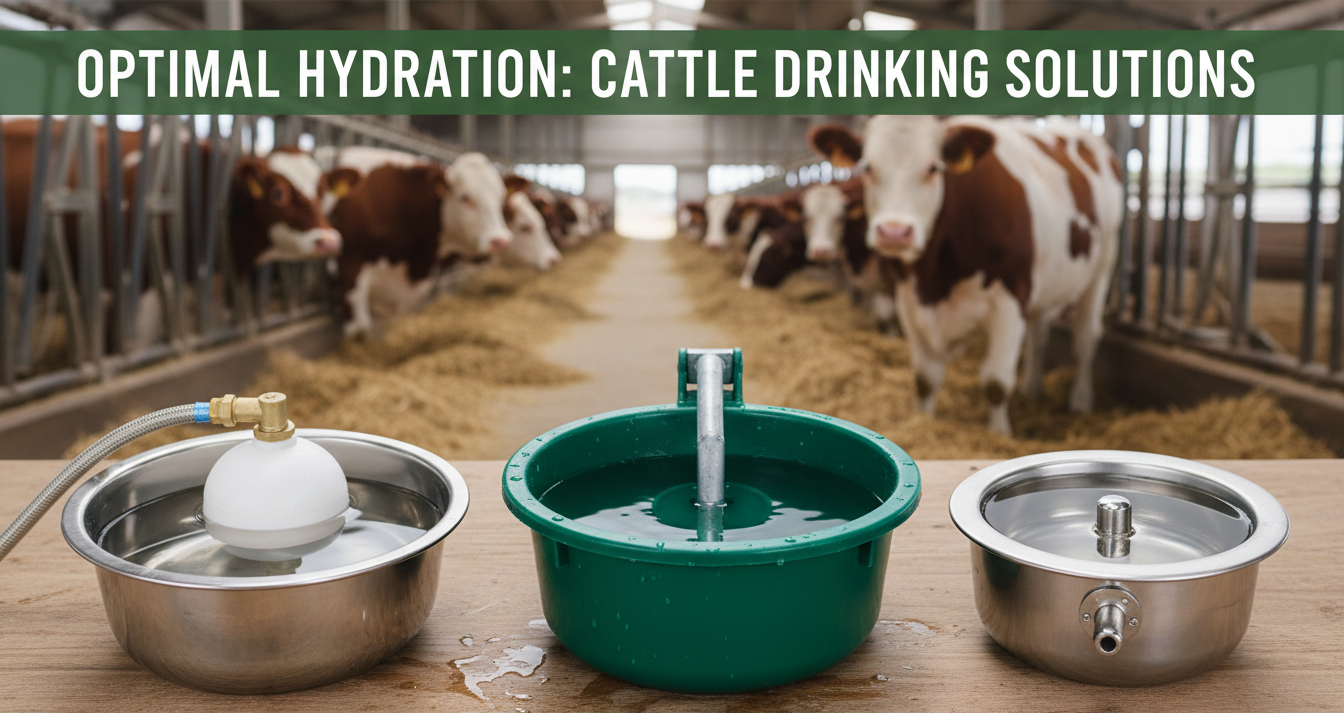
1. Float Valve Systems: How They Work and Pros/Cons
Float valve drinking bowls represent the traditional, time-tested approach to cattle hydration — and they remain the most widely deployed system globally for good reason. The mechanism is elegantly simple: a buoyant float connected to a valve body rises and falls with the water level in the bowl. When the cow drinks and the water level drops, the float descends and opens the inlet valve to allow fresh water to enter. When the water reaches the preset level, the float rises and closes the valve.
The float valve operates on a completely passive principle — no cow action is required to activate water flow. This is its primary advantage across all farm types. From a 600-cow dairy operation in Wisconsin to a 30-cow family farm in Jiangsu, the float valve delivers water without requiring the animal to learn any specific drinking behavior. The cow approaches the bowl, lowers its head, and drinks. The moment the water level drops, the float responds and refills.
However, this simplicity comes with a significant downside: float valves are prone to water wastage through three mechanisms. First, cows naturally play with the floating mechanism — the bobbing action attracts curiosity, especially in heifers, and cows will deliberately push the float down and let it rise repeatedly. Second, the constant water level encourages spillage as cows splash water while drinking or simply rest their muzzles in the bowl. Third, the mechanical float seal can wear or misalign over time, causing slow continuous leakage even when not in use. Field data from Journal of Dairy Science studies indicates 20-30% water wastage is typical for float valve systems in commercial operations.
According to DairyNZ, float valve wastage primarily occurs during the flushing action when cows first approach the bowl.
The durability of float valve systems is both their greatest strength and a potential weakness. The mechanism has no spring-loaded parts that fatigue, no seals that wear from repeated activation cycles, and no sensitive activation triggers. A well-maintained float valve assembly can function reliably for 8-12 years with only annual seal replacement. The primary failure mode is float puncturing or cracking (typically from cleaning equipment impacts) and valve body corrosion in areas with hard water or high mineral content.
Float valves are the optimal choice in three specific scenarios:
- Tie-stall barns: where cows have limited movement and cannot redirect water spillage easily
- Operations with limited technical support: where simplicity outweighs efficiency gains
- Older facilities with existing float valve infrastructure: where retrofitting would exceed budget
2. Paddle Valve Technology: Self-Drinking Mechanism Explained
Paddle valve drinking bowls introduce a mechanical activation layer between the cow and the water supply — requiring the animal to push a paddle or lever to initiate water flow. While this adds a learning curve, it fundamentally changes the drinking event from passive consumption to active engagement, dramatically reducing incidental water loss.
The paddle mechanism works through spring-loaded activation. When the cow pushes the paddle inward (typically with its muzzle or tongue), it compresses a spring and opens the water valve. Water flows as long as the paddle is held in the activated position. When the cow releases the paddle, the spring returns it to the closed position and water flow stops. This immediate shutoff is the key to water savings — water only flows during active drinking.
Water savings with paddle valves typically range from 40-50% compared to float valves. This means a cow that would consume 100 liters daily with a float valve system drinks approximately 50-60 liters with a paddle valve — the difference is actual consumption versus wastage. For a 100-cow operation, this translates to annual water savings of 1.5-2.0 million liters and corresponding sewage/disposal cost reductions. DairyNZ research demonstrates paddle valve systems can recover their installation cost within 18-24 months through water savings alone.
The American Veterinary Medical Association recommends regular valve maintenance regardless of type.
The primary disadvantage of paddle valves is maintenance complexity. The spring mechanism that provides controlled activation is also the primary failure point. Springs can fatigue (typically 2-4 years of heavy use), pivot points can corrode or seize, and the seal around the paddle housing can deteriorate. In my experience at Sound Hardware analyzing warranty claims, approximately 70% of paddle valve failures relate to spring fatigue or seal degradation. Budget for seal replacement every 6-12 months in high-use environments.
Paddle valves require training. Cows new to paddle valve systems typically take 3-7 days to learn the activation mechanism. First-lactation heifers adapt faster (2-4 days) than older cows transferred from float valve systems (7-14 days). During the training period, water consumption may temporarily decrease by 10-15% as animals adapt. This is normal and resolves quickly. We recommend introducing heifers to paddle valves at 8-10 months of age before first calving — they adapt faster and carry the behavior forward into lactation.
Paddle valves are best suited for:
- Free-stall barns: where water efficiency gains are multiplied across large herds
- Operations with technical staff: capable of performing bi-annual maintenance
- Mid-size operations (100-500 cows): where the efficiency-to-complexity ratio favors paddle systems
3. Nipple Valve Basics: Modern Dairy Farm Choice
Nipple valve drinking bowls represent the most water-efficient mainstream technology available — and they are rapidly becoming the default choice for new dairy installations worldwide. The principle is straightforward: water is available only when the cow presses its mouth against the nipple (like a poultry waterer but scaled for bovine anatomy and behavior). The cow initiates flow by pressing, and flow stops when the cow releases.
The water savings are substantial: 60-75% reduction in water wastage compared to float valves. The mechanism eliminates splash loss entirely (there is no bowl to splash in), eliminates play behavior (the activation requires intentional mouth engagement), and eliminates overflow (no water level is maintained to leak or evaporate). A well-designed nipple valve system supplies water only during actual drinking consumption.
For a concrete example: a 600-kg lactating Holstein consuming 100-120 liters of water daily under a float valve system will actually drink approximately 45-55 liters with a nipple valve. The remaining 45-65 liters — previously wasted through spillage, play, and evaporation — is saved. At $0.50 per 1,000 liters (typical municipal/well water cost), the per-cow annual savings is $8-12 in water costs. Factor in reduced sewage disposal (often charged at 60-80% of water intake), and total savings reach $15-30 per cow annually. For a 200-cow operation, this is $3,000-$6,000 annually — typically 3-5 times the retrofit cost.
Nipple valve technology does require the highest initial learning investment from the herd. Cows must learn to press the nipple with sufficient force to activate flow (typically 15-25 Newtons of pressure). Some cows, particularly those transferred from float valve systems, initially struggle with the concept. Training typically takes 7-14 days for a complete herd transition. During this period, monitor water consumption closely — hydration stress can reduce milk yield by 5-10% if left unaddressed. AVMA animal welfare guidelines recommend gradual transitions over 10-14 days for any water system change.
Research from academic studies confirms reduced water waste improves herd health outcomes.
The long-term maintenance profile of nipple valves is favorable. The primary wear points are the rubber seal around the nipple (annual replacement typically) and the activation valve itself (3-5 year replacement). Unlike paddle valves with their spring mechanisms, nipple valve activation is simpler — less can go wrong. The nipple itself (the stainless steel or composite trigger that the cow presses) typically lasts 3-5 years with normal use before needing positioning adjustment or replacement.
Nipple valves are optimal for:
- New construction and major renovations: where the investment in training is justified by long-term efficiency
- Large herds (200+ cows): where scale multiplies savings
- Water-scarce regions: where every liter saved directly impacts operational sustainability
- Pasture-based systems: where water efficiency helps maintain grazing area conditions
4. Water Consumption Comparison Across Valve Types
Understanding the actual usage numbers is essential for accurate cost-benefit analysis. The following table synthesizes field data from multiple research sources and Sound Hardware customer operational data across 50+ installations. All figures represent average consumption patterns for mature Holstein cows in mid-lactation (150-250 days in milk).
| Valve Type | Water Consumed L/cow/day | Water Wasted % | Total Usage L/cow/day | Annual Cost per Cow (USD) |
|---|---|---|---|---|
| Float Valve | 75-85 | 25-30% | 100-120 | $18-22 |
| Paddle Valve | 75-85 | 10-15% | 85-95 | $15-17 |
| Nipple Valve | 75-85 | 3-5% | 78-88 | $14-16 |
Key observations from this comparison:
- The actual water consumption (intake) is consistent across all valve types. Cows drink to meet their physiological needs regardless of the delivery mechanism. The difference is entirely in wastage.
- Float valves waste the most water but require the least cow training and maintenance. For operations where labor is the primary constraint, this trade-off may be acceptable.
- Nipple valves deliver the best efficiency but require the most training investment. The 7-14 day training period is a real cost that must be budgeted.
- Annual costs assume municipal/regional water at $0.50/1,000 liters and sewage at 70% of water intake. In regions with higher water costs or stricter environmental regulations, the savings proportionately increase.
Beyond direct water costs, consider secondary economic impacts:
- Manure volume and handling: Less wasted water means less manure to handle, store, and dispose. At approximately 20-30 liters/cow/day difference between float and nipple systems, the annual manure reduction is 7,000-11,000 liters per cow.
- Bedding management: Reducing water spillage in barns means drier bedding, reduced bacterial load, and potentially lower somatic cell counts. Several Sound Hardware customers in the Midwest US reported 10-15% SCC reductions after converting from float to nipple valve systems.
- Pen/floor maintenance: Less water in walkways reduces slip hazards and improves hoof health outcomes indirectly.
5. Selecting the Right Valve for Your Farm Type
The best valve type depends entirely on your specific operational context — there is no universal answer, only context-appropriate recommendations. Let me walk through the decision framework we use with Sound Hardware customers to match valve technology to farm requirements.
Tie-Stall Barns: Float valves remain the standard.
In tie-stall configurations where each cow has a fixed position, the advantages of float valve simplicity outweigh the efficiency penalties. Cows cannot move between stalls to access multiple watering points, so each stall must have consistently available water. The spillage from individual float valves accumulates in dedicated gutter/catchment systems rather than wetting bedding. For tie-stall operations with 50-200 cows, the maintenance burden of paddle or nipple systems rarely justifies the efficiency gains. Sound Hardware offers float valve drinking bowls designed for tie-stall installations with heavy-duty brass valve bodies rated for 15+ years of continuous service.
Free-Stall Barns: Choose based on management capacity.
Free-stall configurations present the efficiency-versus-complexity trade-off most acutely. Watering points are distributed throughout the pen (typically 1 watering station per 10-15 cows), creating multiplicative waste if float valves are used. However, the distributed access means cows can be monitored and trained more easily — if one cow struggles with a paddle or nipple system, neighbors demonstrate the correct behavior.
For free-stall operations with strong technical staff (capable of bi-annual maintenance), paddle valves offer the best efficiency-to-complexity ratio. The 40-50% water savings recover the additional maintenance time within the first year.
For free-stall operations seeking maximum efficiency or building new facilities, nipple valves are increasingly the default choice. The 60-75% water savings compound across large herds, and modern designs with wide-mouth activation reduce the training period to 5-7 days for most herds.
Pasture and Grazing Systems: Nipple valves preferred.
Outdoor watering presents unique challenges: float valves can freeze in cold climates, and water spillage creates muddy areas around watering points that damage grazing patterns. Nipple valves address both concerns — no standing water to freeze, no spillage to create mud. For rotational grazing operations, nipple valve systems on portable troughs allow water to move with the herd without creating permanent mud holes.
Key consideration for pasture systems: nipple valve flow rate. Multiple cows may drink simultaneously from the same trough during grazing rotation arrival. Ensure the valve is rated for minimum 10-12 liters per minute flow during peak demand. Standard dairy nipple valves typically deliver 8-10 L/min — adequate for most situations but potentially insufficient when 20+ cows arrive at a trough simultaneously. Our high-flow pasture valve models deliver 14-16 L/min for demanding grazing operations.
Transition Timeline and Budget Considerations
If converting from an existing valve type, plan a phased transition:
- Months 1-2: Install new valve systems in 1-2 pens/pastures while maintaining existing systems in remaining areas.
- Months 2-3: Train herd progressively — move trained animals to new pens, keep undertrained animals in familiar pens.
- Months 3-4: Full herd transition complete; begin removing old systems.
- Year 1 end: Evaluate water savings against projected figures; adjust management if needed.
This 3-4 month transition minimizes stress and allows data collection to validate the efficiency improvements.
According to Cooperative Extension studies, water system efficiency directly impacts milk quality.
FAQ
Q: What is the best valve type for tie-stall dairy barns?
Float valve drinking bowls remain the best choice for tie-stall barns. The constant water availability ensures every cow has uninterrupted access to water from its fixed position. The 20-30% wastage is acceptable because spillage is contained in dedicated drainage systems rather than wetting bedding. For tie-stall operations where labor for maintenance is limited, the float valve has 8-12 year service life with minimal intervention that outweighs the efficiency penalties. At Sound Hardware, our float valve models for tie-stall installation include reinforced mounting brackets and corrosion-resistant valve bodies rated for continuous operation. Browse our tie-stall drinking bowl options with specifications matched to various barn configurations.
Q: How much water do nipple valves save compared to float valves?
Nipple valves reduce water wastage by 60-75%, saving 15-25 liters per cow per day. For a 100-cow operation, this equals 550,000-900,000 liters annually. At typical water costs of $0.50/1,000 liters plus sewage disposal at 70% of intake, the annual cost savings is $15-30 per cow. For a 200-cow operation, this is $3,000-$6,000 annually — typically 3-5 times the retrofit installation cost within the first year. The savings compound over the 10-15 year lifespan of quality nipple valve systems, making this one of the highest-ROI investments in modern dairy infrastructure.
Q: Which valve type requires the most maintenance?
Paddle valve systems require the most maintenance. The spring-loaded activation mechanism has wearing components that need attention every 6-12 months — seal replacement, spring inspection, and pivot point lubrication. Float valves are the lowest maintenance (annual seal inspection only), and nipple valves fall in the middle (annual seal replacement plus 3-5 year valve body inspection). For operations considering paddle valves, budget for 2-4 hours of technical labor per 50 cows annually for proper maintenance.
Q: How long does it take to train cows to use nipple valves?
Training typically takes 7-14 days for a complete herd transition from float or paddle valves. First-lactation heifers adapt in 5-7 days — they have no existing behavior to unlearn. Older cows transferred from float valve systems require 10-14 days. During training, monitor water consumption closely; a 10-15% temporary decrease is normal. To accelerate training, spray a light molasses solution on the nipple surface for the first 3-5 days — the sweet taste encourages cows to press and discover the water flow. Per DairyNZ animal welfare guidelines, gradual transitions of 10-14 days are recommended for any water system change to minimize stress.
As noted in Merck Veterinary Manual, hydration status directly affects milk production.
Q: What flow rate is needed for multiple cows drinking simultaneously?
Each nipple valve should deliver minimum 10-12 liters per minute for free-stall and pasture installations where multiple cows drink simultaneously. Standard dairy nipple valves typically flow 8-10 L/min — adequate when cows drink sequentially but potentially insufficient during peak demand (e.g., when a group arrives at a trough after milking). For operations exceeding 15 cows per watering station, or for pasture systems with rotational grazing where 20+ cows may arrive simultaneously, specify high-flow valves rated at 14-16 L/min. The flow rate difference of 4-6 L/min per valve can mean the difference between all cows hydrating adequately and 2-3 cows dominating the water access while others wait.
Ready to optimize your herd water systems?
Browse our complete drinking bowl range — float, paddle, and nipple valve options for every farm type. Or contact our sales team for personalized recommendations based on your herd size and facility configuration.
Post time: May-19-2026