
TL;DR
- Most poultry vaccination programs use fine needles, commonly around 18 G to 22 G, but the correct gauge must follow the vaccine label, bird size, injection route, and veterinarian-approved program.
- Thin water-based vaccines usually flow through smaller-gauge needles, while viscous oil-emulsion or high-adjuvant vaccines often require a larger internal bore to keep pressure and dosing time practical.
- Needle length matters as much as gauge because intramuscular, subcutaneous, and wing-web applications place vaccine at different tissue depths.
- For export buyers, the safest procurement method is to map vaccine viscosity, dose volume, bird age, syringe type, and farm throughput before confirming needle specification.
In export sourcing, I would not approve a poultry needle order from gauge alone. I would ask for the vaccine type, dose volume in milliliters, route, age or weight of birds, injection speed target, syringe model, and whether the customer is using a hand syringe, automatic vaccinator, or multi-dose system. That may sound fussy. It is not. It is the difference between a smooth vaccination day and a line of operators fighting blocked needles, tissue trauma, and inconsistent dose delivery.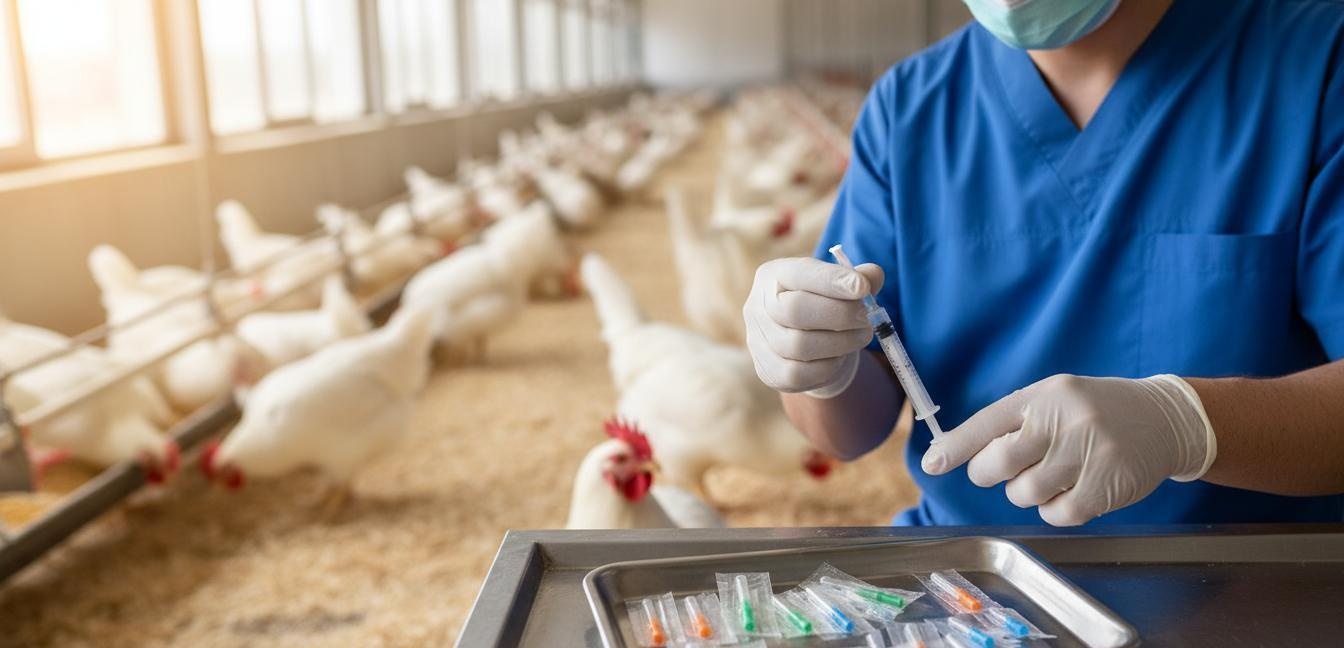
How Should Buyers Map Needle Gauge to Poultry Vaccination Conditions?
Buyers should map needle gauge by starting with the vaccine label and veterinary protocol, then matching the needle bore to bird size, route, dose volume, vaccine viscosity, and equipment pressure. Gauge is an inverse number: a higher gauge number generally means a smaller outside diameter and a narrower bore. A 22 G needle is finer than an 18 G needle. For poultry, that matters because a smaller bore can reduce puncture size, but it can also raise resistance when the vaccine is thick.
A veterinary needle gauge is the standardized diameter category of a hollow injection needle, and in practice it tells the buyer how much physical space the liquid has to pass through. The detail many catalogues hide is that internal diameter also depends on wall thickness. Two needles can both be labeled 20 G, yet a thin-wall version may flow more easily than a regular-wall version. For large purchasing programs, this is where a specification sheet becomes more valuable than a short product name.
Here is a practical selection table for procurement discussion. It is intentionally conservative and should be treated as a starting point for technical confirmation, not as medical direction.
| Use condition | Typical gauge discussion range | Viscosity and flow note | Procurement check |
|---|---|---|---|
| Small birds, low-viscosity aqueous vaccine, small dose such as 0.1 ml to 0.2 ml. | 21 G to 22 G is often discussed when label and route allow it. | Thin liquids usually need less injection force, so a finer needle can be practical. | Confirm route, bird age, dose accuracy, and needle length with the vet program. |
| Broilers or layers receiving routine injectable vaccination by trained operators. | 19 G to 21 G is a common technical discussion range. | Moderate viscosity may still flow well if the syringe and needle wall are matched. | Verify hub fit, bevel consistency, and operator injection speed. |
| Oil-emulsion or high-adjuvant vaccine with noticeably slow flow. | 18 G to 20 G may be considered to reduce pressure. | Higher viscosity increases resistance, so a wider bore can reduce plunger force. | Confirm vaccine label handling temperature, mixing instructions, and vet approval. |
| Automatic syringe or high-throughput flock operation. | Often 18 G to 21 G depending on viscosity and dose volume. | Flow stability matters more because thousands of repeated injections amplify small resistance differences. | Test with the actual syringe, tubing if used, and planned injection rhythm. |
| Wing-web or route-specific applicator programs. | Use the applicator or vaccine supplier specification, not a generic hypodermic gauge rule. | The applicator design controls dose placement and should not be substituted casually. | Request route-specific device compatibility documents before purchase. |
My strongest purchasing rule is simple: do not let a sales catalogue override the vaccine label. According to Merck Veterinary Manual, poultry vaccination success depends on correct vaccine handling, administration, and flock health status, not only on the physical device. According to the WOAH Terrestrial Manual, vaccine quality and correct administration are part of disease control reliability. Those two points sound obvious until a buyer asks for “just the cheapest 20 G needle” for five different vaccines.
Why Does Vaccine Viscosity Change Needle Gauge Selection?
Vaccine viscosity changes needle selection because thicker fluids need more pressure to move through the same bore, and that pressure affects injection speed, operator fatigue, dose consistency, and tissue impact. In plain language, a viscous vaccine behaves less like water and more like light oil. If the bore is too narrow, the operator feels it immediately in the plunger. The needle may not be blocked, but the flow is slow enough to disturb rhythm.
Viscosity is the resistance of a fluid to flow, and for vaccines it is influenced by formulation, adjuvant system, storage temperature within label limits, mixing state, and time out of refrigeration. Because oil-emulsion vaccines can be more viscous than aqueous vaccines, so they often need either a wider bore, a slower stroke, or a tested automatic syringe setup to deliver the same dose without excessive force. A buyer who ignores viscosity may order a fine needle that looks humane on paper but performs poorly in a commercial vaccination line.
The physics is unforgiving. Flow through a small tube is highly sensitive to internal radius. A small reduction in bore can create a disproportionate increase in resistance. That does not mean always choose a bigger needle. Bigger needles can increase puncture size and may be inappropriate for small birds or certain routes. It means that viscosity and bore should be considered together, not separately.
In one internal bench comparison we use for buyer education, we timed a 0.5 ml dose pushed through three poultry needle samples using a manual syringe at a steady operator stroke. With a water-like test liquid, the difference between 20 G and 22 G was noticeable but manageable. With a glycerin-thickened training liquid at approximately 40 mPa·s at 22°C, the 22 G sample required about 2.4 times longer delivery time than the 20 G sample under the same hand force. This is not a vaccine efficacy test and should not replace veterinary validation. It is a procurement lesson: viscosity turns small bore differences into large workflow differences.
That test also made one operator laugh in frustration because the 22 G line looked fine on a specification sheet. After 200 simulated strokes, it did not feel fine. I remember the sound of the plunger squeaking against the barrel in the test room; it was the kind of small detail that tells you the field team will complain by lunchtime. This is why I prefer buyers to request a sample kit before locking a container order.
What Specification Details Matter Besides Gauge?
The buyer should specify needle length, wall type, bevel sharpness, hub material, hub fit, packaging, sterility status, and compatibility with the selected syringe system, not only gauge. Gauge tells you diameter category, but it does not tell you whether the needle will seat securely on the syringe or whether the bevel will remain consistent across production lots.
Needle length is route-sensitive. Intramuscular injection requires a different tissue depth than subcutaneous placement, and wing-web systems are a separate route-specific category. I will not give route prescriptions here because that belongs to the vaccine label and the veterinarian’s program. From a manufacturing and export angle, however, I would ask whether the buyer needs lengths such as 10 mm, 12 mm, 13 mm, 16 mm, or another route-specific dimension, and whether the length tolerance is defined. A 1.0 mm difference can be meaningful in small animals.
Wall type is also important. A thin-wall needle can preserve outside diameter while increasing internal bore, which improves flow without necessarily moving to a lower gauge number. In other words, a buyer facing moderate viscosity does not always need to jump from 21 G to 19 G. Sometimes a properly made thin-wall 20 G needle and a slower injection rhythm solve the practical problem. This is the kind of option that only appears when procurement, veterinary supervision, and supplier engineering talk to each other.
Bevel quality affects penetration force. Poor grinding, burrs, or inconsistent bevel geometry can increase tissue drag and operator resistance. According to ISO 9626, stainless steel needle tubing is covered by dimensional and mechanical requirements for medical device tubing; although buyers must confirm the exact veterinary-use standard applicable to their market, ISO-style dimensional thinking is still useful for supplier audits. According to ISO 7864, sterile hypodermic needles for single use include requirements relevant to needle performance and packaging concepts; veterinary reusable needles may follow different product rules, so buyers should not copy human single-use assumptions blindly.
Hub fit matters because poultry farms often use multi-dose syringes under repetitive motion. A loose hub is maddening. Worse, it can create leakage or dose variation. For Sound-AI-style veterinary syringes and needles, the commercial conversation should include the syringe connection type, cleaning procedure if reusable, needle replacement frequency, and whether the buyer needs copper hub, stainless hub, or disposable configurations for their market.
How Can Export Buyers Build a Safe Gauge Selection Process?
A safe export selection process uses a written specification matrix, sample testing with the actual vaccine or an approved simulator, and documented confirmation from the buyer’s veterinary authority before mass purchase. This process reduces the risk of selecting a needle that is technically attractive but operationally wrong.
I recommend a six-step workflow. Each step is short, but skipping one can be expensive.
- Collect the vaccine label and administration instructions, including dose volume in ml, route, storage temperature, and any device instruction stated by the manufacturer.
- Confirm the veterinarian-approved vaccination program, including bird age, bird type, flock health condition, and operator training requirements.
- Classify the vaccine as low, moderate, or high viscosity for procurement purposes, using supplier data or controlled in-house flow testing when allowed.
- Select two or three candidate needle specifications rather than one, such as 20 G regular-wall, 20 G thin-wall, and 19 G regular-wall for a moderate-to-viscous product.
- Test delivery time, leakage, hub stability, dose repeatability, and operator comfort using the actual syringe model and realistic flock-line rhythm.
- Document the final choice in a purchasing specification that includes gauge, length, wall type, hub, packaging, lot traceability, and acceptance criteria.
Because poultry vaccination is a biological control activity, so procurement should treat needles as risk-control components rather than simple consumables. The cheapest needle is not cheap if it causes slow work, wasted vaccine, or rejected field performance. At the same time, over-specifying the needle can raise cost without improving results. The buyer’s job is to find the narrow practical window where animal welfare, dose delivery, operator efficiency, and unit cost all make sense.
For a distributor, I would create a viscosity-to-gauge product card for each market. It should not say use this needle for this disease. That crosses into veterinary direction. Instead, it should say: for low-viscosity injectable vaccines under vet-approved poultry programs, customers often evaluate these gauge and length ranges; for viscous oil-emulsion products, customers often request these larger-bore or thin-wall alternatives. That wording helps sales teams answer technical questions without pretending to be veterinarians.
How Should Buyers Compare 18 G, 20 G, and 22 G Needles for Poultry?
Buyers should compare 18 G, 20 G, and 22 G needles by balancing flow speed against puncture size and route suitability: 18 G usually offers easier flow for viscous liquids, 22 G usually offers a finer puncture for thin liquids, and 20 G often becomes the middle-ground candidate. This is a procurement comparison, not a universal field instruction.
| Dimension | 18 G candidate | 20 G candidate | 22 G candidate |
|---|---|---|---|
| Flow with viscous vaccine | Usually easier because the bore is wider. | Often workable for moderate viscosity. | May be slow if viscosity is high. |
| Puncture size | Larger puncture and therefore must be justified by route and program. | Middle-ground puncture size. | Finer puncture when label and route allow it. |
| Operator force | Lower force for the same viscous liquid and dose. | Moderate force in many setups. | Higher force when liquid is thick or cold within label limits. |
| High-throughput use | Can support faster flow but must be evaluated for tissue impact. | Often a practical sample-test starting point. | Better suited to thin liquids and carefully controlled speed. |
| Common buying risk | Over-sizing the needle because flow feels easier. | Assuming it fits every vaccine and route. | Underestimating pressure and delivery time for viscous vaccines. |
A simple cost comparison can also mislead. A higher-quality thin-wall needle may cost 8% to 18% more than a basic regular-wall alternative, primarily because tighter tubing control, bevel grinding, hub assembly, and inspection add manufacturing cost. That premium may be justified if it prevents flow problems in a high-throughput operation. It may be wasted if the vaccine is thin, the dose is small, and the veterinary program already specifies a simpler needle. I like numbers, but I dislike fake precision. The right answer is validated in the buyer’s actual workflow.
What Quality Checks Should Be Included in the Purchase Specification?
The purchase specification should include dimensional tolerance, flow confirmation, bevel inspection, hub pull-off or fit testing, corrosion control for reusable needles, packaging integrity, lot traceability, and incoming inspection sampling. These checks help buyers avoid the same gauge, different performance problem that appears too often in low-cost sourcing.
For dimensional control, request outside diameter and length tolerances, and ask whether the supplier can provide internal bore information or wall type. For bevel control, request microscope inspection records or a defined visual standard. For hub control, define connection compatibility and leakage acceptance. For packaging, define carton labeling, lot coding, and moisture protection. If the product is reusable, define cleaning compatibility and expected replacement policy; if it is sterile single-use, define sterilization documentation required by the importing market.
According to the FAO Animal Health resources, vaccination is part of broader animal-health management, which means device reliability supports but does not replace biosecurity, cold chain, and trained administration. According to the NIOSH needlestick prevention guidance, sharps handling creates injury risk for workers; poultry operations should adapt sharps safety and disposal practices to local regulations and farm conditions. These references are not poultry needle catalogues, but they remind buyers that device selection is part of a larger risk system.
Supply-chain transparency also matters for export. A responsible supplier should be able to explain raw material sourcing for stainless tubing, hub material selection, grinding and cleaning steps, in-process inspection, final sampling, and logistics protection. When a buyer asks for 500,000 needles, we make good quality is not enough. I want lot numbers, inspection criteria, and a clear complaint-response process. That is not bureaucracy. It is how you protect both the flock owner and the importer.
What Is a Practical Specification Template for RFQ?
A practical RFQ should define the use case without asking the supplier to make veterinary decisions: state the vaccine viscosity class, dose volume, route category, syringe model, preferred gauge candidates, needle length, hub type, packaging, and documentation requirements. The supplier can then recommend manufacturable options while the veterinarian confirms suitability.
Use this static selector as a non-interactive procurement worksheet:
- Bird type and age range: for example broiler chick, pullet, layer, breeder, or turkey, with weight range if available.
- Vaccine category: aqueous, suspension, oil-emulsion, or other formulation as described by the vaccine supplier.
- Dose volume: specify the exact dose such as 0.1 ml, 0.2 ml, 0.3 ml, or 0.5 ml.
- Route category: intramuscular, subcutaneous, wing-web, or other route as stated by the label and vet program.
- Candidate needle: include gauge, length in mm, wall type, bevel, hub material, and connection type.
- Equipment: specify manual syringe, automatic syringe, tubing system, or applicator model.
- Throughput target: state expected birds per operator per hour, because rhythm changes perceived flow performance.
- Quality documents: request certificate of conformity, lot traceability, inspection plan, and market-specific compliance documents.
For international buyers, I would also include incoterms, carton size, shelf-life or storage requirement if sterile, and replacement parts if the needle is used with reusable equipment. If your market requires particular veterinary device registration, ask for documents before the deposit. It is painful to discover a documentation gap after production. I have seen shipments sit while the product itself was acceptable but the paperwork was not. That is avoidable.
FAQ
Is 20 G the best all-purpose poultry vaccination needle?
20 G is often a useful middle-ground candidate, but it is not automatically the best all-purpose needle. It may balance flow and puncture size in many programs, yet the final choice must follow the vaccine label, bird size, route, viscosity, syringe system, and veterinarian-approved protocol. Buyers should test at least two candidate specifications before bulk purchasing.
Should I use a larger needle for oil-emulsion poultry vaccines?
Oil-emulsion vaccines are often more viscous, so buyers commonly evaluate a larger bore or thin-wall needle to reduce injection pressure. However, the larger needle must still be appropriate for the bird and route. Confirm the vaccine manufacturer’s instructions and the veterinarian’s program before changing gauge.
Does warming a vaccine solve viscosity problems?
Temperature can affect viscosity, but vaccine handling must stay inside the label-approved storage and use conditions. Do not warm, dilute, shake, or alter a vaccine outside the manufacturer’s instructions. If flow is difficult under correct handling conditions, evaluate needle bore, wall type, syringe design, and injection speed instead.
Is a finer needle always better for animal welfare?
A finer needle can reduce puncture size, but it is not always better if it causes excessive pressure, slow delivery, or inconsistent dosing. Animal welfare depends on correct route, sharp bevel, trained handling, clean equipment, accurate dose, and minimal stress. The correct needle is the one validated for the full vaccination program.
What information should I send to a needle supplier?
Send the dose volume, vaccine viscosity class, route category, bird age or weight range, syringe model, target throughput, candidate gauge range, needle length, hub type, and required documents. Do not ask the supplier to replace veterinary judgment. Ask the supplier to translate the approved program into a reliable manufactured specification.
Can the same needle be used for all poultry vaccines on a farm?
One needle specification may not fit all poultry vaccines because formulations, routes, dose volumes, and bird ages differ. A farm or distributor should maintain a specification matrix that separates aqueous vaccines, viscous vaccines, route-specific applicators, and different bird size groups.
Buyer Takeaway
The best poultry vaccination needle specification is not a single gauge number; it is a documented match between vaccine viscosity, route, bird size, dose volume, syringe equipment, and veterinary confirmation. If you are sourcing for a distributor, integrator, or poultry farm network, build a sample test around your real workflow before ordering at container scale. To discuss manufacturable veterinary needle and syringe options, review Sound-AI’s syringes and needles category and prepare your RFQ with the specification template above.
Request a viscosity-to-gauge sample evaluation worksheet for your procurement team.
Post time: May-18-2026