
EU Animal Health Certificate for Livestock Equipment Import | Sound Hardware
TL;DR — Key Takeaways
- Livestock equipment that has contacted animals or animal products requires an EU Animal Health Certificate (Part I) issued by the exporting country’s competent authority — equipment that has never contacted animals is exempt but still requires manufacturer declarations and commercial documentation.
- The TRACES NT system is the mandatory electronic platform for all EU animal health import documents — paper certificates are not accepted for regulated products, and all submissions must be electronic before the shipment arrives at the EU border.
- Border Inspection Post (BIP) physical inspection rates for livestock equipment range from 5% to 100% depending on the commodity risk category — and the importer pays all inspection fees (€150-€500 per inspection plus storage costs).
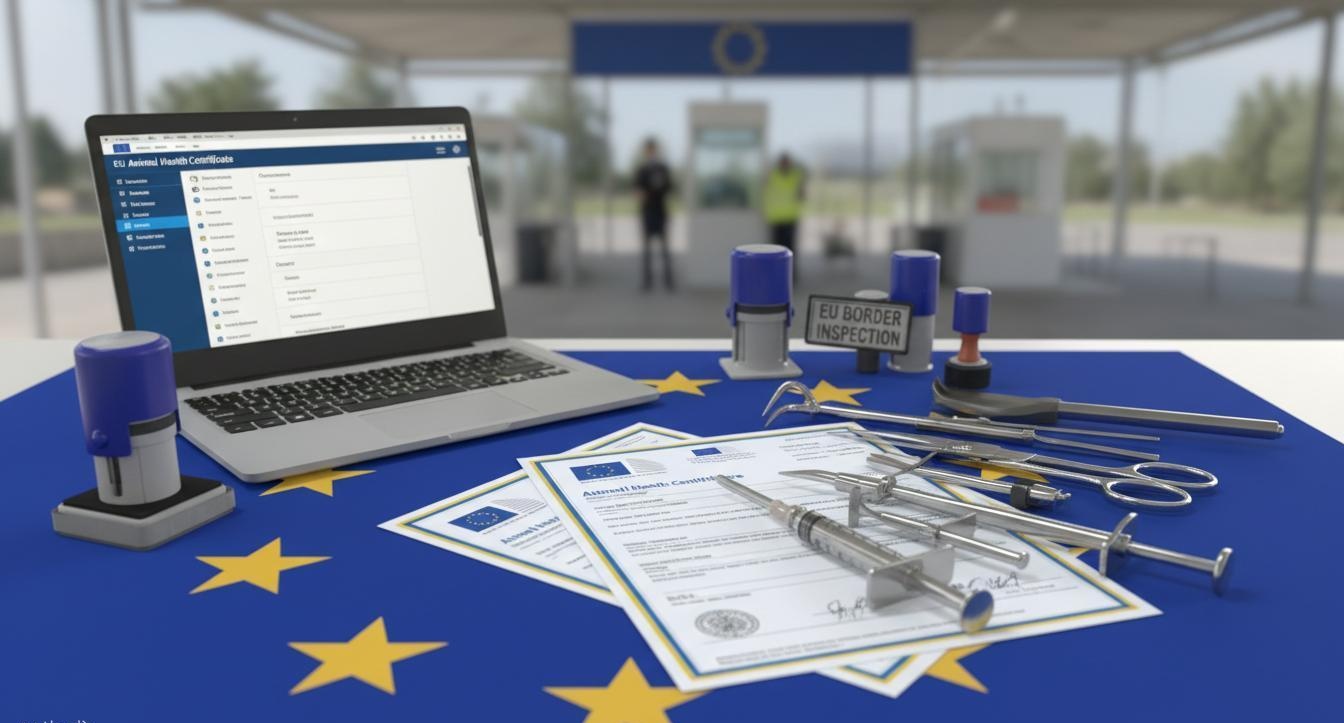
Why Livestock Equipment Imports Face Tighter Health Controls Than Most Trade Goods
I have exported livestock equipment from China to the European Union for over a decade at Sound Hardware, and the regulatory trajectory has been clear: each major animal disease outbreak — foot-and-mouth disease (FMD) in 2001 UK, African swine fever (ASF) since 2018, highly pathogenic avian influenza (HPAI) outbreaks — results in stricter import controls on anything that could potentially carry pathogens across borders. Livestock equipment sits in a gray zone that regulators increasingly treat as a risk pathway: it is not an animal, but it has been in contact with animals, and it is made of materials (plastics, metals) that can harbor viable virus particles on their surfaces for hours to days depending on conditions.
The legal basis is Regulation (EU) 2016/429 — the EU Animal Health Law, which establishes a comprehensive framework for preventing and controlling animal diseases transmissible to animals or humans. Under this regulation, any product of animal origin or product that may transmit animal diseases must be accompanied by an animal health certificate when entering the EU. The key phrase is “may transmit animal diseases” — this is the regulatory hook that brings livestock equipment under health certificate requirements, because equipment used on farms and in veterinary procedures “may” carry pathogens.
The practical consequence for importers: a stainless steel AI gun or a set of drinking bowls, if shipped as used equipment or if manufactured in a facility that also handles animal products, may require an EU animal health certificate even though the products themselves contain no animal-derived materials. I have seen shipments detained at Rotterdam and Hamburg because the exporter assumed “it’s just metal and plastic, no certificate needed” — and the border veterinarian’s risk assessment disagreed.
According to World Organisation for Animal Health (WOAH) standards, fomite transmission — the movement of pathogens on inanimate objects like equipment, clothing, and vehicles — is a recognized and significant disease spread pathway. The EU incorporates WOAH standards into its regulatory framework, which is why livestock equipment faces tighter health controls than, say, construction hardware or consumer electronics. The importer bears the burden of proving the equipment is safe, not the other way around.
EU Animal Health Certificate Part I vs Part II: What Each Document Actually Certifies
The EU animal health import certificate system has two parts, and the distinction is critical: Part I certifies the animal health status of the product (that it is free from specified animal diseases and meets EU import health requirements), while Part II certifies the public health status (that it meets food safety and hygiene standards applicable to products intended for human consumption). For livestock equipment that is not intended for human consumption — which is the case for AI guns, syringes, cow magnets, and drinking bowls — only Part I (animal health) is relevant, unless the equipment will come into contact with food-producing animals in a way that could affect food safety.
Part I of the certificate is issued by the competent veterinary authority in the exporting country — in China, this is the General Administration of Customs of the People’s Republic of China (GACC), specifically the local Customs offices with veterinary inspection authority. The certificate must be issued on the official EU model certificate format, signed and stamped by an official veterinarian, and must include: description of the consignment (product type, quantity, packaging), origin of the goods, destination in the EU, means of transport, and the specific animal health attestations required for that category of product. Each certificate is shipment-specific — you cannot reuse a certificate from a previous shipment, and the certificate must be issued within 10 days of the shipment date.
The Part I certificate also requires a unique certificate reference number (generated by TRACES) that links the paper certificate to the electronic record. Without this reference number, the border inspection post cannot validate the certificate, and the shipment will be detained. At Sound Hardware, we work with GACC Ningbo office for certificate issuance and always initiate the process at least 15 working days before the scheduled shipment date to account for document review and potential corrections.
TRACES NT System: How to Register, Create and Submit Health Certificate Applications
TRACES (TRAde Control and Expert System) NT is the European Commission’s online platform for animal health and food safety certification — it is the mandatory electronic system for all EU animal health import documentation. The system was upgraded to TRACES New Technology (NT) in 2020, and all certificates issued after January 2021 must use the TRACES NT format. Every importer, exporter, and certifying authority involved in regulated animal health imports must have a TRACES account.
Registration requires: an EU Login account (the European Commission’s single sign-on system), selection of the appropriate user role (economic operator, certifying officer, or border control), and verification of business details including Economic Operators Registration and Identification (EORI) number. The EORI number is issued by the customs authority in the EU member state where the importer is established and is required for all customs procedures in the EU.
The certificate creation process: the EU importer (or their agent) initiates a Common Health Entry Document (CHED) in TRACES NT, specifying the commodity type, country of origin, estimated arrival date, and border inspection post. The exporter in the country of origin then completes the relevant certificate template within TRACES, the certifying officer (official veterinarian in the exporting country) reviews and signs electronically, and the completed certificate is linked to the CHED. When the shipment arrives at the EU border, the border inspector accesses the electronic certificate via TRACES and performs document, identity, and physical checks as required. Paper certificates are still generated and must accompany the physical shipment, but the TRACES electronic record is the authoritative version.
Per European Commission TRACES guidance, the entire certificate lifecycle — from creation through border control clearance — is tracked in TRACES, creating a complete audit trail for each consignment. This means any discrepancy between the electronic certificate and the paper version attached to the shipment will be flagged at the border and will result in detention pending clarification.
Required Supporting Documents: Commercial Invoice, Packing List, Manufacturer Declarations
In addition to the animal health certificate, a complete EU import documentation package for livestock equipment requires: commercial invoice (must match certificate product description exactly), packing list (with carton-level detail), bill of lading or airway bill, manufacturer declaration of non-animal origin (if applicable), and any relevant testing or treatment certificates. The manufacturer declaration is particularly important for equipment that has never contacted animals — it is the document that establishes the exemption from animal health certificate requirements. This declaration must state: the products are new and unused, have been manufactured in a facility that does not process animal-derived materials, and have never been in contact with animals, animal products, or materials of animal origin. It must be on company letterhead, signed and dated by an authorized representative.
The commercial invoice must use the Harmonized System (HS) code exactly as it appears on the certificate and all other documents. A mismatch between the HS code on the invoice and the code on the CHED is one of the most common reasons for border clearance delays.
Border Inspection Post (BIP) Requirements: Which Equipment Triggers Physical Inspection
EU Border Inspection Posts (now called Border Control Posts, BCPs, under the new Official Controls Regulation (EU) 2017/625) are the designated entry points for consignments of animals and animal products. For livestock equipment, the inspection frequency depends on the commodity risk category assigned in the EU’s risk categorization framework. Category I (highest risk) commodities face 100% documentary, identity, and physical checks. Category II commodities face 100% documentary checks, 100% identity checks, and a reduced physical check frequency (typically 15-50%). Category III (lowest risk) commodities face 100% documentary checks and reduced identity and physical checks.
Most livestock equipment — if classified correctly as equipment rather than animal products — falls into the lowest risk categories, but this classification is determined by the specific commodity code and the risk assessment in TRACES. Border inspection fees: documentary check (€40-€80 per consignment), identity check (€30-€60), physical inspection (€150-€500 depending on sampling requirements). Storage fees at the BCP typically run €50-€150 per day. These costs are borne by the importer and are separate from freight, duties, and VAT. Per European Commission BCP list, importers must designate the specific BCP where the consignment will enter the EU — this must be chosen in advance and recorded in the CHED.
Post-Import Obligations: Record Keeping and Traceability Requirements After Clearance
After import clearance, EU Regulation (EU) 2016/429 requires importers to maintain complete records of each consignment for a minimum of 3 years. The required records include: the TRACES CHED reference number and digital certificate, paper certificate (if issued), commercial invoice, packing list, transport documents, and any border inspection reports or corrective action documentation. The traceability requirement means that importers must be able to trace each consignment from the border entry point to the first destination within the EU — typically the importer’s warehouse or the end customer’s facility.
Failure to maintain records for the required 3-year period is a compliance violation subject to member state penalties, which vary by country but typically range from €500 to €5,000 for first offenses and can escalate to business license suspension for repeated violations. At Sound Hardware, we provide our EU import clients with a complete documentation package including the animal health certificate (when required), manufacturer declarations, and quality certificates, all organized for easy retrieval during EU member state inspections.
Frequently Asked Questions
- Q1: What is the EU animal health certificate requirement for livestock equipment imports?
- Livestock equipment that has contacted animals or animal products requires an EU Animal Health Certificate (Part I) issued by the competent authority in the exporting country. New, unused equipment never in contact with animals may be exempt but requires manufacturer declaration and commercial documentation. The certificate must be submitted through TRACES NT before shipment arrival at the EU border inspection post.
- Q2: How do I use the TRACES system to apply for an import health certificate?
- The EU importer initiates a Common Health Entry Document (CHED) in TRACES NT, specifying commodity type, origin, arrival date, and border inspection post. The exporter completes the certificate template, the certifying officer (official veterinarian) signs electronically, and the completed certificate is linked to the CHED. Registration requires an EU Login account and EORI number.
- Q3: What documents are required for EU livestock equipment import clearance?
- Required documents include: Animal Health Certificate (Part I) if applicable, commercial invoice (HS codes must match exactly across all documents), packing list with carton-level detail, bill of lading/airway bill, manufacturer declaration of non-animal origin, and any testing or treatment certificates. All documents must reference the same TRACES CHED number.
- Q4: How long does EU border inspection take for veterinary equipment shipments?
- Documentary checks typically take 1-3 working days. Physical inspection, if selected, adds 2-5 working days depending on BCP workload. Total inspection time ranges from 1 to 8 working days. Storage fees (€50-150/day) apply during the entire inspection period. Advance CHED submission (minimum 1 working day before arrival) reduces inspection delays.
- Q5: What records must I keep after importing livestock equipment into the EU?
- Importers must maintain complete records for a minimum of 3 years per EU 2016/429, including: TRACES CHED reference and digital certificate, paper certificate, commercial invoice, packing list, transport documents, and border inspection reports. Records must enable traceability from border entry to first EU destination. Penalties for non-compliance range from €500 to €5,000.
External References: EU Animal Health Law 2016/429 · EC TRACES System · EC BCP List · WOAH · EFSA · EU Customs Union · WTO SPS Agreement · EUROSTAT
Useful Links
Post time: May-20-2026