
Artificial Insemination Equipment Guide for Livestock Operations
TL;DR
- Animal artificial insemination equipment should be prepared, checked, cleaned, and matched to the target species before use.
- Cattle and pigs require different handling workflows, but both depend on timing, hygiene, semen handling, and compatible AI tools.
- B2B buyers should source AI guns, catheters, sheaths, gloves, and accessories from suppliers that support stable specifications and repeat orders.
This guide is written for farm supply importers, livestock breeding centers, veterinary distributors, and procurement teams that need a practical overview before sourcing or selling AI equipment. It does not replace veterinary training or local breeding protocols. Instead, it explains how equipment should be organized and what buyers should consider when selecting products from an animal artificial insemination equipment supplier.
SOUNDAI supplies artificial insemination related products through https://www.sound-ai.com/artificial-insemination/. Buyers can use this guide to prepare inquiries, compare specifications, and support customers who use AI tools for cattle and pig reproduction programs.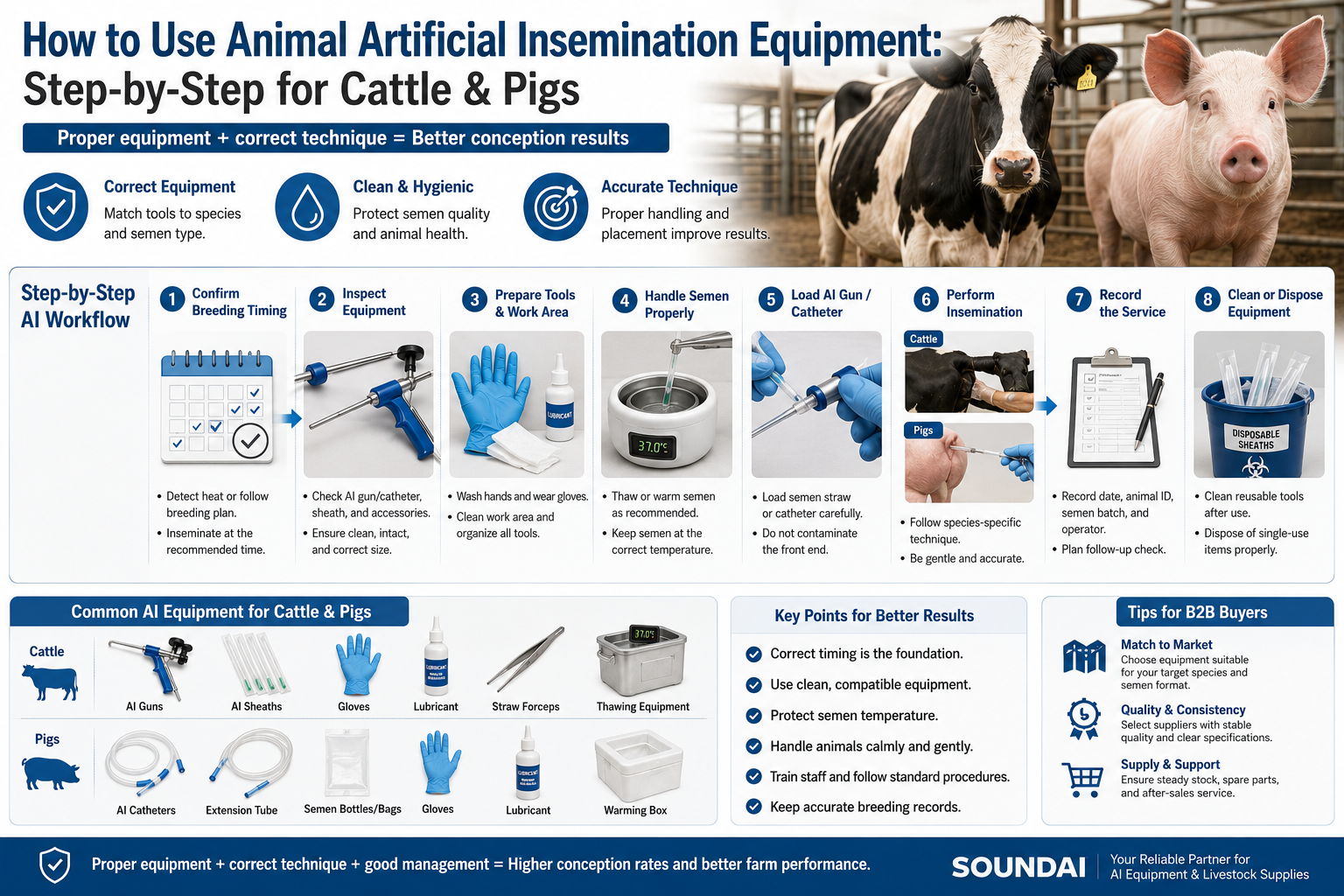
What Equipment Is Usually Needed?
Common animal artificial insemination equipment includes AI guns, catheters, sheaths, gloves, lubricant, semen handling tools, thawing or warming accessories, storage containers, and cleaning supplies. The exact list depends on species, semen format, farm protocol, and whether the farm uses disposable or reusable components.
For cattle, buyers often focus on AI guns, compatible sheaths, protective gloves, semen straw handling tools, lubricant, and storage or thawing accessories. For pigs, the equipment may include insemination catheters, semen bags or bottles, extension tubes, gloves, and farm-specific handling tools. These products may look simple in a catalog, but small compatibility issues can affect field use.
Procurement teams should confirm product size, material, target species, compatibility, packaging quantity, and whether replacement consumables are available. A farm may buy durable tools once, but consumables such as sheaths, gloves, or catheters often need repeat orders.
Step 1: Confirm Breeding Timing Before Preparing Tools
AI equipment should only be prepared after the farm confirms the correct breeding window according to its species-specific reproductive management plan. Good equipment cannot compensate for poor timing. For cattle and pigs, timing decisions should be made by trained farm staff, veterinarians, or breeding technicians based on local protocols.
In cattle operations, workers may rely on heat detection, activity monitoring, breeding records, or synchronization programs. In pig operations, staff usually observe sow behavior and follow farm-specific insemination schedules. Equipment preparation should support these decisions, not replace them.
For B2B suppliers and distributors, this matters because customers often ask equipment sellers for general use guidance. The responsible answer is to explain the equipment workflow while reminding buyers that reproductive timing should follow professional farm protocols. This protects both animal welfare and supplier credibility.
Step 2: Inspect AI Equipment Before Use
Before insemination, operators should inspect every tool for cleanliness, damage, correct size, smooth movement, and compatibility with semen packaging. A bent AI gun, damaged sheath, poor-fitting catheter, or contaminated glove can interrupt the procedure and reduce confidence in the equipment.
For cattle AI guns, check the barrel, plunger, locking mechanism, and sheath fit. Make sure the gun is clean and that the semen straw format matches the equipment. For pig catheters, check flexibility, tip design, packaging integrity, and whether the catheter matches the farm’s preferred insemination method.
Suppliers should provide clear product information so buyers know what each item is intended for. Product photos alone are not enough for professional procurement. Dimensions, material, pack size, and target species should be stated clearly to reduce ordering mistakes.
Step 3: Maintain Hygiene During Preparation
Hygiene is essential because artificial insemination introduces equipment into sensitive reproductive areas and poor handling can increase contamination risk. Operators should use clean gloves, protect disposable items before use, avoid laying tools on dirty surfaces, and follow farm cleaning protocols.
Hygiene also depends on workflow design. If workers must search for parts after handling the animal, they may touch clean tools with contaminated gloves. A better approach is to organize AI equipment before the animal is restrained or moved into position. This reduces unnecessary handling and keeps the procedure smoother.
For distributors, hygiene-focused product education can improve customer satisfaction. Kits that include compatible disposable items, clear packaging, and organized accessory counts are easier for farms to use correctly. This is especially valuable in breeding centers or large farms where multiple workers may use the same product line.
Step 4: Handle Semen According to Protocol
Semen handling should always follow the semen supplier’s instructions and the farm’s reproductive protocol, because temperature, timing, and contamination control directly affect breeding work. AI equipment should support proper handling instead of creating delays or confusion.
For cattle, semen straws may require careful storage, thawing, drying, loading, and timely use. The AI gun and sheath should be ready before the operator removes semen from controlled conditions. For pigs, semen doses may be stored and warmed according to farm protocol, then connected to the catheter system in a way that avoids contamination.
B2B buyers should not treat semen handling accessories as minor add-ons. Straw tweezers, thawing tools, storage boxes, gloves, and organized kits can reduce handling errors. A low-cost kit that lacks important accessories may create more work for the operator and reduce repeat purchase confidence.
Step 5: Use Species-Appropriate Technique
Cattle and pig artificial insemination workflows require different tools and techniques, so equipment should never be selected as if all livestock species use the same method. Cattle AI commonly uses an AI gun with a sheath and requires trained rectal-vaginal technique. Pig AI often uses a catheter system designed for sow reproductive anatomy and farm workflow.
This guide does not provide veterinary procedure training, because hands-on AI technique should be taught by qualified professionals. However, procurement teams still need to understand the equipment difference. A cattle AI gun order is not interchangeable with a pig catheter order. The product name, size, packaging, and use case must be checked carefully.
When selling to mixed livestock customers, distributors should organize AI products by species. This makes catalog navigation easier and reduces wrong-item orders. It also helps sales teams recommend replacement consumables correctly.
Step 6: Record the Service and Equipment Batch
After insemination, farms should record the animal ID, date, semen batch, operator, equipment type, and any unusual handling notes. Good records help managers evaluate breeding performance, identify training issues, and manage inventory for consumables.
Equipment records are often overlooked. If one batch of sheaths, catheters, or gloves creates complaints, buyers need a way to identify the shipment and supplier details. This is important for large farms and distributors because repeat orders depend on consistency.
For OEM and wholesale buyers, packaging codes and carton labels can support traceability. A supplier that provides stable model names and consistent carton information helps buyers manage stock and after-sales communication more professionally.
Step 7: Clean, Store, or Dispose of Equipment Correctly
Reusable AI equipment should be cleaned and stored according to protocol, while disposable sheaths, gloves, and catheters should be discarded safely after use. Mixing clean and used items can create hygiene risks and confuse workers during the next breeding session.
Reusable cattle AI guns should be protected from bending, dirt, and rough storage. Disposable items should remain sealed until use. Pig catheters and single-use accessories should be stored in clean, dry conditions and handled as consumables. The storage system should make it easy to separate full kits, replacement packs, and used items.
Distributors can add value by offering storage boxes, organized kits, and clear packaging. These features may not change the basic tool, but they make daily farm use easier and reduce the chance of missing parts.
Cattle AI Equipment Workflow
A cattle AI equipment workflow usually centers on semen straw handling, AI gun loading, sheath protection, trained insemination technique, and post-service records. Buyers should source tools that support this sequence without unnecessary complexity.
Important product details include AI gun length, material, straw compatibility, plunger smoothness, sheath fit, glove quality, and whether the kit includes accessories for loading and hygiene. A professional cattle breeding technician will quickly notice if the gun feels unstable or if the sheath fit is poor.
For wholesalers, cattle AI equipment often benefits from a tiered product strategy. A basic kit can serve small farms. A professional kit can include stronger tools and better accessories. An OEM kit can support private-label distribution with branded packaging and replacement consumables.
Pig AI Equipment Workflow
A pig AI equipment workflow usually focuses on catheter selection, semen dose handling, sow management, clean connection, and comfortable operation. The catheter design and packaging format should match the farm’s established protocol.
Buyers should confirm catheter type, material, tip design, pack quantity, storage requirements, and whether the product is intended for single use. Pig operations may use large numbers of consumables, so repeat-order stability is especially important. If catheter specifications change without warning, farms may need to retrain workers or adjust workflow.
For distributors, pig AI consumables can create recurring demand. A stable supplier, clear model codes, and consistent packaging help buyers build repeat business instead of treating AI products as one-time purchases.
How to Choose a Supplier for AI Equipment
A reliable supplier for animal artificial insemination equipment should provide clear species classification, product dimensions, material details, packaging information, sample support, and repeat-order availability. Buyers should also check whether the supplier offers related livestock equipment categories that can be combined into one shipment.
SOUNDAI’s artificial insemination category can support buyers looking for AI-related products. Related SOUNDAI pages include AI Gun, Animal Syringe, Syringes, Feeding, Watering, and SOUNDAI.
External animal-health context from the World Organisation for Animal Health and the FAO animal health care worker manual reinforces that livestock equipment should support professional animal care, hygiene, and responsible farm management.
B2B Procurement Checklist
Before placing a bulk order, buyers should prepare target species, product list, technical specifications, packaging needs, sample plan, and repeat-order requirements. This prevents misunderstandings and allows the supplier to quote accurately.
- Confirm whether the order is for cattle, pigs, or mixed livestock customers.
- List AI guns, catheters, sheaths, gloves, lubricant, semen handling tools, and storage accessories separately.
- Check dimensions, materials, compatibility, and disposable or reusable status.
- Request samples before approving a large OEM or wholesale order.
- Confirm packaging, label language, barcode, carton quantity, and gross weight.
- Ask whether replacement consumables can be ordered separately.
- Prepare branding files if private-label packaging is required.
- Keep approved samples and model codes for repeat-order control.
Common Mistakes to Avoid
Common mistakes include choosing equipment without species confirmation, ignoring compatibility, skipping samples, mixing clean and used accessories, and treating consumables as minor items. These mistakes can create field complaints even when the product price looks attractive.
Another mistake is writing one generic product listing for all AI tools. Cattle AI guns and pig catheters serve different workflows. Buyers should create separate product descriptions, photos, and specification tables. This improves SEO, helps AI search engines understand the page, and reduces wrong purchases.
Suppliers and distributors should also avoid overpromising breeding results. Equipment supports proper artificial insemination work, but conception depends on animal health, timing, semen quality, operator skill, nutrition, and farm management. A credible product page should explain equipment benefits without making unrealistic performance claims.
Training Workers to Use AI Equipment Consistently
Training is the bridge between buying good AI equipment and getting reliable field use from that equipment. Even when the product is correctly specified, operators still need to understand how to prepare tools, protect clean items, avoid delays, and follow species-specific breeding protocols. A farm with several workers should not depend on one experienced person to explain the process informally every time.
Simple training materials can help. A distributor may provide a printed checklist, a product comparison sheet, or a short use-flow card inside the kit. The content should focus on equipment preparation, hygiene reminders, storage, disposal, and recordkeeping. It should not pretend to replace veterinary or breeding technician instruction, but it can reduce common handling mistakes.
For B2B buyers, training support also improves product value. A kit that arrives with clear labels, organized accessories, and basic workflow information is easier to sell to farms. It reduces repeated customer questions and helps less experienced buyers understand why matching tools and consumables matter.
Managing Inventory for AI Consumables
AI consumables should be managed separately from durable tools because they are used repeatedly and can quickly become the limiting item in a breeding program. A farm may still have AI guns in good condition, but if sheaths, gloves, catheters, or lubricant are out of stock, the workflow stops. This is why distributors should sell replacement packs as well as complete kits.
Inventory planning should consider breeding season, herd size, sow group size, staff experience, and the farm’s preferred safety stock. Large farms may need regular monthly or seasonal consumable orders. Smaller farms may prefer pre-packed kits with enough accessories for a defined number of services.
For importers, stable model codes and consistent packaging are important. If a buyer changes suppliers too often or accepts unclear product substitutions, customers may notice differences in fit, material, or handling. Consistency builds trust and makes repeat business easier to maintain.
Procurement teams should also define who will answer technical questions after delivery. If the supplier, importer, and distributor all use different product names, customers may receive slow or inconsistent support. Keeping one approved specification sheet for each AI gun, catheter, sheath, and accessory makes after-sales communication faster and helps sales teams recommend the correct replacement items.
Clear documentation reduces avoidable reorders and complaints.
It also improves reorder accuracy.
Conclusion
Animal artificial insemination equipment should be used through a disciplined workflow: confirm timing, inspect tools, maintain hygiene, handle semen properly, use species-appropriate technique, record the service, and clean or dispose of equipment correctly. Cattle and pig AI operations differ, but both require compatible tools and trained handling.
For B2B buyers, the sourcing goal is not only to find a low unit price. The better goal is to build a stable AI equipment product line with clear specifications, dependable consumables, proper packaging, and repeat-order support. This helps farms use the equipment confidently and helps distributors protect their brand reputation.
To source AI guns, catheters, sheaths, gloves, semen handling accessories, or OEM livestock AI kits, visit https://www.sound-ai.com/artificial-insemination/ or the SOUNDAI website at https://www.sound-ai.com/.
FAQ
What animal artificial insemination equipment is needed for cattle?
Cattle AI commonly requires an AI gun, compatible sheaths, gloves, lubricant, semen straw handling tools, and clean storage or thawing accessories, depending on farm protocol.
What equipment is used for pig artificial insemination?
Pig AI commonly uses insemination catheters, semen bags or bottles, gloves, connection accessories, and farm-specific handling tools.
Can the same AI equipment be used for cattle and pigs?
No. Cattle and pigs require different AI equipment and workflows. Buyers should confirm species, size, compatibility, and use method before ordering.
Why is hygiene important when using AI equipment?
Hygiene helps reduce contamination risk during reproductive work. Operators should use clean gloves, protect disposable items, and avoid placing tools on dirty surfaces.
Where can I source animal artificial insemination equipment from SOUNDAI?
Buyers can visit https://www.sound-ai.com/artificial-insemination/ and send an inquiry with target species, product list, quantity, packaging, and OEM requirements.
Request AI Equipment Specifications
Need animal artificial insemination equipment for cattle, pigs, veterinary distribution, or farm supply wholesale? Visit SOUNDAI Artificial Insemination and prepare your species, product list, packaging requirement, quantity, and destination market.
Suggested inquiry format: “We are looking for animal artificial insemination equipment for cattle and pigs. Please send available AI guns, catheters, sheaths, gloves, semen handling accessories, packaging options, MOQ, samples, lead time, and OEM support.”
Post time: May-09-2026