
Livestock Equipment HS Code Classification: Correct Tariff Codes for AI Guns, Syringes, Magnets and Drinking Bowls | Sound Hardware
TL;DR — Key Takeaways
- HTS heading 9018.32 covers AI guns as “tubular metal needles and needles for sutures and parts and accessories thereof” — but this classification is contested and may alternatively fall under 9018.39 (other instruments), making binding ruling requests essential for first-time importers.
- Using the wrong HS code can trigger customs audits reaching back 5 years, with penalties of 20% of underpaid duties plus interest — the cost of a binding ruling request (US$300-500) is trivial compared to the risk of a multi-year audit assessment.
- Cow magnets are the most classification-disputed livestock product — they can be classified under Chapter 82 (tools), Chapter 84 (machinery parts), or Chapter 90 (veterinary instruments) depending on the specific magnet type and material composition.
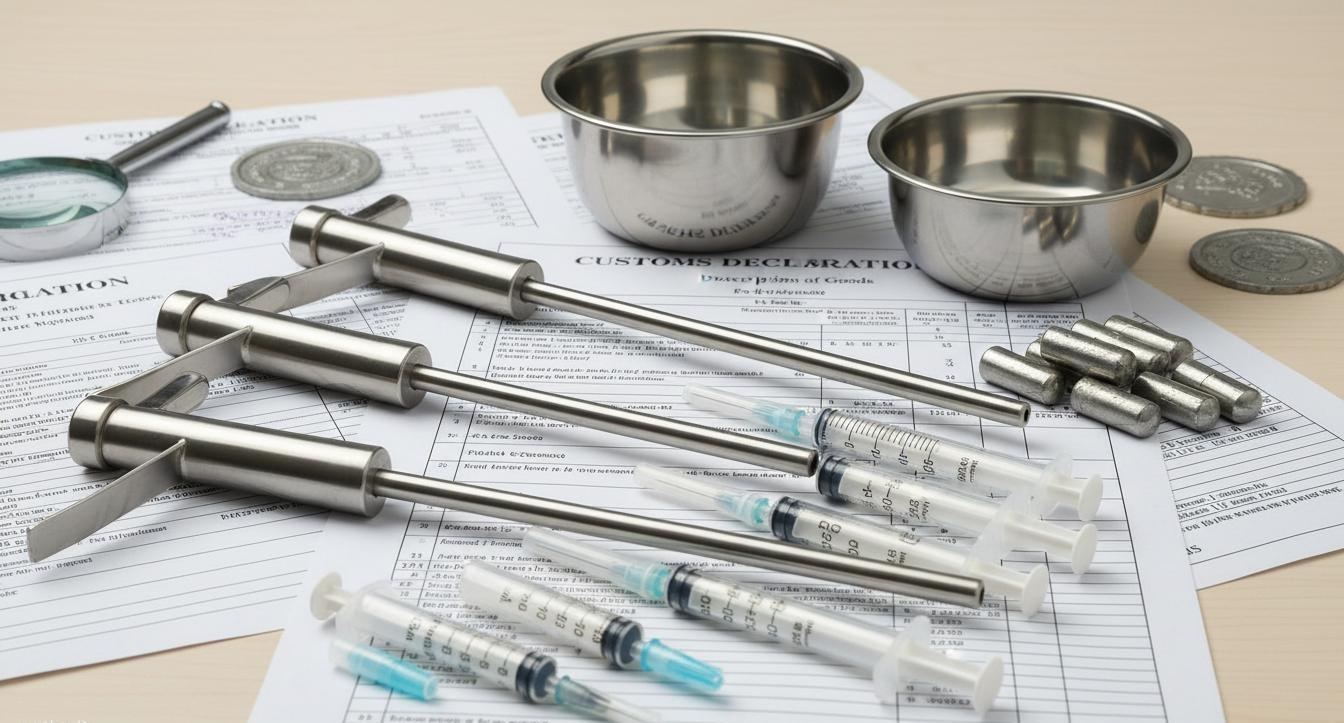
Why Using the Wrong HS Code Can Trigger Customs Audits and Penalty Assessments
In my twelve years of exporting livestock equipment from Ningbo to every major market, HS code misclassification is the single most expensive administrative error an importer can make — and it is also the most common. I have seen an Australian importer receive a US$47,000 penalty notice from Australian Border Force because their broker had been classifying AI gun cassettes under HS 3926.90 (other plastic articles, duty rate 5%) instead of 9018.39 (other medical instruments, duty rate 0% in Australia — but subject to entirely different regulatory requirements). The goods had been clearing correctly for 3 years before an audit caught the error, and the full 3 years of underpaid duties (even though the rate was lower) plus penalties and interest came due in a single demand letter.
The WCO Harmonized System is governed by the International Convention on the Harmonized Commodity Description and Coding System, which establishes the first 6 digits of the HS code globally. Beyond those 6 digits, individual countries add their own statistical suffixes. The General Rules for the Interpretation of the Harmonized System (GIRs) provide the legal framework for classification, with GIR 1 establishing the primacy of the heading text and section/chapter notes, GIR 2 covering incomplete or unfinished articles, and GIR 3 covering goods classifiable under multiple headings. The key rule for livestock equipment: if a product is “specially designed for veterinary use,” it tends to be classified under Chapter 90 (Optical, Photographic, Medical, Surgical Instruments) rather than under the material-based chapters.
Customs audit authority varies by country, but under the WTO Trade Facilitation Agreement, most countries allow retrospective audit periods of 3 to 5 years. In the US, US CBP can audit entries up to 5 years from the date of entry under 19 USC 1509, and under 19 USC 1592, penalties for negligent misclassification range from 20% to 40% of the underpaid duties. Gross negligence and fraud penalties are substantially higher. The lesson from 12 years in this industry: even a “favorable” misclassification (where your duty rate is lower than it should be) can result in penalties because it is still a violation of the importer’s obligation to use reasonable care in classification.
AI Guns and Cassette Tubes: HTS Chapter 9018 — The Veterinary Instrument Classification
Under the Harmonized System, veterinary artificial insemination instruments are classified under heading 9018 — “Instruments and appliances used in medical, surgical, dental or veterinary sciences.” The subheading structure within 9018 is: 9018.31 (syringes, with or without needles), 9018.32 (tubular metal needles and needles for sutures, and parts and accessories thereof), and 9018.39 (other instruments and appliances — a residual category).
AI guns present a classification challenge because they combine a metal cannula (the insertion tube) with a plastic or metal body and a plunger mechanism. The metal cannula is functionally equivalent to a tubular metal needle — but it is not a hypodermic needle, and it does not pierce tissue in the same way. Customs authorities in different countries have classified AI guns under three different subheadings: 9018.32 (as “tubular metal needles”), 9018.39 (as “other instruments”), and even 9018.31 (as “syringes”) when the AI gun mechanism is similar to a syringe plunger.
Cassette tubes and AI sheaths — the disposable plastic tubes used with AI guns — are typically classified under 9018.39 as accessories to veterinary instruments. However, if shipped separately from the AI gun, they may be classified by material (Chapter 39 for plastics) rather than by function (Chapter 90), depending on the specific country’s classification rulings. This is exactly the type of classification uncertainty that justifies a binding ruling request before commercial imports begin. At Sound Hardware, we provide the full technical specifications and material composition data for every AI product to help importers prepare binding ruling applications.
Veterinary Syringes and Needles: Subheading 9018.31 vs 9018.39 — The Precision Distinction
Veterinary syringes are classifiable under HS 9018.31 — “Syringes, with or without needles” — and this classification is generally consistent across all major importing countries. The World Customs Organization Explanatory Notes to heading 9018 explicitly include “syringes for medical or surgical uses (of glass, metal, plastics, etc.)” within the scope of 9018.31, and “veterinary uses” are included within the scope of heading 9018 as a whole.
The classification becomes more nuanced for: (1) syringe barrels shipped separately from plungers, (2) automatic or repeating syringes with dose-setting mechanisms, and (3) hypodermic needles shipped separately from syringes. Hypodermic needles — including veterinary needles — are classified under 9018.32 as “tubular metal needles,” not under 9018.31 as syringe parts. This distinction matters because different countries may apply different duty rates to 9018.31 vs 9018.32 entries. Needles made of stainless steel (SUS304 or SUS316L) with a plastic hub are still classified under 9018.32 based on the essential character of the needle, not the hub material.
For dose-controlled automatic syringes used in large-animal vaccination, the classification shifts to 9018.39 (other instruments) because the dose-setting mechanism makes the device more than a simple syringe — it becomes a “dosing instrument” in customs terminology. This is a classification distinction that has real cost implications: 9018.31 (standard syringes) often has a 0% duty rate in many FTA partner countries, while 9018.39 (other instruments) may carry a 2.5% to 5% duty rate in the same country.
Cow Magnets and Metal Hardware: Chapter 82 vs Chapter 84 — The Article vs Article Problem
Cow magnets (rumen magnets) are the most classification-contested livestock equipment product from China. The fundamental classification question is whether a cow magnet is: (a) a tool of base metal (Chapter 82), (b) a permanent magnet article (heading 8505), (c) an agricultural machinery part (Chapter 84), or (d) a veterinary instrument (Chapter 90). Different countries have reached different conclusions.
Under GIR 1, the heading text controls: if the magnet is described as a permanent magnet article (heading 8505 covers “permanent magnets and articles intended to become permanent magnets after magnetization”), then that heading takes priority unless the magnet is more specifically described elsewhere. However, if the magnet is “specially designed for veterinary use” — and cow magnets are — heading 9018 may take priority under the functional classification principle. The most common US import classification for cow magnets is under HTS 8505.11.00 (permanent magnets, metal), which carries a 2.1% duty rate, but some importers successfully classify them under 9018.39 (veterinary instruments, 0% duty rate).
The key to correct classification is the magnet’s primary function and design specificity. A generic cylindrical magnet that could be used in any industrial application is likely classifiable under 8505; a magnet specifically shaped, polished, and packaged for veterinary rumen insertion, with a diameter tolerance of ±0.2mm and a specific Gauss rating (typically 800-1,200 Gauss at surface), is more likely classifiable under 9018. I recommend importers photograph the magnet’s packaging and labeling as part of their binding ruling application — if the packaging says “For Veterinary Use Only” with dosage and insertion instructions, this supports 9018 classification.
According to USITC HTS database search and WCO classification opinions, the classification of veterinary magnets remains unsettled globally, with different WCO member countries issuing divergent rulings over the past decade. Per US CBP rulings database, at least 4 different CBP binding rulings have addressed cow magnet classification, and the results are not entirely consistent — which is exactly why binding ruling requests are essential for this product category.
Automatic Drinking Bowls and Watering Equipment: Chapter 84 vs Chapter 90
Automatic drinking bowls for livestock are fundamentally mechanical appliances — they use float valves, pressure valves, or tipping mechanisms to regulate water supply — and are correctly classified under Chapter 84 (Machinery and Mechanical Appliances). The specific subheading is 8424.81 (mechanical appliances for agricultural or horticultural use, including spraying and watering appliances). Drinking bowls with only a simple float mechanism and no electrical components are subclassified under 8424.81.90 for most country-specific tariff schedules.
The Chapter 90 argument — that drinking bowls are “veterinary instruments” — has been advanced by some importers seeking the typically lower duty rates of Chapter 90, but this classification has been rejected in every customs ruling I am aware of. The reasoning: drinking bowls serve a husbandry function (providing water) rather than a veterinary function (diagnosing, treating, or preventing disease), and their essential character is mechanical rather than medical. Drinking bowls that include water heating elements or electronic water level monitoring add complexity — the heating element may require separate classification or lead to classification under Chapter 85 (electrical machinery) for the electrical component, with the mechanical bowl classified separately.
Feeding troughs are generally classified under 8436.80 (other agricultural machinery) as agricultural appliances. The material of construction (plastic, galvanized steel, stainless steel) does not change the classification — the function as agricultural feeding equipment controls. According to WTO tariff data, 8436.80 duty rates in most developed countries range from 0% to 3.5%, making this a relatively low-cost tariff classification compared to some of the higher-rate chapters.
Binding Ruling Requests: How to Get Official Classification Confirmation Before You Ship
A binding ruling (also called an advance ruling or binding tariff information) is a written determination from a customs authority confirming the correct HS code for your specific product — and it is legally binding on that customs authority for a specified period (typically 3 years). For importers bringing in new or classification-uncertain livestock equipment, a binding ruling is the most cost-effective risk management tool available.
The application process: submit a written request to the relevant customs authority (US CBP for US imports, member state customs for EU BTI rulings, etc.) containing: full product description and technical specifications, material composition (percentages by weight), intended use, photographs and/or engineering drawings, commercial samples if available, proposed classification and justification, and the legal argument citing the relevant GIRs, heading text, and explanatory notes. The typical processing time for a binding ruling is 30 days for US CBP and 90 days for EU BTI, though complex classifications can take longer. There is no application fee for US CBP rulings; EU BTI applications typically cost €200-€500 depending on the member state.
At Sound Hardware, we maintain a library of HS classification documentation for every product we export, including technical specifications, material composition certificates, and sample documentation packages formatted for major importing countries’ ruling application requirements. I recommend importers file binding ruling requests at least 90 days before their first commercial shipment — this provides time for processing and, if the initial classification is challenged, for appeal or resubmission before the container leaves China.
According to CIPS procurement standards and International Chamber of Commerce best practices for international trade, HS code determination should be completed during the sourcing and contracting phase, not after the goods are manufactured and ready to ship. The classification decision affects: the commercial invoice (which must state the correct HS code), the certificate of origin (which links to the HS code for FTA eligibility), the letter of credit (if used), and the customs entry (which is the importer’s legal declaration). Fixing a wrong HS code after the goods are in transit is both more expensive and more legally risky than getting it right before production begins.
Frequently Asked Questions
- Q1: What is the correct HS code for veterinary AI guns imported from China?
- AI guns are classified under HS heading 9018 (veterinary instruments), with subheading either 9018.32 (tubular metal needles and accessories), 9018.39 (other instruments), or 9018.31 (syringes) depending on the specific mechanism design. Classification is contested between these subheadings. Importers should request a binding ruling from their country’s customs authority before first commercial import.
- Q2: What is the HS code for hypodermic needles used in livestock veterinary applications?
- Veterinary hypodermic needles are classified under HS 9018.32 — “tubular metal needles and needles for sutures.” This applies regardless of whether the needle hub is plastic or metal, based on the essential character of the needle. Needles shipped attached to syringes follow the syringe classification (9018.31); needles shipped separately fall under 9018.32.
- Q3: How do I classify cow magnets and magnetic metal devices for customs purposes?
- Cow magnets are contested between HS 8505.11 (permanent magnets, 2.1% US duty) and 9018.39 (veterinary instruments, 0% US duty). Magnets specifically shaped, polished, and packaged for veterinary use with veterinary labeling support 9018 classification. Generic cylindrical magnets fall under 8505. A binding ruling is recommended due to inconsistent global classification treatment.
- Q4: What is the tariff rate for livestock equipment under HTS Chapter 9018?
- Under US HTS, veterinary instruments in 9018.31 (syringes), 9018.32 (needles), and 9018.39 (other instruments) generally carry a 0% duty rate because most countries exempt medical/veterinary instruments from import duties under WTO agreements. However, country-specific FTA agreements may alter this — always verify with your country’s tariff schedule.
- Q5: How do I request a binding tariff classification ruling for livestock equipment?
- Submit a written request to your country’s customs authority containing: full product description, material composition, intended use, photos/drawings, samples if available, proposed HS code and legal justification citing GIRs. US CBP processes in ~30 days (free); EU BTI takes ~90 days (€200-500). File at least 90 days before first shipment.
External References: WCO HS Convention · USITC HTS Database · US CBP Rulings · WTO Tariff Data · ICC · CIPS · FIATA · EU TARIC
Useful Links
Post time: May-20-2026