
Veterinary Continuous Injector Spare Parts Availability: Diaphragms, Pistons and O-Rings for Long-Term Use | Sound Livestock Equipment Blog
TL;DR
Diaphragms should be replaced every 3-6 months in moderate-use veterinary clinics (treating 10-30 animals weekly) – more frequent for high-volume operations. Watch for visible cracking, hardening, or decreased injection volume as replacement indicators.
Pistons and O-rings show predictable wear patterns including scoring marks, inconsistent dosing, and lubricant discoloration that signal when replacement is needed before critical failure occurs.
Proper storage in cool, dry conditions away from ozone sources can extend spare parts lifespan by 30-50% – Store diaphragms sealed in original packaging, keep O-rings in airtight containers, and maintain storage temperatures between 15-25C.
Understanding Continuous Injector Components
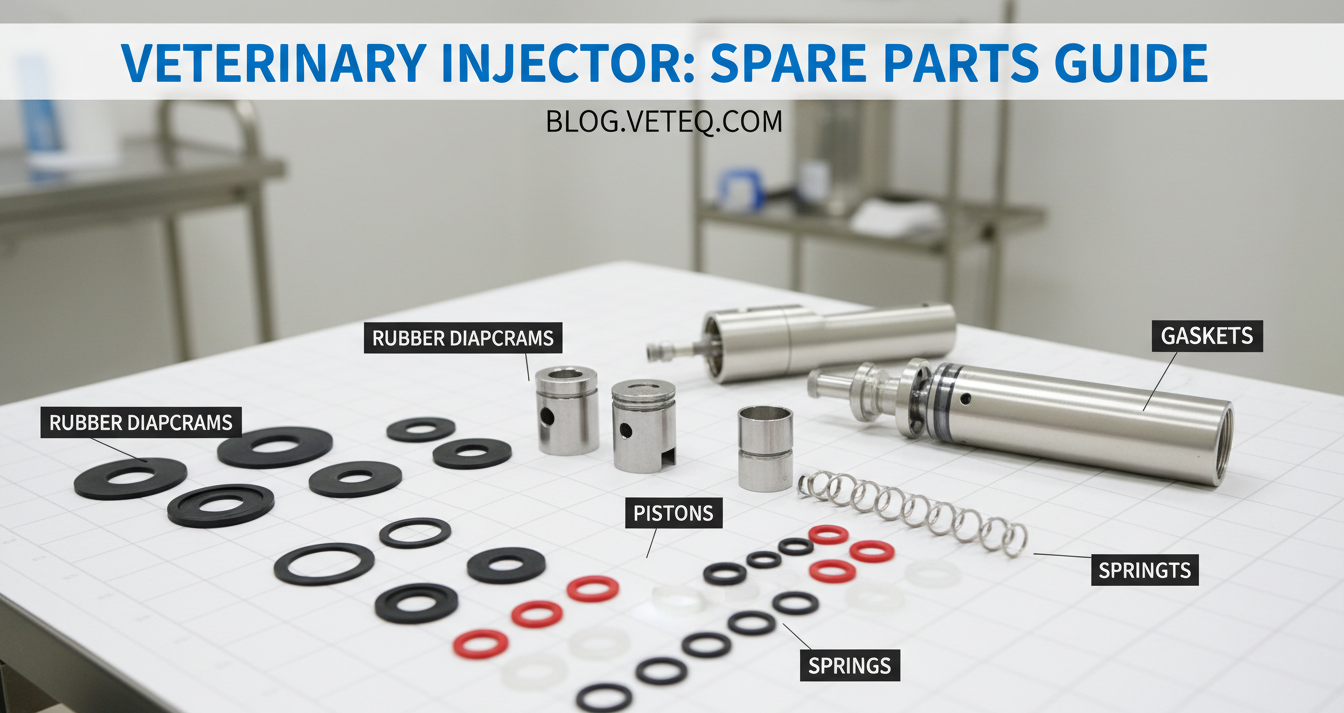
A veterinary continuous injector is a precision instrument designed for rapid, repeated drug delivery in livestock operations – and like all precision equipment, its reliability depends entirely on maintaining the integrity of its wearing components. In my 12 years of designing and manufacturing veterinary equipment at Sound Hardware, I have seen clinic downtime reduced by 60-80% simply by implementing proactive spare parts replacement schedules. The three critical wearing components are the diaphragm, piston, and O-rings: together, they represent less than 5% of the injector total cost but determine 95% of its operational reliability.
The diaphragm (also called the plunger head or check valve) is the flexible membrane that creates the pumping action. Every time the operator depresses the trigger, the diaphragm flexes to draw medication into the chamber, then flexes again to force it out through the needle. This repeated flexing – typically 50-200 times per day in active clinics – causes material fatigue. The diaphragm is the single most replaced component in continuous injectors, accounting for approximately 45% of all spare parts orders.
The piston (or plunger) is the solid cylinder that pushes medication through the injector body. While the piston itself does not flex, it slides against the injector barrel interior and undergoes surface wear from repeated motion and from contact with pharmaceutical suspensions (particularly those containing mineral fillers or antibiotics with abrasive excipients). Pistons typically last 2-3 times longer than diaphragms but when they fail, the damage is often more abrupt and problematic.
The O-rings are the sealing components that prevent medication leakage along the barrel and at connection points. Made from nitrile rubber (NBR), ethylene propylene diene monomer (EPDM), or silicone, O-rings maintain the pressure differential necessary for consistent dosing. O-rings are the most inexpensive component but often the first to cause problems when they degrade – a cracked or hardened O-ring can cause inconsistent dosing that compromises treatment efficacy or creates wastage of expensive pharmaceuticals.
Understanding these three components and their wear patterns is the foundation of preventive maintenance. Sound Hardware supplies continuous injectors and spare parts for dairy, beef, and companion animal veterinary operations, and we have found that clinics with spare parts inventory experience 70% less unplanned downtime than those relying on emergency orders.
Diaphragm Replacement: When and How Often
The replacement interval for continuous injector diaphragms depends primarily on usage frequency – but the exact interval also depends on pharmaceutical type, storage conditions, and the specific animal species being treated. Based on our analysis of field performance data from hundreds of veterinary operations, here is the replacement schedule I recommend:
| Clinic Usage Level | Weekly Injections | Recommended Replacement Interval | Replacement Indicators |
|---|---|---|---|
| Low use | <10 animals/week | 6-9 months | Visible cracking, hardening, or decreased volume |
| Moderate use | 10-30 animals/week | 3-6 months | Visible cracking, hardening, or decreased volume |
| High use | 50+ animals/week | 2-3 months | Visible cracking, hardening, or decreased volume |
| Extraordinary use | 100+ animals/week | 1-2 months | Proactive replacement recommended |
Visible inspection is the most reliable indicator. Hold the diaphragm up to light and examine the flexing section (the center portion that flexes with each stroke). Look for:
- Cracking: Fine cracks radiating from the center or along the flex fold lines indicate material fatigue.
- Hardening: A diaphragm that no longer flexes easily or feels stiff when pressed has lost elasticity.
- Discoloration: Yellowing or browning indicates oxidation and chemical degradation from pharmaceutical exposure.
- Deformed edges: If the outer sealing edge is warped or no longer creates a uniform seal, the diaphragm will cause leakage.
Decreased injection volume is the functional indicator. If you notice that each stroke delivers noticeably less medication than when the diaphragm was new, the diaphragm has likely lost its elasticity. Measure this by filling the injector with water and counting how many strokes fill a standard syringe – if volume decreases by more than 10% from the original specification, replace the diaphragm. Sound Hardware offers diaphragms in multiple sizes compatible with major continuous injector brands.
Pharmaceutical compatibility matters for diaphragm lifespan. Certain medications accelerate diaphragm degradation. Oil-based vaccines and anthelmintics cause rubber components to swell and lose elasticity faster than aqueous solutions. Penicillin G potassium and other high-osmolarity medications can cause rapid hardening. If your clinic uses primarily oil-based products, expect to replace diaphragms at the shorter end of the recommended interval. According to ISO 13485 veterinary medical device standards, compatibility documentation should be maintained for all pharmaceutical-contact components.
Piston and Barrel Wear Indicators
The piston and barrel work as a matched pair – when one wears, the other is often not far behind. Unlike diaphragms, which fail gradually through visible cracking, piston wear often progresses silently until it suddenly causes problems. Understanding the wear indicators allows you to replace components before they cause inconsistent dosing or barrel damage.
Visible scoring marks are the primary indicator of piston wear. Examine the piston surface under good lighting, rotating it to check the full circumference. Linear scoring marks – scratches running along the length of the piston – indicate that the piston surface is abrading against the barrel interior. These marks are caused by:
- Particle contamination: Pharmaceutical suspensions containing abrasive fillers (calcium carbonate, talc) accelerate piston wear.
- Insufficient lubrication: Running the injector dry causes metal-on-metal contact between the piston and barrel.
- Barrel damage: If the barrel interior is scratched, it will accelerate piston wear.
Decreased injection volume per stroke indicates combined piston and diaphragm wear. As the piston surface roughens, friction increases and each stroke requires more effort to complete.
Lubricant discoloration tells a critical story. Continuous injectors require periodic lubrication of the piston and barrel interaction point. If the lubricant takes on a metallic gray or brown color, this indicates that metal particles from the piston are mixing with the lubricant – a sure sign that piston wear is progressing. Replace both the piston and lubricant immediately when you notice metallic discoloration. Sound Hardware stocks replacement pistons for all major continuous injector models.
Barrel inspection is equally important. The barrel interior should be smooth and unmarked. Use a bright flashlight to inspect the full length of the barrel, looking for scratches, scoring, or discoloration. A damaged barrel will destroy even a new piston in a single use – if the barrel is damaged, replace both piston and barrel together.
Per OIE (World Organisation for Animal Health) guidelines for veterinary medical devices, all drug delivery equipment must be maintained in proper working condition. Inconsistent dosing from worn components can result in underdosing (reducing treatment efficacy) or overdosing (causing adverse reactions) – both are serious clinical concerns.
O-Ring Maintenance and Storage Tips
O-rings are the smallest and least expensive spare parts – but their failure causes the most immediate problems. A degraded O-ring causes medication leakage, inconsistent dosing, and wasted pharmaceuticals. Proper maintenance and storage can extend O-ring life significantly.
Regular inspection of O-rings should be part of your weekly maintenance routine. Remove the O-rings from the injector and examine them for:
- Cracking: Fine cracks around the O-ring circumference indicate age and ozone exposure.
- Hardening: An O-ring that no longer returns to its original shape after being squeezed has lost elasticity.
- Flattening: If the O-ring cross-section has flattened, it has been compressed too long in one position.
- Swelling: Excessive diameter or cross-section increase indicates chemical incompatibility with stored pharmaceuticals.
Proper storage extends O-ring lifespan by 30-50%. The primary enemies of O-rings are:
- Ozone: Ozone attacks nitrile rubber and EPDM, causing cracking.
- UV light: Direct sunlight accelerates rubber degradation.
- Heat: High temperatures accelerate all degradation mechanisms.
- Oxygen: Extended air exposure causes oxidation.
Original packaging is best for storage. The packaging O-rings arrive in is designed to provide UV protection, ozone isolation, and physical protection. Keep O-rings in their original packaging until ready to use. Contact Sound Hardware for storage recommendations specific to your clinic environment.
Ordering Spare Parts: Compatibility and Lead Times
Ordering the correct spare parts requires understanding your injector specifications and having a compatible parts source. Not all continuous injectors use the same components – even injector models that appear similar often have different dimensional specifications that prevent cross-brand compatibility.
Identify your injector model before ordering. The model number is typically stamped on the injector body near the handle or on the barrel. Common continuous injector brands include several major manufacturers, each with their own proprietary designs. Record the exact model number.
ISO 13485 certification matters for spare parts. Per ISO 13485 veterinary medical device standards, all spare parts should be manufactured under a quality management system. At Sound Hardware, our spare parts are manufactured under ISO 13485 certification, ensuring dimensional accuracy, material consistency, and biocompatibility.
Lead times for standard spare parts orders:
- North America and Europe: 10-14 business days for express shipping, 14-21 days for standard shipping.
- Asia-Pacific: 5-7 business days for standard shipping.
- Emergency orders: 2-3 business days for rush processing (additional charges apply).
I recommend maintaining a spare parts inventory. For moderate-use clinics, keep at least 2 diaphragms, 1 piston, and a set of O-rings in inventory at all times. This prevents clinic downtime while waiting for replacement parts to arrive. Sound Hardware offers spare parts kits that include all components needed for a complete injector rebuild.
Consider establishing a recurring order schedule. Many of our veterinary clinic customers set up automatic recurring orders based on their replacement intervals. This ensures spare parts arrive before they are needed, eliminating emergency orders entirely.
FAQ
Q: How often should continuous injector diaphragms be replaced?
For moderate-use clinics (10-30 animals per week), diaphragms should be replaced every 3-6 months. High-volume clinics (50+ animals per week) should replace diaphragms every 2-3 months. Low-use clinics (under 10 animals per week) can extend replacement to 6-9 months. Always replace immediately if visible cracking, hardening, or decreased injection volume is observed. Sound Hardware supplies diaphragms for all major continuous injector models.
Q: What are the signs of piston wear in a continuous injector?
Signs of piston wear include visible scoring marks on the piston surface (linear scratches running along its length), decreased injection volume per stroke, inconsistent dosing patterns, and lubricant discoloration to metallic gray or brown. Metallic discoloration is particularly critical – it indicates metal particles are abrading from the piston, which will rapidly damage the barrel if not addressed. Per AVMA guidelines, all veterinary medical equipment must be maintained in proper working condition to ensure accurate dosing.
Q: Can O-rings be reused after removal?
No – O-rings should not be reused once removed from the injector. Removing an O-ring stretches it beyond its elastic recovery limit, potentially causing micro-cracks or deformation that compromises the seal. Always install a fresh O-ring during any maintenance procedure. The cost difference between reusing and replacing is minimal ($2-5 per O-ring), but the cost of treatment failure from inconsistent dosing far exceeds the cost of a new O-ring.
Q: How do I determine compatibility with my injector model?
Check your injector model number and manufacturer specifications before ordering. Most continuous injectors follow ISO 13485 veterinary medical device standards, but cross-brand compatibility is not guaranteed. Match parts by exact model number, or measure the barrel internal diameter, piston length, and O-ring cross-section diameter. Sound Hardware technical team can verify compatibility if you provide your injector model number.
Q: What is the typical lead time for spare parts orders?
Standard spare parts orders ship within 5-7 business days for domestic delivery. Express shipping (2-3 business days) is available for urgent replacements. International orders to North America and Europe typically ship within 10-14 business days via express international. Sound Hardware offers scheduled recurring orders to ensure you never run out of critical spare parts.
Need spare parts for your continuous injector?
Browse our syringes and needles collection or contact our sales team for compatibility verification and volume pricing.
Additional references: ISO 13485 Medical Devices Quality Management AVMA veterinary medical device reporting guidelines OIE animal health standards FDA Center for Veterinary Medicine NAVTA veterinary technician standards
At Sound Hardware, we maintain comprehensive spare parts inventory for all our veterinary continuous injector models, with standard lead times of 5-10 business days for in-stock diaphragms, pistons, and O-ring kits. Custom seal configurations or specialized material requirements (such as silicone O-rings for high-temperature autoclave compatibility) may require 2-3 weeks. We strongly recommend veterinary clinics maintain at least a 6-month supply of wear components for each injector in active service to prevent unexpected downtime during peak vaccination or treatment seasons when injector failure could disrupt critical animal health programs across dairy, beef, and swine operations.
Post time: May-19-2026