
TL;DR
- Disposable AI sheaths simplify hygiene control and reduce cross-contamination risk between animals.
- Reusable AI sheaths can lower material cost per use only when cleaning, disinfection, drying, storage, and inspection are reliable.
- For high-volume breeding programs, labor time and biosecurity risk are often more important than the visible unit price.
- Buyers should request material data, dimensions, packaging, compatibility guidance, and clear usage instructions before bulk orders.
Direct answer: cost versus hygiene
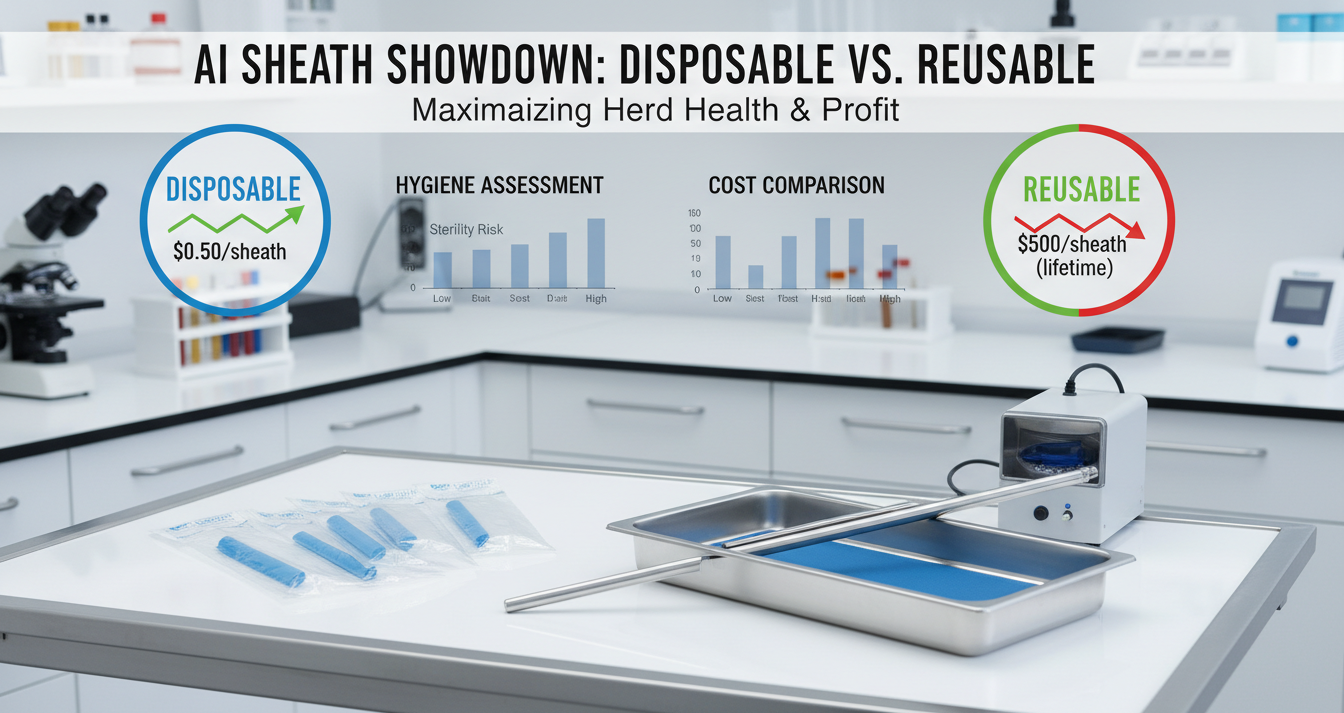
Disposable cattle AI sheaths usually offer stronger hygiene control because each procedure starts with a clean, unused sheath. They reduce the risk that biological material, lubricant residue, manure contamination, or cleaning failure will transfer between animals. Reusable AI sheaths can reduce the visible material cost per insemination, but only if the farm has strict reprocessing discipline: immediate cleaning, correct disinfectant, full rinsing, complete drying, clean storage, and inspection before reuse. When labor cost, missed cleaning steps, disease risk, and technician time are included, disposable sheaths are often the safer choice for commercial breeding programs and distributors serving many farms. Reusable sheaths may make sense in controlled veterinary settings where trained staff manage cleaning and traceability.
Hygiene differences that matter in real use
Artificial insemination is a procedure where hygiene affects both animal health and breeding outcome. A sheath may contact lubricant, reproductive tract fluids, environmental dust, and worker handling surfaces. Disposable sheaths control one major variable: the product is not reused. This simplifies training because technicians do not need to decide whether a reprocessed sheath is clean enough. Reusable sheaths introduce more process risk. Even if the material can withstand disinfection, the cleaning process may fail if residue remains inside a narrow channel, if the wrong disinfectant is used, or if the sheath is stored while still wet. In markets with inconsistent farm hygiene, disposable products are easier to standardize.
True cost-per-use calculation
The cheapest option is not always the lowest unit price. For disposable sheaths, cost-per-use is simple: one sheath per procedure, plus storage and disposal. For reusable sheaths, buyers must include purchase cost, expected number of safe uses, cleaning labor, disinfectant, water, drying space, inspection time, rejected worn sheaths, and the potential cost of contamination events. If trained labor is expensive or farm routines are rushed, the reusable option may cost more than expected. Distributors should explain this clearly to buyers. A reusable product can be economical only when the farm actually follows the reprocessing protocol every time.
When disposable sheaths are the better choice
Disposable AI sheaths are usually preferred for high-throughput breeding days, multi-farm technician routes, distributor sales to farms with different hygiene levels, and situations where traceability and biosecurity are priorities. They are also easier for new technicians because the workflow is simple: open, use, dispose, and record. This reduces procedure variation. For export buyers, disposable sheaths may also be easier to pack, label, and sell as consumable inventory. The distributor can forecast repeat demand and pair the sheaths with other artificial insemination supplies.
When reusable sheaths may be justified
Reusable sheaths may be considered when the user is a professional veterinary team, the number of animals is limited, the cleaning station is reliable, and the product material is designed for repeated disinfection. The buyer should confirm material compatibility with disinfectants, maximum recommended reuse cycles, inspection criteria, and storage requirements. Reusable products should not be sold as a simple cost-saving substitute unless the supplier and distributor can provide clear reprocessing instructions. Without that discipline, the apparent saving can become a hygiene liability.
Technical buyer comparison table
| Factor | Disposable AI Sheath | Reusable AI Sheath | Buyer Interpretation |
|---|---|---|---|
| Hygiene control | Strong, single-use barrier | Depends on cleaning quality | Disposable is safer when farm hygiene varies |
| Cost structure | Higher visible per-use product cost | Lower material cost if reused safely | Reusable cost must include labor and disinfectant |
| Training requirement | Simple workflow | Requires reprocessing discipline | Disposable is easier for large teams |
| Distributor inventory | Consumable repeat sales | Durable item plus cleaning guidance | Choose based on market expectations |
How should buyers evaluate the product before ordering?
A good evaluation process starts with the real use case. Buyers should define animal type, age range, body weight, herd size, daily use frequency, sanitation level, water or medication source, installation environment, and the skill level of workers who will operate or clean the product. A farm with trained staff and written hygiene procedures can use equipment that requires more careful handling; a distributor selling to many small farms may need a more rugged, simple, and forgiving product. The same item can be excellent in one setting and problematic in another if the buyer ignores the operating environment. For this reason, a serious RFQ should include not only quantity and target price, but also the reason for purchase, the expected service life, and the most common failure or complaint the buyer wants to prevent.
What should be included in the RFQ?
The RFQ should include exact product name, target animal, expected quantity, destination country, preferred material, size or capacity requirement, packaging requirement, private-label need, sample request, target delivery date, and any required documentation. If the product touches medicine, semen, feed, or drinking water, the buyer should also ask for cleaning instructions, compatible disinfectants, replacement parts, and recommended storage conditions. For distributors, carton information is not a small detail. Carton size, gross weight, inner packing, barcode labels, and spare-part kits affect warehouse handling, freight cost, and customer support. A low unit price can disappear quickly if the packing is weak, if replacement parts are unavailable, or if the item is difficult to explain to end users.
How should samples be tested?
Samples should be tested in a way that reflects real use, not only visual appearance. A sample that looks acceptable on a desk may still fail when installed in a barn, handled by workers with gloves, washed repeatedly, exposed to cold weather, or used with restless animals. Buyers should inspect dimensions, material finish, moving parts, seals, valves, threads, spring action, edges, cleaning access, instructions, and packaging. When possible, test several samples rather than one perfect display sample. Record the test results in writing and compare them with the supplier’s specification. If a sample is approved, keep one golden sample in your office and ask the supplier to keep one matching sample at the factory. This reduces disputes during mass-production inspection.
What mistakes should buyers avoid?
The most common mistake is buying only by unit price. In livestock equipment, the lowest price can lead to higher total cost if the product leaks, rusts, cracks, clogs, injures animals, contaminates a procedure, or creates complaints that require replacement shipments. Another mistake is ignoring spare parts. Small pieces such as seals, O-rings, springs, valves, needles, washers, caps, and tubing are inexpensive but can stop work when missing. A third mistake is failing to translate product knowledge into end-user instructions. If the distributor sells to farms that have never used the product before, clear usage guidance, cleaning steps, and troubleshooting notes are part of the product value. Good procurement is not only buying goods; it is buying a manageable system.
How can distributors reduce after-sales risk?
Distributors can reduce after-sales risk by standardizing product versions, stocking spare parts, requesting clear labels, and educating customers before problems occur. If the same market uses multiple animal sizes, different water pressures, or different veterinary protocols, one SKU may not be enough. A small product matrix can prevent misuse: one model for calves, one for adult cattle, one for high-pressure systems, one for cold climates, or one for professional veterinary use. Before ordering a container, distributors should ask the supplier for product photos, installation diagrams, exploded drawings if available, and recommended spare-part ratios. These materials help sales teams answer questions accurately and help farms use the equipment correctly.
Detailed pre-shipment inspection checklist
Before shipment, buyers should inspect product quantity, model number, material, surface finish, moving parts, dimensions, function, packaging, labels, carton strength, and spare-part inclusion. If the product includes valves, springs, seals, magnets, needles, or dosing components, test several units from different cartons rather than only one top sample. Confirm that the instruction sheet matches the actual product. For OEM or private-label orders, check logo placement, color, barcode, carton marks, and language before the goods leave the factory. A pre-shipment inspection is much cheaper than solving avoidable problems after the goods arrive in the destination market.
Frequently asked questions
Should I request samples before a bulk order?
Yes. Samples allow buyers to verify material, dimensions, fit, animal acceptance, packaging, cleaning access, and product consistency. For distributor orders, samples should also be shown to several real end users before bulk purchasing.
What information should be included in the RFQ?
Include animal type, use environment, quantity, preferred material, capacity or size, destination country, packaging requirement, private-label requirement, spare-part need, sample request, and expected annual demand.
Is veterinary guidance required?
For animal-health procedures, injection work, artificial insemination, cow magnets, disease prevention, and treatment decisions, buyers should follow qualified veterinary guidance and local farm biosecurity protocols.
How do I compare two suppliers with similar prices?
Compare sample quality, material consistency, communication speed, packing method, spare-part availability, documentation, and ability to explain product limitations. A supplier that helps prevent misuse is usually more valuable than one that only offers a lower unit price.
Final procurement recommendation
The best sourcing decision is the one that combines product performance, user training, spare-part availability, and clear supplier communication. Buyers should review the relevant Sound-AI product category, request samples where appropriate, document the approved specification, and confirm the final protocol with qualified veterinary or farm-management professionals when animal health is involved. A few extra questions before production can prevent leakage, poor fit, contamination risk, downtime, animal refusal, and avoidable after-sales claims after the shipment arrives.
Disclaimer: This article is for B2B product-selection and procurement guidance. It is not a substitute for veterinary diagnosis, treatment, or local regulatory compliance advice.
Post time: May-19-2026