
TL;DR — Key Takeaways
- Australia has the world’s strictest biosecurity controls for imported goods that may carry animal pathogens — livestock equipment faces mandatory BICON permit requirements, decontamination treatments (heat or chemical), and quarantine inspection fees that can add AUD 500-1,500 per shipment.
- All livestock equipment imports must be declared through the BICON (Biosecurity Import Conditions) system to determine permit requirements — importing without checking BICON conditions is the single most common cause of shipment detention and destruction at Australian ports.
- Non-compliant shipments are seized, treated at the importer’s cost, re-exported, or destroyed — and the importer pays all costs. An AUD 8,000 container of AI equipment can cost AUD 3,500+ to treat and re-clear after a biosecurity violation.
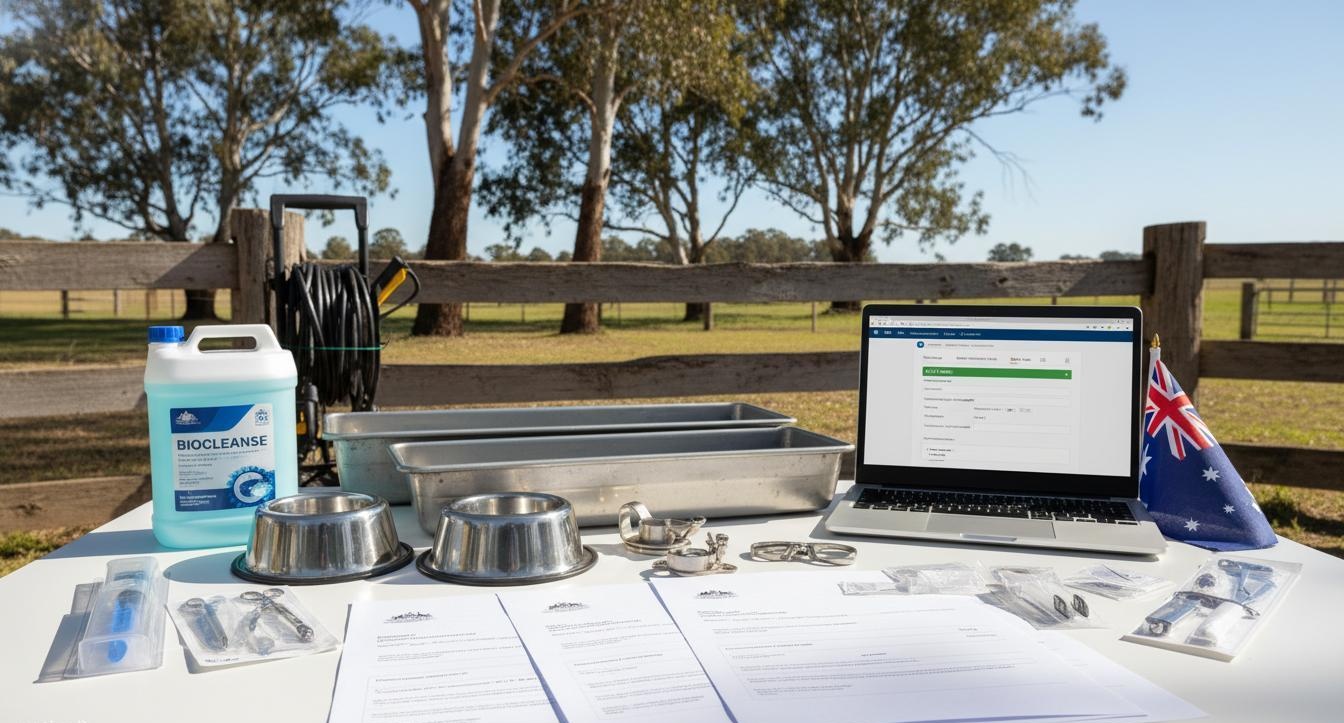
Why Australia Has the World’s Strictest Biosecurity Controls for Livestock Equipment
I have exported livestock equipment to Australia for over a decade, and every shipment requires more documentation, more inspection, and more patience than shipments to any other market. Australia’s geographic isolation has protected its agricultural industries from diseases that are endemic elsewhere — foot-and-mouth disease (FMD), African swine fever (ASF), Newcastle disease, and bovine spongiform encephalopathy (BSE) have never established in Australia. This disease-free status is worth billions of dollars annually in export market access for Australian agricultural products, and the biosecurity system is designed to protect it at all costs.
The legal framework is the Biosecurity Act 2015, which replaced the Quarantine Act 1908 and modernized Australia’s border biosecurity powers. Under the Biosecurity Act, the Director of Biosecurity can impose conditions on the importation of any goods that may introduce pests or diseases, including requiring permits, mandating specific treatments (heat treatment, fumigation, chemical disinfection), directing goods to specific ports for inspection, and ordering the destruction or re-export of non-compliant goods. For livestock equipment specifically, the key risk is fomite transmission — the equipment surfaces can carry viable virus particles, bacteria, or parasite eggs that could introduce exotic animal diseases into Australian livestock populations. Per WOAH disease transmission data, fomite transmission is a documented pathway for FMD, ASF, and multiple other OIE-listed diseases, which is why Australia treats equipment with the same seriousness as live animal imports.
BICON Permit Application Process: How to Navigate the Biosecurity Import Conditions System
BICON (Biosecurity Import Conditions system) is the Australian Department of Agriculture, Fisheries and Forestry’s (DAFF) online system for determining import conditions and, where required, applying for import permits. Every importer must use BICON to check conditions before any livestock equipment is shipped to Australia. The process: (1) search BICON by commodity type (e.g., “veterinary equipment,” “artificial insemination equipment”), material composition (metal, plastic, wood), and origin country; (2) review the import conditions for your specific commodity pathway — some pathways require a permit, some do not, some have mandatory treatment requirements; (3) if a permit is required, submit the permit application via BICON with product descriptions, photographs, and manufacturer declarations; (4) receive the permit (typically 20 working days for standard applications) before the goods are shipped.
The critical rule: the permit must be issued before the goods depart the exporting country. Australia does not allow permit applications after the goods are in transit, and goods arriving without a required permit will be directed for export or destruction — there is no “apply at the border” option. Standard BICON permit application fee is approximately AUD 120-240 depending on complexity. At Sound Hardware, we initiate the BICON permit process 60 days before scheduled shipment for all Australian orders to ensure the permit is approved before the container leaves Ningbo.
Mandatory Decontamination Treatments: Heat Treatment vs Chemical Disinfection Standards
Australia mandates specific decontamination treatments for livestock equipment based on the assessed biosecurity risk level of the commodity. The two primary treatment types are heat treatment and chemical disinfection, and each has specific technical requirements that must be certified by an approved treatment provider.
Heat treatment requires the equipment to be heated to a core temperature of at least 70°C and maintained at that temperature for a minimum of 60 minutes. This is the preferred treatment method for metal and heat-resistant plastic equipment because it is effective against virtually all pathogens of concern and leaves no chemical residue. The treatment must be performed by a DAFF-accredited treatment provider, who issues a treatment certificate with the treatment parameters (temperature, duration, equipment serial number) that accompanies the import permit documentation. For equipment with electronic components, plastic parts that cannot withstand 70°C, or items with lubricants or seals that would be damaged by heat, chemical disinfection is the alternative.
Chemical disinfection typically uses a quaternary ammonium compound solution (at minimum 0.1% active ingredient concentration, 10-minute contact time) or a chlorine-based solution (at 200ppm available chlorine, 10-minute contact time). The surface must be cleaned of visible contamination before disinfection — disinfectants are ineffective on dirty surfaces. After disinfection, equipment must be dried and packaged in clean, sealed packaging to prevent recontamination. Treatment certification for chemical disinfection must include: disinfectant name and concentration, contact time, method of application, and the treatment provider’s accreditation number. Per DAFF import conditions, any treatment provider outside Australia must be approved by DAFF — importers should verify provider accreditation status directly on the DAFF website before booking treatment.
Accredited Treatment Providers: Using Only Approved Service Providers for Your Documentation
Only DAFF-accredited treatment providers can issue valid treatment certificates for Australian biosecurity clearance. Using a non-accredited provider — even if the treatment is technically identical — will result in the certificate being rejected at the border, the goods being detained, and the treatment needing to be repeated by an accredited provider (at the importer’s cost) or the goods being re-exported. For Chinese exporters, there are DAFF-accredited treatment providers in major port cities including Shanghai, Ningbo, Shenzhen, and Qingdao — confirm the provider’s current accreditation status on the DAFF website before booking, as accreditations are reviewed periodically and can be suspended for non-compliance. At Sound Hardware, we maintain relationships with two DAFF-accredited treatment providers in Ningbo for our Australian export shipments and verify accreditation status quarterly.
Biosecurity Levy and Import Charges: The Hidden Costs Beyond Freight and Duties
Australian biosecurity costs are additional to freight, customs duties, and GST and are entirely borne by the importer. The biosecurity levy applies to all imports above AUD 1,000 in customs value at a rate of approximately 0.5% of the customs value (with a minimum charge of approximately AUD 50). In addition to the levy, individual inspection and treatment fees apply: documentary assessment (AUD 50-100), physical inspection if directed (AUD 150-400), treatment supervision if required (AUD 200-500), and detention storage fees (AUD 40-80 per day while held for biosecurity processing). For a typical 20ft container of livestock equipment valued at AUD 25,000, the total biosecurity cost (levy + inspection + potential treatment) typically ranges from AUD 500 to AUD 1,500.
Non-Compliance Consequences: Seizure, Treatment at Cost, and Re-Export Requirements
Australian biosecurity enforcement is among the most aggressive globally because the consequences of a disease incursion are measured in billions of dollars of lost export market access. Non-compliant goods are subject to: direction for export or destruction (the two mandatory options for goods arriving without a required permit), quarantine and treatment at the importer’s cost (if the goods have a permit but fail inspection or lack proper treatment certification), penalty infringement notices (AUD 2,664 for individuals, AUD 13,320 for corporations per breach), and possible prosecution for serious or repeat violations (penalties under the Biosecurity Act range up to AUD 2,664,000 for corporations for the most serious offenses). Even a single non-compliant shipment creates a compliance record that increases the inspection probability for all future shipments from the same importer. I recommend importers work with a licensed customs broker who has Australian biosecurity expertise, not a general-purpose freight forwarder — the broker’s knowledge of BICON pathways, required documentation, and treatment certification standards can prevent detentions that cost far more than the broker’s fee.
Frequently Asked Questions
- Q1: What biosecurity permits are required to import livestock equipment into Australia?
- Most livestock equipment requires a BICON permit from DAFF. Check BICON by commodity type, material, and origin country. Metal/plastic new equipment may qualify for reduced requirements. Equipment contacting animals needs full biosecurity assessment and mandatory decontamination. Permits must be issued before shipment — Australia does not accept post-departure applications.
- Q2: How do I use BICON to find import conditions for veterinary equipment?
- Visit the DAFF BICON website, search by commodity (e.g., “veterinary instruments”), select material composition (metal/plastic/wood), specify origin country, and review the import conditions. The system indicates whether a permit is required, whether treatment is mandatory, and which documents must accompany the shipment. BICON is a self-service system — no registration required for condition searches.
- Q3: What decontamination treatment is required for livestock equipment imported to Australia?
- Heat treatment (70°C core temperature, minimum 60 minutes) is the preferred method for metal and heat-resistant plastic equipment. Chemical disinfection (quaternary ammonium 0.1% minimum, 10-minute contact) is used for heat-sensitive items. Both must be performed by DAFF-accredited providers who issue certified treatment certificates. Equipment must be cleaned before treatment and packaged in sealed, clean packaging after treatment.
- Q4: How much does the Australian biosecurity levy cost for livestock equipment imports?
- The biosecurity levy is approximately 0.5% of customs value (minimum AUD 50), applied to imports above AUD 1,000. Additional costs: documentary assessment (AUD 50-100), physical inspection (AUD 150-400 if directed), treatment supervision (AUD 200-500), and detention storage (AUD 40-80/day). Total biosecurity cost for a typical container (AUD 25,000 value) ranges from AUD 500-1,500.
- Q5: What happens if my livestock equipment fails Australian biosecurity inspection?
- Non-compliant goods are directed for export, destruction, or treatment at importer’s cost. Arriving without a required permit means mandatory export or destruction — no border application option. Penalty notices range from AUD 2,664 (individuals) to AUD 13,320 (corporations) per breach. A compliance record increases inspection probability for all future shipments from the same importer.
External References: Biosecurity Act 2015 · DAFF Import Conditions · BICON System · WOAH · WTO SPS Agreement · DAFF BICON Guide · Australian Home Affairs
Final recommendation after twelve years of Australian export experience: Budget a full 90 calendar days from initial BICON check from BICON check to shipment departure for your first Australian livestock equipment order. After 2-3 successful shipments, the timeline can compress to 45-60 days as you build familiarity with the pathways, treatment providers, and documentation requirements. The time investment is significant but non-negotiable — Australia does not compromise on biosecurity, and no shipping expedient can bypass the BICON system.
Useful Links
Post time: May-20-2026