
Incoterms for Livestock Equipment: FOB Ningbo vs CIF | Sound Hardware
TL;DR — Key Takeaways
- FOB Ningbo puts the buyer in control of freight forwarder selection, freight rate negotiation, and shipment routing — for heavy livestock equipment where freight can be 25-40% of landed cost, buyer-controlled logistics typically save 8-15% versus CIF.
- CIF “all-inclusive” quotes from Chinese suppliers almost never include bunker adjustment factors (BAF), peak season surcharges (PSS), port congestion fees, or destination terminal handling charges — these hidden surcharges can add US$800-2,500 to a single 20ft container shipment.
- For single items weighing over 1.5 tonnes (like heavy cattle crushes or hydraulic chutes), FOB with a buyer-nominated forwarder who specializes in heavy-lift cargo is the only safe choice — general-purpose forwarders selected by the supplier often lack the heavy-lift expertise needed to avoid transit damage.
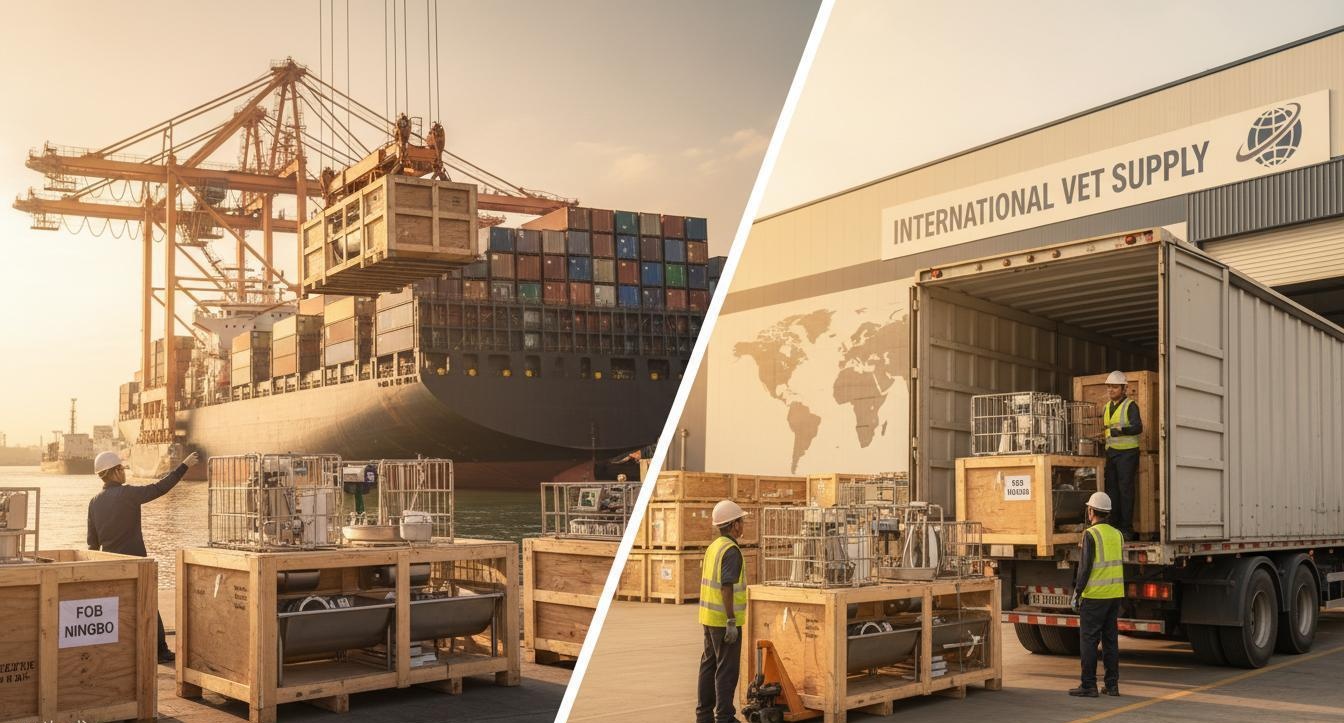
Why “Standard CIF” Is Often the Wrong Choice for Heavy Farm Equipment
I have managed livestock equipment exports from Ningbo to over 30 countries, and the Incoterms conversation with a first-time buyer almost always starts the same way: they ask for a “CIF price” because it sounds simpler — the supplier handles everything to the destination port, one price covers freight and insurance, and the buyer’s only job is customs clearance. For lightweight, standardized consumer goods, CIF can work. For heavy, specialized livestock equipment — AI gun assemblies, hydraulic cattle equipment, large drinking bowl orders — CIF is often the most expensive shipping method disguised as the simplest.
The core problem with CIF for heavy equipment: CIF terms (Cost, Insurance, and Freight) per Incoterms 2020 (ICC Publication 723) require the seller to arrange and pay for carriage to the named destination port — but the seller selects the freight forwarder. When the seller chooses the freight forwarder, that forwarder works for the seller, not the buyer. The forwarder’s commercial incentive is to secure the lowest possible rate for the seller (to win the business), not to select the most reliable carrier, the fastest route, or the most buyer-favorable terms. For heavy livestock equipment — where a single crate can weigh 800kg to 2 tonnes and requires specialized handling — the forwarder’s carrier selection decision directly affects the probability of transit damage, the actual transit time, and the final cost after hidden surcharges.
At Sound Hardware, I have seen too many cases where a buyer accepted a CIF quote that looked competitive — US$3,200 for a 20ft container Ningbo-to-Houston — only to receive a destination invoice for an additional US$1,800 in “terminal handling,” “congestion surcharge,” “documentation fee,” and “chassis rental” that the CIF quote did not include because these charges are destination-side and the seller’s forwarder did not disclose them. The buyer’s total freight cost was US$5,000 — 56% higher than the CIF quote — and the buyer had zero ability to negotiate because the forwarder was the seller’s contractor, not theirs.
FOB Ningbo Explained: What the Terms Actually Cover and Who Manages Each Stage
Under FOB Ningbo (Free On Board, named port of shipment), the seller’s obligations end when the goods are loaded onto the vessel at Ningbo Port. The seller: produces and packages the goods, handles export customs clearance in China, delivers the goods to Ningbo port, and loads them onto the vessel nominated by the buyer. The buyer: nominates the vessel (via their freight forwarder), contracts and pays for ocean freight, arranges and pays for marine insurance, handles import customs clearance at destination, and arranges inland transportation from the destination port to the final delivery address.
The critical advantage for heavy livestock equipment: the buyer’s own freight forwarder — not the seller’s — handles the heavy-lift arrangements, including: booking specialized heavy-lift container slots, arranging crane services at both origin and destination ports, ensuring the vessel can accommodate the weight of individual items, and selecting a carrier with experience in heavy/awkward-dimension cargo. A general-purpose forwarder selected by the seller may not even know that a 1.8-tonne cattle squeeze chute requires a flat rack container (not a standard 20GP) and may book standard container space that cannot physically accommodate the cargo.
According to FIATA (International Federation of Freight Forwarders Associations) best practices, heavy-lift and out-of-gauge cargo requires forwarders with specialized equipment capabilities and established relationships with breakbulk and heavy-lift carriers. A buyer-nominated forwarder who knows the buyer’s cargo profile — weight, dimensions, special handling requirements — provides value far beyond price comparison.
CIF Hidden Costs: Freight Surcharges, Bunker Adjustment Factors, and Port Congestion Fees
The CIF price you receive from a supplier is almost never the actual total freight cost. Standard CIF quotes typically include only the base ocean freight rate and basic insurance — they exclude the surcharges that can add 15-40% to the total freight bill. The surcharges that buyers discover at destination include:
| Surcharge Type | Typical Cost (20GP Ningbo→US) | Frequency | Disclosed in CIF Quote? |
|---|---|---|---|
| Bunker Adjustment Factor (BAF) | US$300-600 | Every shipment | Rarely |
| Peak Season Surcharge (PSS) | US$200-800 | Jul-Nov | Almost never |
| Port Congestion Surcharge | US$200-500 | Variable | Never |
| Terminal Handling Charge (THC) | US$200-400 (origin + dest) | Every shipment | Sometimes |
| Documentation Fee | US$50-150 | Every shipment | Sometimes |
| Chassis/Equipment Surcharge | US$100-300 | Variable | Never |
Per Freightos Baltic Index data, these surcharges combined can reach US$1,500-3,000 for a single 20ft container shipment during peak season — effectively doubling the base freight cost. Under FOB terms, the buyer’s own forwarder provides a fully detailed quotation including all surcharges before booking, so the buyer knows the total cost. Under CIF terms, the supplier’s CIF quote is the only number the buyer sees until destination invoices arrive.
Weight and Volume Threshold: When Heavy Equipment Makes FOB More Economical Than CIF
The FOB vs CIF decision for livestock equipment is fundamentally an economic calculation, and the breakpoint is determined by cargo weight and freight cost as a percentage of product value. For lightweight, high-value products (e.g., electronic veterinary diagnostic tools weighing 5kg but valued at US$5,000), the freight cost is a small fraction of product value, and CIF convenience may justify the premium. For heavy, moderate-value products (e.g., galvanized steel drinking bowls — 20 tonnes of product valued at US$25,000 with freight costing US$4,800 — 19% of product value), freight cost is a major component of landed cost, and the 8-15% savings from buyer-controlled logistics translates to US$400-700 per container.
The practical threshold I recommend: if any single item in your shipment weighs over 1,500kg, use FOB with a buyer-nominated heavy-lift forwarder. Below 1,500kg per item, the standard containerized freight market is efficient enough that either FOB or CIF can work, but FOB still provides the buyer with cost transparency and control. Items over 1,500kg often require flat rack or open-top containers, which are a niche market with limited carrier availability and widely varying rates — this is exactly the scenario where supplier-arranged freight creates the largest cost surprises.
Choosing a Freight Forwarder: Why Own Forwarder Relationships Beat Supplier Recommendations
Building a relationship with a freight forwarder who knows your specific cargo profile is one of the highest-ROI activities a livestock equipment importer can undertake. A good forwarder provides: advance rate quotations with full surcharge breakdowns, carrier performance data (on-time percentage, damage claim rate), container availability alerts during peak season, and proactive rerouting when port congestion or carrier disruptions affect your planned route. The supplier’s recommended forwarder — however competent they may be — reports to the supplier, not to you.
Key criteria for selecting a livestock equipment forwarder: proven experience with heavy-lift cargo (ask for references from other heavy equipment importers), established carrier relationships with shipping lines serving the Ningbo-to-your-destination corridor, in-house customs brokerage (or a trusted partner broker), real-time cargo tracking capability, and transparent fee structure with written quotations including all surcharges. Interview at least three forwarders before committing. The forwarder will handle tens or hundreds of thousands of dollars of your cargo over the relationship — this is not a transaction to award to the cheapest quote without due diligence.
The Exception Cases: When CIF Actually Makes Sense for Livestock Equipment Imports
CIF is not always wrong. It makes sense in specific scenarios: first-time importers with very small volumes (1-3 CBM of mixed samples), LCL (Less than Container Load) shipments where the buyer has no forwarder relationship, and spot-purchase orders where the buyer is testing a new supplier with a US$2,000-5,000 order and freight cost represents less than 10% of order value. For these cases, the convenience of CIF (supplier handles logistics, buyer focuses on product quality evaluation) outweighs the freight cost savings that FOB would provide.
At Sound Hardware, we support both FOB and CIF transactions and recommend FOB for any order exceeding US$15,000 in value or 8 CBM in volume. For orders below these thresholds, we provide both FOB and CIF quotations so the buyer can make an informed comparison. The right Incoterms choice is specific to the buyer’s cargo profile, logistics capability, and risk tolerance.
Frequently Asked Questions
- Q1: Why is FOB Ningbo often better than CIF for heavy livestock equipment imports?
- FOB Ningbo gives the buyer control over freight forwarder selection, freight rate negotiation, and shipment routing. For heavy equipment where freight can be 25-40% of landed cost, buyer-controlled logistics typically save 8-15% versus seller-arranged CIF. The buyer’s forwarder works for the buyer’s interests, not the seller’s.
- Q2: What additional fees are often added to CIF pricing for shipping from China?
- Common hidden CIF surcharges include: Bunker Adjustment Factor (BAF, US$300-600), Peak Season Surcharge (PSS, US$200-800 in Jul-Nov), Port Congestion Surcharge (US$200-500), Terminal Handling Charges (US$200-400), documentation fees (US$50-150), and chassis surcharges (US$100-300). Combined surcharges can add US$1,500-3,000 per container.
- Q3: When should I choose CIF over FOB for livestock equipment imports?
- CIF makes sense for: first-time importers with very small volumes (1-3 CBM), LCL shipments where the buyer lacks forwarder relationships, and spot-purchase/test orders under US$5,000. For orders exceeding US$15,000 or 8 CBM, FOB is almost always more cost-effective and provides better logistics control.
- Q4: How do I select a freight forwarder for my livestock equipment shipment?
- Select a forwarder with: proven heavy-lift cargo experience, established carrier relationships on the Ningbo-to-your-destination route, in-house customs brokerage, real-time tracking capability, and transparent all-in pricing. Interview at least 3 forwarders. Verify references from other heavy equipment importers before committing.
- Q5: What Incoterms should I use for small volume livestock equipment orders?
- For small volume orders (1-3 CBM, under US$5,000), CIF is a reasonable choice for convenience — the freight cost savings from FOB are minimal at this volume. For sample orders under US$2,000, consider FCA or EXW with express courier (DHL/FedEx) for faster transit and simpler documentation.
External References: ICC Incoterms 2020 · Freightos Baltic Index · FIATA · World Shipping Council · CSCMP · ISM · CIPS · WTO
Bottom line: Choose FOB Ningbo for any livestock equipment order where freight cost exceeds 10% of product value and you plan to import regularly. The initial effort of finding a forwarder pays back within 2-3 shipments. Choose CIF only for samples and very small trial orders under US$5,000.
Useful Links
Post time: May-20-2026