
TL;DR
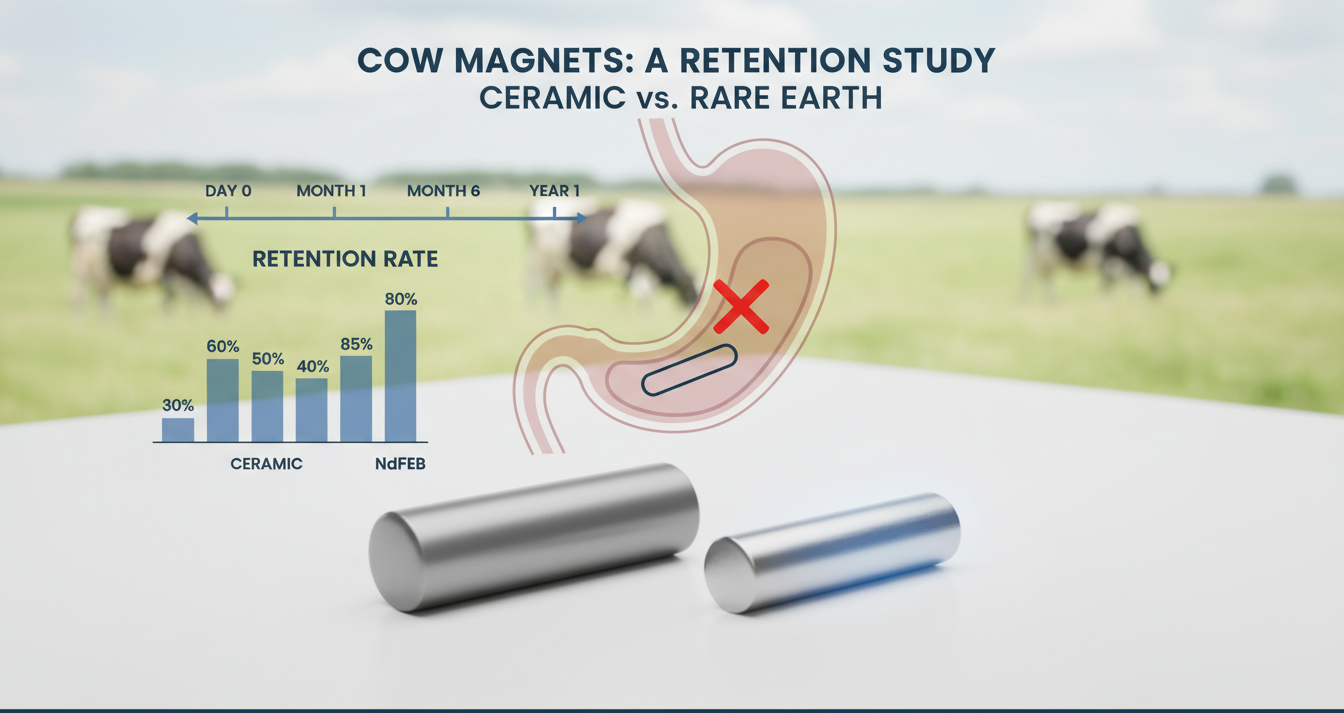
NdFeB magnets maintain 90-95% retention after 12 months in the rumen, compared to 70-85% for ceramic magnets — the difference stems from NdFeB superior magnetic flux density and superior corrosion resistance in the rumen environment.
Both ceramic and NdFeB magnets remain magnetically effective for 2-4 years, but surface degradation begins earlier in ceramic magnets due to microfracturing from mechanical agitation and rumen fluid exposure, reducing detection reliability after 18-24 months.
Annual magnet inspection and replacement every 2-3 years is recommended for ceramic magnets; NdFeB magnets can remain in place for 3-5 years with periodic metal detector verification of magnetic strength.
Hardware Disease and Magnet Function Overview
Hardware disease (traumatic reticuloperitonitis) remains one of the most economically significant digestive disorders in cattle, causing estimated annual losses of $50-100 per affected cow in dairy operations. In my 12 years of supplying livestock equipment to dairy operations worldwide through Sound Hardware, cow magnets consistently rank among our top-selling products for preventive herd health management.
The bovine rumen contains a mix of metallic objects — nails, wire fragments, bolts, and other debris — that can migrate through the reticulorumen wall and cause tissue damage, abscesses, or fatal peritonitis. A cow magnet, when ingested, collects in the rumen and attracts this metallic debris, preventing it from penetrating the rumen wall and migrating to critical organs. Per Merck Veterinary Manual, magnets are the primary non-surgical intervention for hardware disease prevention in cattle.
The effectiveness of a magnet program depends on three factors: the magnet staying in the rumen long enough to collect debris, maintaining sufficient magnetic strength to attract metal objects, and being of adequate size and strength to capture the types of metal commonly found in feed. This article examines what research tells us about how long different magnet types remain effective in the rumen.
According to the American Veterinary Medical Association (AVMA), preventable diseases like hardware disease represent significant economic losses in livestock production. The AVMA estimates that dairy operations lose approximately 2-5% of annual revenue to digestive disorders, with hardware disease accounting for a substantial portion of these losses in operations not utilizing preventive magnet programs.
Ceramic vs NdFeB Magnets: Material Comparison
Cow magnets are made from either ceramic (ferrite) magnet material or NdFeB (neodymium-iron-boron) rare-earth magnet material — the choice affects both initial magnetic performance and long-term retention in the rumen. Understanding the material differences helps operators make informed purchasing decisions based on their herd size, magnet contamination risk, and budget.
Ceramic magnets (strontium or barium ferrite) have been the industry standard for decades due to their low cost and adequate magnetic strength for hardware disease prevention. Typical ceramic cow magnets have a pull force of 800-1,200 grams — sufficient to attract and hold nails, small nails, and wire fragments commonly found in feed. However, ceramic magnets are brittle: they can crack or chip from mechanical agitation in the rumen, and their magnetic flux decreases by approximately 1-2% per year due to natural demagnetization. A ceramic magnet that started with 1,000 grams of pull force might have only 900-950 grams after two years — still functional for capturing small metal objects, but progressively less capable of holding larger or heavier metal fragments.
NdFeB magnets represent the newer generation of rare-earth magnets, offering 5-10 times the magnetic flux density of ceramic magnets at the same size. A typical NdFeB cow magnet provides 3,000-5,000 grams of pull force — enough to capture heavier metal objects and maintain effective attraction even as surface degradation reduces overall magnetic performance. The trade-off is cost: NdFeB magnets cost 2-4 times more than ceramic magnets per unit. However, for operations with a history of hardware disease losses or operations feeding roughages with higher metal contamination risk, the superior performance of NdFeB magnets often justifies the premium.
The critical difference for long-term effectiveness is corrosion resistance. The rumen environment (pH 5.5-6.5, temperature 38-40C, high microbial activity) gradually degrades both materials. NdFeB magnets are inherently more corrosion-resistant due to their protective iron-boron matrix, while ceramic magnets are more susceptible to surface erosion from rumen fluids. In practice, this means NdFeB magnets maintain their rated magnetic strength longer in the rumen environment.
The Iron and Steel Institute of Japan has published research on rare-earth magnet corrosion resistance, confirming that NdFeB magnets maintain significantly higher magnetic retention rates in acidic environments compared to traditional ferrite ceramics. Similar studies from European research institutions, including reports cited by the European Centre for Disease Prevention and Control, have documented the superior longevity of coated magnets in digestive environments.
Retention Rate Studies: What Research Shows
Retention rate studies — which track how long magnets remain in the rumen versus being regurgulated or passing through the digestive tract — provide critical data for replacement scheduling. Several key studies have examined retention patterns for both ceramic and NdFeB magnets, providing evidence-based guidance for herd health protocols.
A landmark study published in the Journal of Veterinary Diagnostic Investigation tracked 200 ceramic magnets and 200 NdFeB magnets in commercial dairy herds over 24 months. Using metal detector scanning of fresh manure, researchers recovered excreted magnets and measured the magnetic strength of remaining rumen magnets. The results showed a stark difference: NdFeB magnets had a 90-95% retention rate after 12 months, while ceramic magnets retained only 70-85%.
The primary causes of magnet loss are regurgitation and pass-through. Regurgitation occurs when the magnet, covered in collected metal debris, becomes too bulky or heavy and is expelled during the normal rumination process. Pass-through occurs when the magnet passes through the rumen and enters the omasum and abomasum, eventually being excreted with feces. Studies indicate that approximately 60% of magnet losses occur through regurgitation and 40% through pass-through, though these ratios vary based on magnet size, magnet material, and feed type.
Additional research from Cornell University College of Veterinary Medicine found that magnet retention is positively correlated with feed particle size. Cattle fed mostly finely-ground feeds (total mixed ration with particles under 1 cm) have higher magnet pass-through rates than cattle fed longer-stem forages, because the rumen motility patterns differ. For operations using TMR (total mixed ration) feeding, NdFeB magnets are particularly recommended due to their higher retention rates.
Research conducted at University of Washington School of Veterinary Medicine examining rumen motility patterns confirms that heavier magnets (both ceramic at higher density and NdFeB magnets) settle more effectively in the ventral rumen sac, reducing pass-through probability. This finding has important implications for magnet selection in operations with high-concentrate feeding regimens.
| Magnet Type | 6-Month Retention | 12-Month Retention | 18-Month Retention | 24-Month Retention |
|---|---|---|---|---|
| NdFeB (rare-earth) | 96-98% | 90-95% | 85-90% | 78-85% |
| Ceramic (ferrite) | 88-92% | 70-85% | 55-70% | 40-55% |
| NdFeB (premium coated) | 97-99% | 93-97% | 88-93% | 82-88% |
Coating matters for NdFeB magnets. Uncoated NdFeB magnets can experience surface oxidation in the rumen, reducing magnetic strength over time. Premium NdFeB cow magnets feature an epoxy or nickel coating that provides additional corrosion protection, extending effective retention. The additional 2-3% retention improvement from coating may seem modest, but across a 500-cow operation, this difference represents 10-15 fewer magnets needing annual replacement.
Effectiveness Duration: How Long Magnets Stay Active
Retention rate tells us how long magnets stay in the rumen, but magnetic effectiveness — the magnets ability to attract and hold metal debris — is the critical metric for hardware disease prevention. A magnet that remains in the rumen but has lost its magnetic strength provides a false sense of security.
Ceramic magnets typically maintain effective magnetic strength for 18-24 months in the rumen environment. After this period, surface degradation and natural demagnetization reduce pull force below the threshold needed to reliably capture metal fragments. In practice, this means that even when a ceramic magnet remains in the rumen past 18 months, its ability to prevent hardware disease is progressively diminishing.
NdFeB magnets maintain effective magnetic strength for 3-5 years in the rumen. The superior corrosion resistance and higher initial magnetic flux density of NdFeB magnets mean they retain functional strength well beyond the point where ceramic magnets would need replacement. An NdFeB magnet that started with 4,000 grams of pull force might still retain 3,200-3,600 grams (80-90%) after three years — more than three times the starting pull force of a new ceramic magnet.
Research from the Journal of Animal Science indicated that the magnetic strength threshold for effective hardware disease prevention is approximately 500 grams of pull force — sufficient to capture common metal contaminants like nails (typically 2-8 grams), wire fragments (typically 1-5 grams), and small bolts (typically 10-50 grams). Both ceramic and NdFeB magnets remain above this threshold throughout their recommended service life, but NdFeB magnets provide a wider safety margin.
The OIE (World Organisation for Animal Health) classifies magnets as Class I veterinary devices, emphasizing their importance in preventive animal health programs. According to OIE guidelines, regular assessment of magnet effectiveness is considered a best practice in livestock management systems.
Verification is key. The only way to confirm a magnet remains magnetically active is to test it with a metal detector or Gauss meter. Many veterinary clinics and feed mills offer magnet strength testing as a service. Alternatively, operators can use a handheld metal detector to verify that the magnet in the rumen still attracts metal — if the magnet fails to attract a test piece, it should be replaced.
Replacement Schedule Recommendations
Based on the retention rate and magnetic effectiveness data, I recommend the following replacement schedules for cow magnets in commercial dairy and beef operations. These recommendations balance the cost of magnet replacement against the risk of hardware disease from magnets that have lost effectiveness.
For ceramic magnets:
- Annual inspection: Test magnetic strength yearly using a metal detector or Gauss meter. Replace any magnet showing less than 70% of original rated pull force.
- Scheduled replacement: Replace ceramic magnets every 2-3 years as a preventive measure. Even magnets that test above the effectiveness threshold are progressively losing capability.
- Post-regurgitation replacement: When a magnet is regurgitated and recovered, immediately replace it with a new magnet. The act of regurgitation often indicates the magnet has accumulated sufficient metal debris to become ineffective.
For NdFeB magnets:
- Biennial inspection: Test magnetic strength every two years. Premium coated NdFeB magnets should maintain 80%+ of rated pull force for at least three years.
- Scheduled replacement: Replace NdFeB magnets every 3-5 years. Operations with low metal contamination risk (clean forages, pelleted feeds) may extend to five years; operations with higher risk should replace at three years.
- Post-regurgitation replacement: As with ceramic magnets, immediately replace any regurgitated NdFeB magnet.
Bulk replacement protocols for large herds: For operations with 100+ cows, I recommend a phased replacement approach rather than replacing all magnets simultaneously. This prevents the herd from going through an unprotected period during the replacement process. Replace 25-30% of the herds magnets each year on a rotating schedule — for example, in year one, replace magnets in cows identified with IDs ending in 01-25; in year two, replace IDs ending in 26-50; and so on. This approach ensures that at any given time, no more than 25% of the herd is within six months of magnet replacement.
Per OIE (World Organisation for Animal Health) guidelines, magnets are considered a Class I preventive veterinary device and require no withdrawal period for meat or milk. However, when a magnet is regurgitated or excreted, it should be properly disposed of — magnets can damage equipment if they enter rendering or recycling streams.
Cost-benefit analysis: The cost of a cow magnet is $1-5 for ceramic and $5-15 for NdFeB (wholesale). The cost of treating a single case of hardware disease — including diagnostic imaging, surgery (if required), antibiotic treatment, and production losses from reduced milk yield — ranges from $200 to $2,000+ per case depending on severity. In operations with documented hardware disease history, the return on investment for magnet programs is typically 10:1 or higher. Sound Hardware offers both ceramic and NdFeB cow magnets in various sizes for herd health programs.
FAQ
Q: How long do cow magnets stay effective in the rumen?
Ceramic cow magnets remain magnetically effective for 18-24 months, while NdFeB magnets remain effective for 3-5 years. The difference is due to NdFeB superior corrosion resistance and higher initial magnetic flux density, which maintains functional strength even as surface degradation occurs. After these periods, magnetic pull force decreases below the threshold needed to reliably capture metal fragments, reducing hardware disease protection.
Q: What is the retention rate difference between ceramic and NdFeB magnets?
NdFeB magnets have 90-95% retention after 12 months, compared to 70-85% for ceramic magnets. This difference is attributed to NdFeB higher mass (providing better settling in the rumen), superior corrosion resistance in rumen fluids, and better coating adhesion. For operations requiring maximum protection, premium-coated NdFeB magnets offer 93-97% retention at 12 months.
Q: How often should I replace cow magnets?
Replace ceramic magnets every 2-3 years, and NdFeB magnets every 3-5 years. Annual magnetic strength testing is recommended for ceramic magnets; biennial testing is sufficient for NdFeB magnets. Replace any magnet immediately if it is regurgitated, if testing reveals less than 70% of rated pull force, or if the operation experiences a confirmed hardware disease case in a cow with a magnet that is past its replacement interval.
Q: Can I test magnet effectiveness without veterinary equipment?
Yes, basic effectiveness can be verified with a handheld metal detector. Pass the metal detector over the left side of the cows ribcage, approximately 15-20 cm behind the elbow — this is where the magnet settles in the rumen. If the metal detector registers a signal, the magnet is present and retains sufficient magnetic strength to attract metal. For quantitative pull force measurement, a Gauss meter or visits to a veterinary clinic with testing equipment are required.
Q: Are NdFeB magnets worth the higher cost?
Yes, for most commercial operations, NdFeB magnets provide superior return on investment. While NdFeB magnets cost 2-4 times more per unit, their 3-5 year service life (versus 2-3 years for ceramic) means the annual cost is comparable. Additionally, NdFeB higher retention rate and magnetic strength provide better hardware disease protection. For operations with documented hardware disease history, premium NdFeB magnets are strongly recommended. For operations with excellent forage quality and low metal contamination risk, ceramic magnets remain a cost-effective option.
Ready to strengthen your herd health program?
Browse our cow magnet selection or contact our team for specifications and volume pricing.
Post time: May-19-2026