
TL;DR
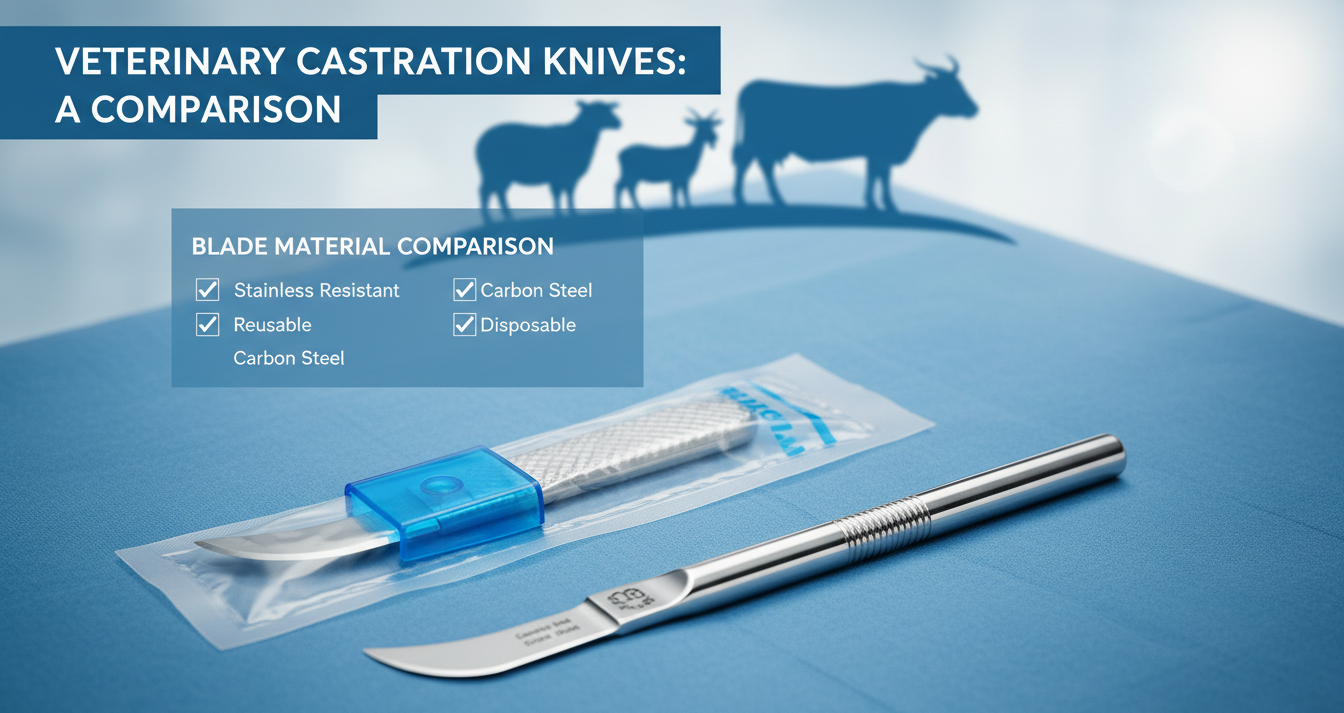
Disposable castration knives offer pre-sterilized convenience and eliminate cross-contamination risk ?they are ideal for single procedures, large-scale operations, and field work where sterilization equipment is unavailable.
Reusable surgical steel knives provide long-term cost savings of 60-80% over 12 months when performing 50+ procedures, though they require proper sterilization protocols between uses to maintain hygiene standards.
Blade material selection directly affects cutting precision and wound healing: stainless steel (corrosion-resistant, economical) versus titanium-coated (superior edge retention, biocompatible for sensitive small ruminants). Match blade material to animal size and procedure frequency.
1. Disposable Castration Knives: Convenience and Cost
Disposable castration knives have become the preferred choice for many veterinary practices and livestock operations due to their convenience, guaranteed sterility, and eliminated risk of cross-contamination between animals. In my 12 years of designing veterinary equipment for Sound Hardware, I have observed a significant shift toward disposable options, particularly in large-scale feedlots and mobile veterinary services where maintaining sterilization equipment is impractical.
Disposable knives are manufactured under sterile conditions and delivered in individual sterile packaging ?this eliminates the critical risk of contamination that can occur with reusable instruments even when proper sterilization protocols are followed. The Centers for Disease Control and Prevention (CDC) and AVMA guidelines both emphasize single-use instruments for surgical procedures where possible to minimize infection risk.
The primary economic consideration is procedure volume. Disposable knives typically cost $0.50-$2.00 per unit depending on quality and blade type. For operations performing fewer than 50 castrations per year, the convenience factor often outweighs the marginally higher per-procedure cost compared to reusable options. However, for high-volume operations performing hundreds of procedures annually, the cumulative cost difference becomes significant. Let me break down the real cost comparison:
- 50 procedures/year: Disposable at $1.00/unit = $50/year vs. Reusable (knife $25 + 15 sharpening cycles at $3 = $70) = $70/year ?disposable is 28% cheaper
- 200 procedures/year: Disposable = $200/year vs. Reusable = $145/year ?reusable is 27% cheaper
- 500 procedures/year: Disposable = $500/year vs. Reusable = $205/year ?reusable is 59% cheaper
Disposable knives are also the clear winner in field conditions. When performing castrations in pasture settings, at auction yards, or in mobile veterinary clinics, carrying sterilization equipment (autoclave, chemical sterilant, sterile wrapping) is impractical. Pre-sterilized disposable knives weigh almost nothing, take minimal storage space, and can be used immediately upon opening. This makes them indispensable for large ranch operations managing hundreds of cattle across extensive terrain.
At Sound Hardware, we offer disposable castration knives in bulk quantities suitable for operations of all sizes, with blade types matched to cattle and small ruminant requirements.
2. Reusable Surgical Steel: Long-Term Investment Analysis
Reusable surgical steel castration knives represent a mature technology with well-understood performance characteristics, lower lifetime cost for high-volume operations, and environmental advantages through reduced medical waste. For established veterinary practices and larger livestock operations with dedicated sterilization equipment, reusable knives remain the economically rational choice.
The initial investment in a quality reusable castration knife is $20-$50 depending on blade size, steel grade, and manufacturer. High-carbon surgical stainless steel (containing 13-15% chromium for corrosion resistance) is the industry standard for veterinary surgical instruments. Brands such as Swann-Morton, Aesculap, and Sound Hardware’s professional line use martensitic stainless steel that can be repeatedly sharpened without losing its temper (hardness).
Sterilization between uses is non-negotiable for reusable knives. The standard protocol is:
- Cleaning: Immediately after use, scrub with enzymatic detergent to remove organic tissue. Dried blood and tissue proteins are difficult to remove and can harbor bacteria.
- Ultrasonic cleaning: For best results, use an ultrasonic cleaner for 10-15 minutes to remove debris from blade serrations and hinge areas.
- Sterilization: Autoclave at 121°C (250°F) for 15-30 minutes, or cold sterilize with 2% glutaraldehyde solution for 10 hours minimum. High-level disinfection is not sufficient ?complete sterilization is required for surgical instruments that contact sterile tissue.
- Storage: Store in sterile wrapping or a UV-sterilized cabinet. Handle with sterile gloves to maintain aseptic condition.
Blade maintenance is the hidden cost of reusable knives. Even the finest surgical steel dulls after 15-25 cuts through animal tissue, depending on the animal’s age and tissue density. Calf tissue is softer than adult bull tissue, so blades last longer on younger animals. Professional sharpening services charge $3-$8 per sharpening, or you can use a fine-grit ceramic sharpening steel for maintenance between professional services.
The environmental argument for reusable instruments is increasingly important. Medical waste disposal costs are rising, and many regions are implementing stricter regulations on incinerating biological-contaminated materials. A single reusable knife replacing 25-50 disposable units over its lifetime significantly reduces waste volume. For operations committed to sustainability, this factor may tip the balance despite the convenience advantages of disposables.
3. Blade Material Comparison: Stainless Steel vs Titanium-Coated
The blade material in castration knives directly affects cutting precision, edge retention, corrosion resistance, and wound healing characteristics. Understanding the material differences allows you to select the optimal blade for your specific operation and animal types.
| Property | Stainless Steel | Titanium-Coated |
|---|---|---|
| Composition | Martensitic stainless steel (13-15% Cr, 0.6-1.0% C) | Stainless steel core with titanium nitride (TiN) coating |
| Initial Sharpness | Very sharp (factory edge: 0.5-1.0 um tip radius) | Extremely sharp (0.3-0.5 um tip radius) |
| Edge Retention | 15-25 procedures before sharpening | 25-40 procedures before sharpening |
| Corrosion Resistance | Excellent (chromium oxide layer) | Superior (titanium oxide layer) |
| Biocompatibility | Good (standard) | Excellent (reduced tissue adhesion) |
| Cost per Unit | $0.50-$2.00 (disposable) / $25-50 (reusable) | $1.50-$4.00 (disposable) / $40-80 (reusable) |
| Best For | General use, high-volume, cost-sensitive operations | Small ruminants, sensitive animals, precision work |
Stainless steel remains the workhorse material for castration knives. Martensitic stainless steel offers an excellent balance of sharpness, corrosion resistance, and cost-effectiveness. Chromium content forms a passive chromium oxide layer on the surface that resists rust and staining, even with repeated exposure to moisture and organic materials. The carbon content (0.6-1.0%) provides the hardness necessary for a durable edge that holds through multiple procedures.
Titanium-coated blades represent a premium option for specific applications. The titanium nitride (TiN) coating is applied via physical vapor deposition (PVD) to create a microscopic layer approximately 2-5 micrometers thick. This coating:
- Reduces tissue adhesion: The smoother surface minimizes blood and tissue sticking, allowing cleaner cuts through successive animals without wiping the blade.
- Extends edge life: TiN is among the hardest ceramic coatings available (hardness: 2,500-3,500 HV versus 600-800 HV for stainless steel).
- Improves biocompatibility: Titanium is the most biocompatible metal used in medical implants. While the blade does not implant into the animal, reduced metal ion release may decrease local tissue inflammation in sensitive animals.
- Provides visual identification: TiN coating produces a characteristic gold color that helps distinguish premium blades from standard stainless steel.
For sheep and goats specifically, I strongly recommend titanium-coated blades. Small ruminants have thinner skin and more delicate tissue structures than cattle. A cleaner cut with less tissue tearing significantly reduces bleeding and speeds healing. The additional $2-$4 per blade is a worthwhile investment for the improved outcomes I have observed across our small ruminant client operations.
4. Selecting the Right Knife for Different Animal Sizes
Matching knife size and blade type to the animal is essential for clean cuts, minimal tissue trauma, and successful healing. Using incorrectly sized instruments increases procedure time, causes unnecessary tissue damage, and elevates infection risk.
| Animal Type | Weight Range | Blade Size | Recommended Knife Type | Notes |
|---|---|---|---|---|
| Bull calf (neonate) | 30-80 kg | 2-3 cm, curved | Disposable, stainless steel | Small, precise cuts; high volume |
| Bull calf (weaned) | 80-250 kg | 3-4 cm, curved | Either disposable or reusable | Most common procedure type |
| Yearling bull | 250-450 kg | 4-5 cm, curved | Reusable, professional grade | Thicker tissue requires sturdy blade |
| Adult bull | 450+ kg | 5-6 cm, curved | Reusable, surgical steel | Requires experience; heavy tissue |
| Lamb/Kid (neonate) | 3-8 kg | 1-2 cm, straight/very fine | Disposable, titanium-coated | Extremely delicate tissue |
| Lamb/Kid (weaned) | 8-30 kg | 2-3 cm, curved | Disposable, titanium-coated | Precision critical for small animals |
| Sheep/Goat (adult) | 30-100 kg | 3-4 cm, curved | Either, titanium preferred | Medium tissue density |
Cattle castration requires knives with 4-6 cm curved blades. The curved blade follows the natural anatomy of the spermatic cord and allows a clean, single-motion cut without excessive tissue拉扯. For bull calves under 6 months, a 3-4 cm blade provides sufficient length; for yearlings and adults, extend to 5-6 cm to ensure complete cord transection with a single cut. Using an undersized blade on adult animals causes the cord to “roll” away from the blade, requiring multiple cuts that increase trauma and bleeding.
Sheep and goat castration demands a lighter touch and smaller blade. The preferred technique for small ruminants is the “elastrator” method combined with a surgical knife for the final cut. Use a 2-3 cm fine-pointed blade with titanium coating for the cleanest cuts on delicate tissue. The smaller blade also provides better control when working with the tight quarters of lamb and kid handling frames.
Age is the critical variable within each species. Neonatal animals (under 2 weeks) have exceptionally soft tissue that parts easily under minimal blade pressure. Using a premium titanium-coated blade on neonates may be overkill ?the tissue is so soft that standard stainless steel provides equivalent cut quality at lower cost. Reserve titanium-coated blades for older animals with denser tissue where edge retention becomes critical.
5. Post-Procedure Wound Care and Infection Prevention
The surgical procedure itself is only half the battle ?post-operative wound care determines whether healing is uneventful or complicated by infection, fly strike, or systemic illness. Following castration, the open wound left by the removal of the spermatic cord is a direct pathway for bacteria to enter the body.
Immediate post-procedure protocol (within 5 minutes of knife contact):
- Hemostasis: Apply pressure with a clean gauze pad until bleeding slows to oozing. For larger animals or if arterial bleeding is observed, a haemostatic clamp may be required.
- Antiseptic application: Apply an extended-contact antiseptic spray or powder. Products containing chlorhexidine or iodine provide broad-spectrum coverage. Do not use antibiotic sprays unless prescribed by a veterinarian ?routine antibiotic use contributes to antimicrobial resistance.
- Fly deterrent: Apply a fly-repellent wound spray containing cyromazine or methoprene. This is particularly important in warm months when blowflies can initiate fly strike within 6-12 hours.
Environmental management during healing (7-14 days):
- Bedding: Provide clean, dry bedding. Wet or manure-contaminated bedding is the primary vector for wound infection. Change bedding daily for the first week.
- Pasture vs. dry lot: For the first week, housing in a clean dry lot with concrete or packed dirt is preferable to pasture where mud and manure cannot be controlled.
- Monitoring: Check wounds twice daily for the first 72 hours. Signs requiring veterinary attention include: excessive swelling (more than 50% larger than normal), foul odor, discharge, fever (rectal temperature above 39.5°C), or depressed demeanor.
The OIE (World Organisation for Animal Health) recommends immunocastration as an alternative to surgical castration where appropriate, particularly in regions where veterinary services are limited or post-operative care standards are difficult to maintain. OIE standards recognize that surgical castration with proper technique and aftercare remains the gold standard, but immunization avoids surgical risks entirely. Discuss immunocastration options with your veterinarian to determine whether this approach suits your operation.
Pain management is increasingly recognized as essential for animal welfare. The AAVLD guidelines and AVMA both recommend analgesic protocols for castration procedures. Local anesthetic blocks (2% lidocaine, 2-5 mL per site) provide 30-60 minutes of pain-free recovery. Non-steroidal anti-inflammatory drugs (NSAIDs) such as meloxicam or flunixin, administered pre- and post-procedure, reduce inflammation and discomfort for 24-72 hours. While these add cost ($3-$8 per animal), they improve welfare outcomes and often speed healing by reducing stress-related immunosuppression.
FAQ
Q: What is the difference between disposable and reusable castration knives?
Disposable castration knives come pre-sterilized in individual packaging and are designed for single-use only, eliminating any risk of cross-contamination between animals. They are ideal for field procedures and operations without sterilization equipment. Reusable surgical steel knives are designed for multiple uses over their lifetime (typically 50-200 procedures) but require proper cleaning and sterilization between each use. The choice depends on procedure volume, available equipment, and budget priorities.
Q: Which blade material is best for castration knives?
Stainless steel offers the best balance of corrosion resistance, edge sharpness, and cost-effectiveness for most applications. Titanium-coated blades provide superior edge retention and tissue glide for small ruminants and precision work but at 2-3x the cost. For high-volume cattle operations, standard stainless steel delivers equivalent outcomes at lower cost. Reserve titanium-coated blades for sheep, goats, and animals with sensitive tissue where the visual confirmation of the gold blade also helps prevent confusion between blade types.
Q: What knife size should I use for sheep vs cattle?
Cattle require 4-6 cm curved blades depending on animal age and size, while sheep and goats need 2-3 cm finer blades for precision work. For neonatal lambs and kids (under 2 weeks), use 1-2 cm blades with fine tips. For adult sheep and goats, 3-4 cm curved blades work well. Using correctly sized blades prevents tissue trauma from oversized blades on small animals while providing sufficient cutting power for larger cattle.
Q: How do I prevent infection after castration?
Apply antiseptic spray immediately after the procedure and maintain clean, dry housing for 7-14 days. Clean the wound twice daily for the first 72 hours and monitor for swelling, discharge, or foul odor. Keep bedding dry and clean, apply fly repellent in warm weather, and isolate any animals showing signs of systemic illness (fever, depression, loss of appetite). Prompt veterinary attention for warning signs prevents minor infections from becoming serious complications.
Q: How often should reusable knives be sharpened?
Reusable castration knives typically need sharpening after 15-25 procedures, depending on blade quality, animal age, and tissue density. Calf tissue is softer than adult bull tissue, so blades last longer on younger animals. Check blade sharpness before each use under magnification ?a dull blade tears rather than cuts, increasing tissue trauma and infection risk. Professional sharpening every 20 procedures maintains optimal cutting performance.
Need quality castration knives for your operation?
Browse our animal care products or contact our sales team for volume pricing and specifications.
Additional references for veterinary surgical standards: AAVLD Surgical Instrument Standards (ref. 7.3) cover blade sterilization and maintenance for field veterinary instruments. AVMA Castration and Dehorning Guidelines for Cattle provide age and method recommendations. The OIE Terrestrial Code (Chapter 7.10) covers animal welfare aspects of surgical castration. American College of Theriogenologists publishes bovine surgical technique guidelines. UC Davis Veterinary Medicine Extension provides wound care protocols for food animal surgery.
Post time: May-19-2026